Defence ministry approves procurement of Predator drones from US
announcement likely during PM Modi's Washington trip
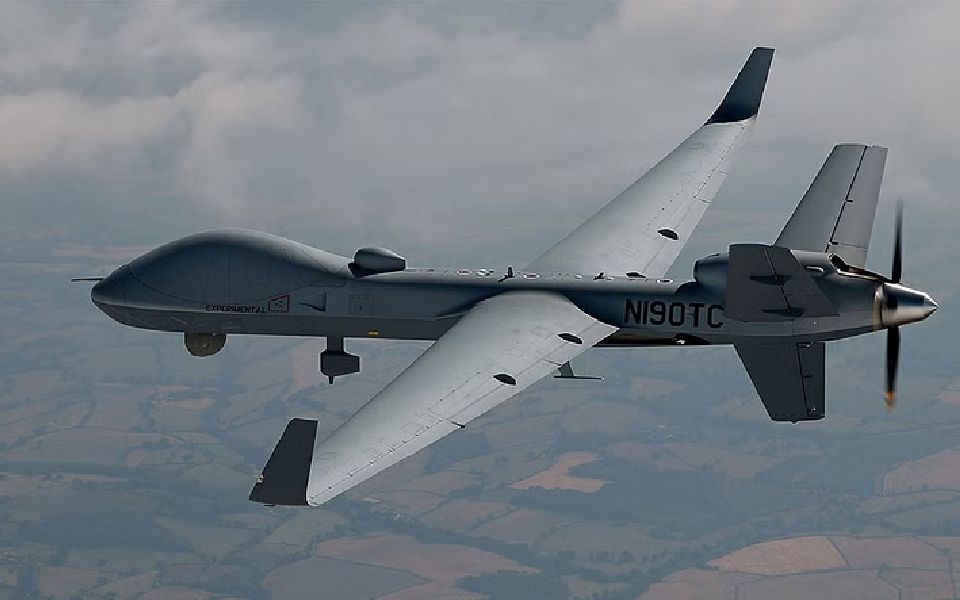
New Delhi, Jun 15: The Defence Ministry on Thursday approved procurement of 30 MQ-9B Predator armed drones from the US under a government-to-government framework and the nearly USD 3 billion deal is expected to be announced following talks between Prime Minister Narendra Modi and US President Joe Biden in Washington next week.
The procurement of the weaponised 'hunter-killer' drones from General Atomics was cleared at a meeting of the Defence Acquisition Council (DAC) chaired by Defence Minister Rajnath Singh, people familiar with the matter said.
The Sea Guardian Predator drones are being procured at a cost of around USD 3 billion to crank up the surveillance apparatus of the armed forces, especially along the frontier with China, they said.
The approval to the long-awaited procurement following years of negotiations came around 10 days after US Defence Secretary Lloyd Austin held wide-ranging talks with Singh that focused on significantly expanding overall strategic and defence engagement between the two countries.
There is a likelihood of firming up of an agreement on manufacturing of the GE-414 fighter jet engine in India during Modi's visit to Washington. India is looking at the project to power its indigenously developed combat aircraft, the people cited above said.
The MQ-9B drone is a variant of the MQ-9 "Reaper" which was used to launch a modified version of the Hellfire missile that eliminated al-Qaeda leader Ayman al-Zawahiri in the heart of Kabul in July last year.
It is expected that the mega procurement deal worth around USD 3 billion would be announced following talks between Modi and Biden at the White House next week.
The defence ministry is now in the process of issuing an actionable letter of request (LoR) to the US government. The formal contract is likely to be concluded after the US responds to the Indian communication with a letter of offer and acceptance.
It is not immediately known whether the procurement will have any aspect of technology transfer.
The people cited above said there could be an announcement on the deal in Washington next week but the final signing of the contract may take some time as the procurement will have to be cleared by India's Cabinet Committee on Security.
The Sea Guardian drones are being procured for the three services as they can carry out a variety of roles including maritime surveillance, anti-submarine warfare and over-the-horizon targeting among others.
It is learnt that the Navy is likely to get 14 drones while the Indian Air Force and the Army will get eight each.
The high-altitude long-endurance (HALE) drones are capable of remaining airborne for over 35 hours and can carry four Hellfire missiles and around 450 kgs of bombs.
The MQ-9B has two variants -- Sky Guardian and its sibling Sea Guardian.
In 2020, the Indian Navy had taken on lease two MQ-9B Sea Guardian drones from General Atomics for a period of one year for surveillance in the Indian Ocean. The lease period has been extended subsequently.
The Indian Navy has been bolstering its surveillance mechanism to monitor growing Chinese activities including frequent forays by PLA warships in the Indian Ocean Region.
Indian armed forces have been focusing on procuring unmanned platforms including armed drones in the backdrop of the eastern Ladakh border standoff with China, and to track movements of Chinese warships in the Indian Ocean region.
The drone is the first hunter-killer unmanned aerial vehicle (UAV) designed for long-endurance and high-altitude surveillance.
The MQ-9B has signals intelligence and communications intelligence systems integrated onboard, but it can take any number of other custom sensors as necessary.
In 2019, the US approved the sale of armed drones to India and even offered integrated air and missile defence systems.
The Indian Navy has been strongly pushing for the procurement to boost its overall surveillance over the Indian Ocean, a region that has witnessed increasing forays by Chinese ships and submarines in the last few years.
Following the eastern Ladakh standoff, India has significantly enhanced its day and night surveillance over the Line of Actual Control (LAC) using a fleet of remotely piloted aircraft. The Indo-US defence ties have been on an upswing in the last few years.
In June 2016, the US designated India a "Major Defence Partner" paving way for sharing of critical military equipment and technology.
The two countries have also inked key defence and security pacts over the past few years, including the Logistics Exchange Memorandum of Agreement (LEMOA) in 2016 that allows their militaries to use each other's bases for repair and replenishment of supplies.
The two sides also signed COMCASA (Communications Compatibility and Security Agreement) in 2018 which provides for interoperability between the two militaries and provides for the sale of high-end technology from the US to India.
In October 2020, India and the US sealed the BECA (Basic Exchange and Cooperation Agreement) agreement to further boost bilateral defence ties.
The pact provides for sharing of high-end military technology, logistics and geospatial maps between the two countries.
Let the Truth be known. If you read VB and like VB, please be a VB Supporter and Help us deliver the Truth to one and all.
T'gana RTC strike: Talks between govt, employees successful

Hyderabad (PTI): Talks between employees of Telangana State Road Transport Corporation (RTC) who were on strike and the state government concluded successfully on Friday as the government agreed to the key demands of the workmen.
Following a day-long marathon of talks between the leaders of the employees' Joint Action Committee (JAC) and the cabinet sub-committee, the government announced after midnight that it acceded to the demands, including a merger of RTC with the government, 11 per cent pay revision and elections to the employees' unions.
A committee comprising officials and employee leaders would be appointed over the merger of RTC with the government, it said.
The RTC management has also agreed to address the remaining issues as well, an official release said.
The employees would call off their strike and the RTC buses would hit the roads shortly, it said.
The employees had been on an indefinite strike since April 22 over a series of demands, including the merger of RTC with the government.
Earlier in the day, a driver of the RTC, who attempted suicide on April 23 during the strike, died at a hospital here in the early hours of Friday.
Shankar Goud, a 55-year-old driver, set himself ablaze by pouring petrol at Narsampet in Warangal district when the employees were staging a protest on Thursday in support of their demands.
Goud suffered serious burns, was initially admitted to a state-run hospital in Warangal, and later shifted to a super-speciality hospital in Hyderabad for advanced treatment.
"He succumbed (to injuries) at about 1.30 am on Friday," a senior official said.
The driver’s body was taken to his relative’s village, Muttojipet in Warangal district, for funeral rites.
Tension prevailed in Muttojipet as his family members and RTC employees attempted to take the body to the Narsampet bus station, where he worked, to enable his colleagues to pay their last respects. However, police did not permit this, citing law-and-order concerns.
This led to a deadlock before the funeral could proceed.
Union Minister Bandi Sanjay Kumar criticised the Telangana government for not allowing the body to be taken to the Narsampet bus station.
Kumar, Minister of State (Home), visited Muttojipet village in Warangal district, where the funeral was held, and paid homage to Goud.
“They (family members) want to take the body to the bus depot for five minutes. Is the RTC bus depot in Pakistan or Bangladesh? They are emotionally attached to taking the body there. The government is hurting sentiments and creating fear among RTC employees,” Kumar told reporters.
He also expressed anger at the police for not allowing the body to be taken to the bus station and staged a protest, according to a release from his office.
RTC employees and BJP workers attempted to take the mortal remains in an ambulance to Narsampet, but were stopped by the police.
Later, after discussions with the police, the family members and RTC employees agreed to conduct the funeral in the village.
Sanjay Kumar, stating he would abide by the family’s decision, left the village after the funeral was conducted there.
Transport Minister Ponnam Prabhakar said an ex gratia of Rs 10 lakh, a house, and a government job would be provided to the kin of Goud.
Chief Minister A Revanth Reddy expressed shock over the employee’s death and conveyed deep condolences to the grieving family, according to the release.
The RTC employees’ JAC had earlier announced an agitation programme from April 24 to 29, including silent marches and submission of memorandums to MLAs and other leaders.