Deity is owner of land attached to temple, priest cannot be treated as 'Bhumiswami': SC
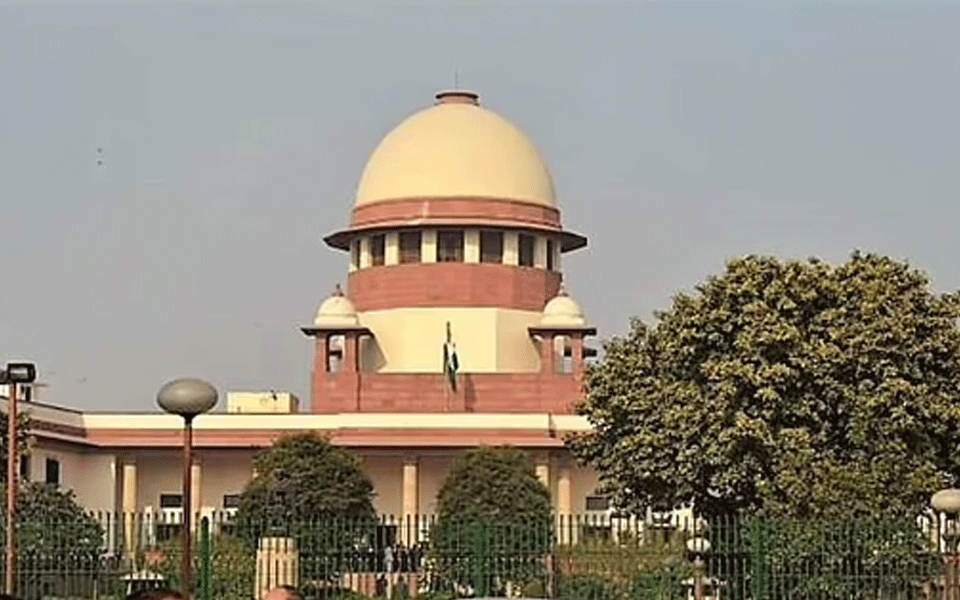
New Delhi(PTI): A priest cannot be treated as Bhumiswami (owner of land) and the deity is the owner of the land attached to a temple, the Supreme Court has ruled.
A bench of Justices Hemant Gupta and A S Bopanna said the 'pujari', or priest, only holds the land for the purpose of management of the property of the temple.
"In the ownership column, the name of the deity alone is required to be mentioned, as the deity being a juristic person is the owner of the land. The occupation of the land is also by the deity which is carried out by the servant or the managers on behalf of the deity. Therefore, the name of the manager or that of the priest is not required to be mentioned in the column of occupier as well," the top court said on Monday.
It added that the law is clear on the distinction that the Pujari is not a Kashtkar Mourushi, (tenant in cultivation) or a government lessee or an ordinary tenant of the maufi lands (land exempted from payment of revenue) but holds such land on behalf of the Aukaf Department (relating to 'Devasthan) for the purpose of management.
"The Pujari is only a grantee to manage the property of the deity and such grant can be reassumed if the Pujari fails to do the task assigned to him, i.e, to offer prayers and manage the land. He cannot be thus treated as a Bhumiswami," the bench said.
"We do not find any mandate in any of the judgments to hold that the name of Pujari or manager is required to be mentioned in the revenue record, the bench said.
It said that the name of the Collector as manager cannot be recorded in respect of property vested in the deity as the Collector cannot be a manager of all temples unless it is a temple vested with the State.
The apex court was hearing an appeal filed by Madhya Pradesh challenging an order of High Court which quashed two circulars issued by the state government under the MP Law Revenue Code, 1959 (Code).
These circulars ordered deletion of the names of pujari from the revenue record so as to protect the temple properties from unauthorised sale by the priests.
Let the Truth be known. If you read VB and like VB, please be a VB Supporter and Help us deliver the Truth to one and all.
Rajnath to top commanders: Outmaneuver adversaries with strategic surprise
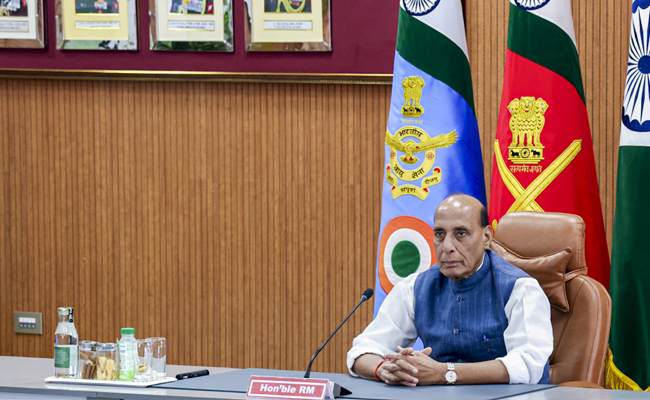
Jaipur/New Delhi (PTI): Defence Minister Rajnath Singh on Friday directed the top military commanders of the three services to integrate an "element of surprise" into modern warfare to outmaneuver India's adversaries and bolster strategic posture.
In his address at the joint commanders conference in Jaipur, Singh also described the Operation Sindoor as a testament to the "swift, precise, and joint response" of the Indian armed forces to safeguard national interests and called upon the military to remain ready to deal with any security challenges.
In their two-day deliberations, the commanders carried out a comprehensive review of the combat preparedness of the military in the wake of the evolving regional security situation.
Operation Sindoor was a demonstration of India's growing capabilities and a symbol of the nation's collective resolve and new military ethos, Singh said, a day after the first anniversary of Operation Sindoor.
He also unveiled a 'Joint Doctrine for Integrated Communication Architecture' that is aimed at strengthening doctrinal clarity, interoperability and integrated communications across the armed forces in future multidomain operations.
The joint commanders' conference, themed 'Military Capability in New Domains', brought together the top leadership of the defence ministry and the three services to deliberate on emerging security challenges and future readiness.
Comprehensive deliberations were held on future warfare, multidomain operations, technological transformation and joint capability development.
The conference witnessed extensive discussions on cognitive warfare, cyber resilience against evolving quantum and AI-enabled threats, military capability development in emerging domains, indigenous innovation and AI-enabled warfighting concepts.
It was attended by Chief of Defence Staff Gen Anil Chauhan, Chief of the Naval Staff Admiral Dinesh Kumar Tripathi, Chief of the Army Staff Gen Upendra Dwivedi, Chief of the Air Staff Air Chief Marshal AP Singh and Defence Secretary Rajesh Kumar Singh among others.
In his remarks, Singh asked the commanders to remain "future-ready" by learning from the operation as well as the current global security landscape.
He underscored the need to strengthen capabilities in artificial intelligence, autonomous systems, data analytics and secure communication networks to stay prepared in the rapidly evolving geopolitical security scenario. He emphasised that future conflicts will increasingly be shaped by hybrid threats, information dominance and operations conducted simultaneously across cyber, space, electromagnetic and cognitive domains, according to an official readout.
Highlighting the transformative impact of emerging technologies, Singh stressed on the importance of ensuring integrated national preparedness across all spectrums of conflict, it said.
Singh's remarks at the conference came a day after the first anniversary of Operation Sindoor.
The defence minister appreciated the progress achieved in enhancing jointness, integration and technological adoption across the three services, the readout noted.
Singh said that jointness constitutes a pivotal dimension within the transformative changes sweeping across the global defence sector.
"Future wars will not be won solely through weaponry, but through innovative thinking and enhanced synergy," he said.
The defence minister exhorted the commanders to cultivate the "element of surprise" to remain unpredictable to the nation's adversaries and secure a strategic edge in any given situation.
He, however, urged them to remain vigilant of the element of surprise of the enemy and always stay two steps ahead.
Singh also reiterated the Narendra Modi government's commitment to enhancing the capabilities of the defence forces through state-of-the-art weapons and platforms. He added that special focus is being laid on research in niche domains.
During the conference, he released a documentary film on Operation Sindoor.
The film reaffirms the nation's and defence forces' commitment to operational preparedness and decisive national response capabilities.
Demonstrations of advanced systems and platforms developed for intelligence fusion, operational planning and information management were also showcased during the conference reflecting growing integration of cutting-edge technologies into joint operational structures, according to the defence ministry.
The discussions will contribute significantly towards shaping India's future military transformation and integrated operational preparedness, it said.