Delhi air quality close to 'severe plus' category, odd-even on anvil
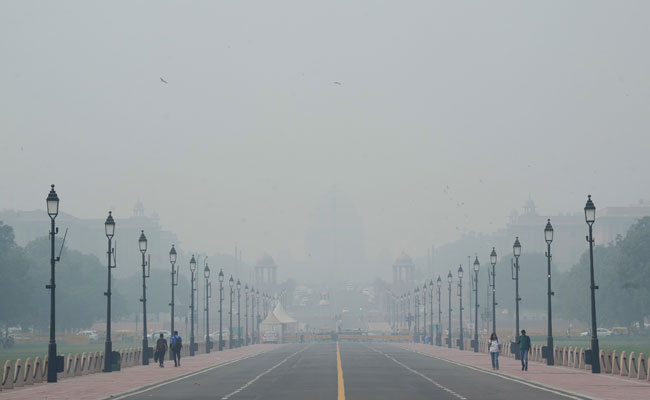
New Delhi (PTI): Delhi's air quality has deteriorated further and now stands closer to the "severe plus" category, a stage which might trigger the implementation of the odd-even car rationing measure in the capital.
The city's air quality index stood at 437 at 7 am, worsening from 419 at 4 pm on Thursday.
The capital's 24-hour average AQI, recorded at 4 pm every day, was 401 on Wednesday, 397 on Tuesday, 358 on Monday, 218 on Sunday, 220 on Saturday, and 279 on Friday.
The relatively better air quality last weekend is attributed to rain. Air pollution levels surged in the following days due to intense firecracker bursting on Diwali night and a resurgence in stubble burning in the neighbouring states.
These effects were compounded by unfavourable meteorological conditions, primarily calm winds and low temperatures, hindering the dispersion of pollutants. Neighbouring Ghaziabad (374), Gurugram (404), Greater Noida (313), Noida (366), and Faridabad (415) also recorded very poor to severe air quality.
An AQI between zero and 50 is considered good, 51 and 100 satisfactory, 101 and 200 moderate, 201 and 300 poor, 301 and 400 very poor, 401 and 450 severe and above 450 severe plus.
Earlier this week, Delhi Environment Minister Gopal Rai had mentioned the possibility of the return of the odd-even car rationing measure if the AQI crosses the 450-mark.
The measure, implemented four times since 2016, allows cars to operate on alternate days based on the odd or even last digit of their registration numbers. The last enforcement was in 2019.
The government last week postponed its implementation after a notable improvement in the city's air quality due to rain on Friday.
Recent findings from a joint project by the Delhi government and IIT-Kanpur found that vehicular emissions accounted for about 38 per cent of the capital's air pollution on Wednesday. This reduced to 25 per cent on Thursday.
Secondary inorganic aerosols -- particles such as sulfate and nitrate that are formed in the atmosphere due to the interaction of gases and particulate pollutants from sources like power plants, refineries, and vehicles -- is the second major contributor to Delhi's foul air, accounting for 30 to 35 per cent of the air pollution in the city the last few days.
Calm winds and low temperatures are allowing accumulation of pollutants and relief is unlikely over the next few days, an official at the India Meteorological Department (IMD) said.
An improvement in the wind speed November 21 onwards might bring air pollution levels down, he said.
Delhi's air quality dropped over the last few days despite the state government implementing stringent measures, including a ban on construction work and the entry of diesel-guzzling trucks into the city.
According to IQAir, a Swiss company that specialises in air quality monitoring, Delhi was the most polluted city in the world on Thursday, followed by Baghdad and Lahore.
A system developed by the Pune-based Indian Institute of Tropical Meteorology to identify the contribution of different pollution sources showed stubble-burning accounted for 7.5 per cent of the air pollution in the capital on Thursday. It is likely to come down to 3.5 per cent on Friday and 3 per cent on Saturday.
An official of the Commission for Air Quality Management (CAQM) had earlier said stringent measures, including a ban on construction work and the entry of polluting trucks in the national capital, under the final stage of the central government's air pollution control plan called the Graded Response Action Plan (GRAP) will continue until further orders.
The Delhi government on Thursday set up a six-member special task force to ensure strict implementation of measures outlined in the GRAP in the capital. Delhi's special secretary (environment) will head the STF, whose members include senior officials from the departments of transport, traffic, revenue, Municipal Corporation of Delhi and Public Works Department.
Doctors say breathing in the polluted air of Delhi is equivalent to the harmful effects of smoking approximately 10 cigarettes a day.
Prolonged exposure to high levels of pollution can cause or exacerbate respiratory problems such as asthma, bronchitis and chronic obstructive pulmonary disease (COPD) and dramatically raise the risk of cardiovascular disease, they said.
Unfavourable meteorological conditions, combined with vehicular emissions, paddy-straw burning, firecrackers and other local pollution sources, contribute to hazardous air quality levels in Delhi-NCR during winters.
According to a report compiled by the Energy Policy Institute at the University of Chicago (EPIC) in August, air pollution is shortening lives by almost 12 years in Delhi.
Let the Truth be known. If you read VB and like VB, please be a VB Supporter and Help us deliver the Truth to one and all.
Seven killed as govt hospital’s compound wall collapse due to rain

Bengaluru (PTI): Seven people, including three children, were killed when the compound wall of a hospital collapsed here on Wednesday, police said.
The incident occurred in the Bowring and Lady Curzon Hospital, they added.
When the heavy rains, coupled with strong winds, battered the area, the seven victims were taking shelter near the wall, which suddenly came down crashing, police further said. All seven people were killed on the spot, they added.
According to police sources, the victims were street vendors.
Police and emergency services personnel rushed to the spot with an earthmover to bring out the bodies from the debris with the help of residents.