Delhi govt has control over services except for public order: SC on Delhi-Centre service row
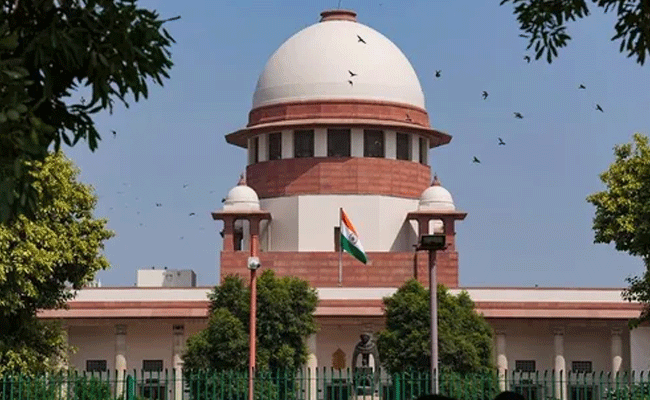
Asserting that an elected government needs to have control over the administration, a five-judge constitution bench, headed by Chief Justice DY Chandrachud, said the Union territory of Delhi has "sui generis (unique) character" and refused to agree with the 2019 judgement of Justice Ashok Bhushan that the Delhi government has no power over the issue of services.
"Further expansion of the Union's power will be contrary to the Constitutional scheme...Delhi is similar to other states and has a representative form of government," the top court said in its verdict over the contentious issue of administrative control over services between the Centre and the Delhi government.
"The National Capital Territory of Delhi government has legislative and executive powers over services sans...public order, police and land," said the bench, which also comprised Justices M R Shah, Krishna Murari, Hima Kohli and P S Narasimha.
The primacy of the Centre in administrative issues would abrogate the federal system and the principle of representative democracy it said, adding if 'services' are excluded from the legislative and executive domain, then ministers would be excluded from controlling civil servants.
Democracy and federalism are part of the basic structure of the Constitution, the CJI said while reading out the judgement in a packed courtroom.
The order also said if officers stop reporting to ministers then the principle of collective responsibility is affected, and added that in a democratic form of governance, the real power of administration must rest on the elected arm of government.
The bench said the Union government's power in matters where both the Centre and States can legislate is limited to ensure that the governance is not taken over by the Central government.
The Constitution bench was set up to hear the legal issue concerning the scope of legislative and executive powers of the Centre and the National Capital Territory government over control of services in Delhi after the Union home ministry issued a notification in 2015, stating that it has control over services in Delhi. The notification was challenged by the Arvind Kejriwal government in the Delhi high court.
The SC bench had reserved its order on January 18 after hearing the submissions of Solicitor General Tushar Mehta and senior advocate A M Singhvi for the Centre and the Delhi government respectively for almost four-and-a-half days.
On May 6 last year, the top court referred the issue of control of services in Delhi to a five-judge Constitution bench.
The plea moved by the Delhi government arises out of a split verdict of February 14, 2019, in which a two-judge bench of Justices A K Sikri and Ashok Bhushan, both now retired, had recommended to the CJI that a three-judge bench be set up to finally decide the issue of control of services in the national capital.
Justice Bhushan had ruled that the Delhi government had no power at all over administrative services, while Justice Sikri had made a distinction.
He had said the transfer or posting of officers in the top echelons of the bureaucracy (joint director and above) can only be done by the Centre and the lieutenant governor's view will prevail in case of a difference of opinion on matters related to other bureaucrats.
In a 2018 judgment, a five-judge Constitution bench had unanimously held that the Delhi LG was bound by the aid and advice of the elected government, and both needed to work harmoniously with each other.
Let the Truth be known. If you read VB and like VB, please be a VB Supporter and Help us deliver the Truth to one and all.
CCTVs in police stations: SC asks amicus to convene meeting on utilisation of funds
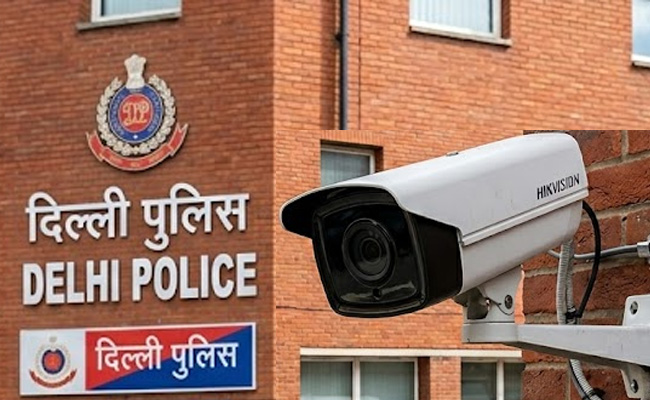
New Delhi (PTI): The Supreme Court on Tuesday said that a meeting be convened on May 6 to deliberate on the aspect of utilisation of funds by the states on installation of CCTVs in police stations across the country.
A bench of Justices Vikram Nath and Sandeep Mehta asked senior advocate Siddhartha Dave, who is assisting it as an amicus curiae in a suo motu matter concerning lack of functional CCTVs in police stations, to hold a meeting on May 6 with the Centre, all states and Union Territories.
"We are of the view that a meeting be convened by the amicus, as done earlier, in which the home secretary of the central government or his nominee not below the rank of joint or additional secretary and the home secretary of states/Union Territories will participate," the bench said.
The issue cropped up after the amicus flagged the aspect of utilisation of funds by the states.
Dave told the bench that in UTs, the Centre gives 100 percent funds while in hilly states, the central government gives 90 percent funding.
He said in remaining states, the Centre gives 60 percent while the rest 40 percent funding is by the respective state.
"Why don't we get responses of the states only on utilisation of funds?" the bench said.
The top court suggested that the amicus can convene a meeting with the Centre, states and UTs on the issue.
It posted the matter for hearing on May 13 and said that a report be submitted before it.
On April 7, the Centre told the top court that all issues concerning installation of CCTVs in police stations would be sorted out within two weeks.
Attorney General R Venkataramani had told the bench that he was taking stock of the issue and a lot of things were happening.
On February 26, the apex court directed the Centre and others to participate in a meeting to deliberate upon the feasibility, modalities and implementation framework of the issues, including creation of a centralised dashboard and standardisation of CCTV infrastructure in police stations.
The top court had earlier directed registration of a suo motu case over the lack of functional CCTVs in police stations after taking cognisance of a media report.
The apex court had in 2018 ordered the installation of CCTV cameras across police stations to check human rights abuses.
In December 2020, the top court directed the Centre to install CCTV cameras and recording equipment at the offices of investigating agencies, including the Central Bureau of Investigation (CBI), the Enforcement Directorate (ED) and the National Investigation Agency (NIA).
It said that states and UTs should ensure that CCTV cameras were installed at every police station, at all entry and exit points, main gate, lock-ups, corridors, lobby and reception, as well as in areas outside the lock-up rooms so that no part was left uncovered.
The top court said that CCTV systems must be equipped with night vision and have audio as well as video footage.
The court made it mandatory for the Centre, states and the UTs to purchase such systems which allow storage of data for at least one year.