Delhi excise policy 'scam': SC to pronounce verdict on Manish Sisodia's bail pleas on Monday
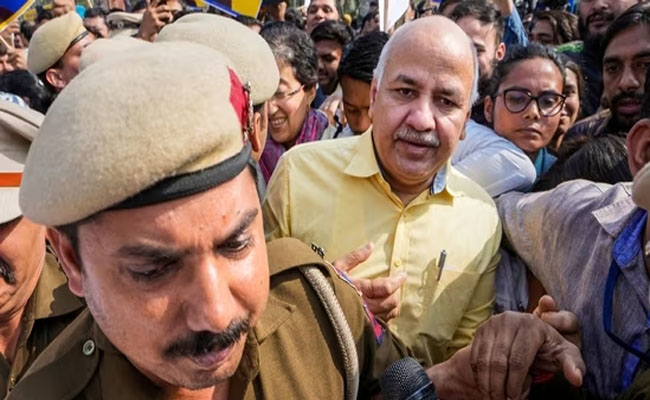
New Delhi (PTI): The Supreme Court is scheduled to pronounce its verdict on Monday on two separate regular bail pleas of former Delhi deputy chief minister Manish Sisodia in corruption and money-laundering cases related to the now-scrapped excise policy for the national capital.
A bench of Justices Sanjiv Khanna and S V N Bhatti, which had reserved its verdict on October 17 on both the pleas, will pronounce it.
On October 17, the top court told the Enforcement Directorate (ED) that if a bribe that was allegedly paid for tweaking the Delhi excise policy is not part of the predicate offence, it would be difficult to prove the money-laundering case against Sisodia.
It had told the federal agency that it cannot go on assumptions of bribe being paid and whatever protection is there under law, needs to be granted.
Sisodia was arrested by the Central Bureau of Investigation (CBI) on February 26 for his alleged role in the "scam". The Aam Aadmi Party (AAP) leader has been in custody since then.
The ED arrested Sisodia in a money-laundering case stemming from the CBI FIR on March 9 after questioning him in the Tihar jail.
Sisodia resigned from the Delhi cabinet on February 28.
The high court denied him bail in the CBI case on May 30, saying having been the deputy chief minister and excise minister, he is a "high-profile" person who has the potential to influence the witnesses.
On July 3, the high court declined him bail in the money-laundering case linked to alleged irregularities in the city government's excise policy, holding that the charges against him are "very serious in nature".
The Delhi government had implemented the policy on November 17, 2021, but scrapped it at the end of September 2022 amid allegations of corruption. According to the investigating agencies, the profit margins of wholesalers were increased from 5 to 12 per cent under the new policy.
The agencies have alleged that the new policy resulted in cartelisation and those ineligible for liquor licences were favoured for monetary benefits.
However, the Delhi government and Sisodia have denied any wrongdoing and said the new policy would have led to an increase in the State's revenue share.
Let the Truth be known. If you read VB and like VB, please be a VB Supporter and Help us deliver the Truth to one and all.
Vaishnaw flags off Jammu-Srinagar Vande Bharat, services from May 2
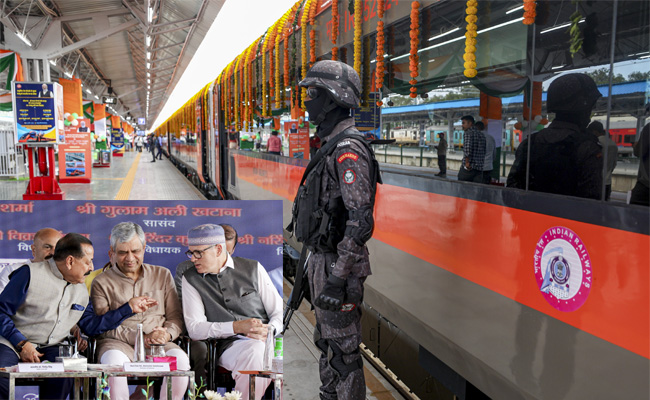
Srinagar (PTI): Railways Minister Ashwini Vaishnaw on Thursday flagged off the 20-coach Vande Bharat Express train between Jammu and Srinagar, the first direct train between the twin capitals of Jammu and Kashmir.
Chief Minister Omar Abdullah and Minister of State in the Prime Minister's Office, Jitendra Singh, were among the dignitaries present at the flagging off ceremony.
The direct train services between Srinagar and Jammu will reduce travel time between the twin capitals of Jammu and Kashmir, and boost tourism, besides providing an all-weather surface transport link.
Prime Minister Narendra Modi inaugurated the first direct train service between Katra and Srinagar on June 6, 2025. This service is now being extended up to the Jammu Tawi Railway Station.
The work on the Rs 43,780-crore rail project, linking Kashmir to the rest of the country, began in the late 1990s, with the first train operating in the Kashmir Valley in October 2008.
While train services had reached Udhampur by 2005, the treacherous terrain through the mountainous Pir Panjal range made it tough to link the valley with the rest of the country until 2025.
"The modern 20-coach Vande Bharat train will commence its maiden journey from Jammu Tawi, traversing the route up to Srinagar while connecting the challenging geographical terrains of the Valley," an official said, adding that a train from Srinagar has also started moving towards Jammu simultaneously.
Before the commencement of the Jammu-Srinagar service, a trial run of the Vande Bharat was conducted on Tuesday from Jammu to Shri Mata Vaishno Devi Katra railway stations, officials said.
The inaugural Vande Bharat train, equipped with state-of-the-art amenities and comprising 20 coaches, will cover a total distance of 267 kilometres.
The Jammu-Srinagar train service -- scheduled to start on May 2 -- will operate six days a week. There will be no train service on this route on Tuesdays.
"Constructed using indigenous technology, this Vande Bharat Express will offer passengers a world-class travel experience," Senior Divisional Commercial Manager Uchit Singhal said.
"It features amenities such as the 'Kavach' safety system for passenger security, a GPS-based information system, and comfortable rotating seats. This service will not only reduce travel time but also provide a massive boost to the local economy and tourism," he added.
The extension of the Vande Bharat to Jammu Tawi is the latest milestone in a decade-long effort to transform railway connectivity in Jammu & Kashmir.
The Udhampur-Katra section was commissioned in 2014. The Kashmir Valley saw its first electric train in February 2024, while a dedicated Jammu Railway Division was created in January 2025.
Stations at Jammu Tawi, Katra, Udhampur, and Budgam are being redeveloped under the Amrit Bharat Station Scheme.
The Udhampur-Srinagar-Baramulla Rail Link, built at a total cost of Rs 43,780 crore with 36 tunnels spanning 119 km and 943 bridges, is the connective tissue that makes all of this possible, an official said.