Delhi floods: Farmlands, shanties, shops inundated, evacuated people stare at bleak future
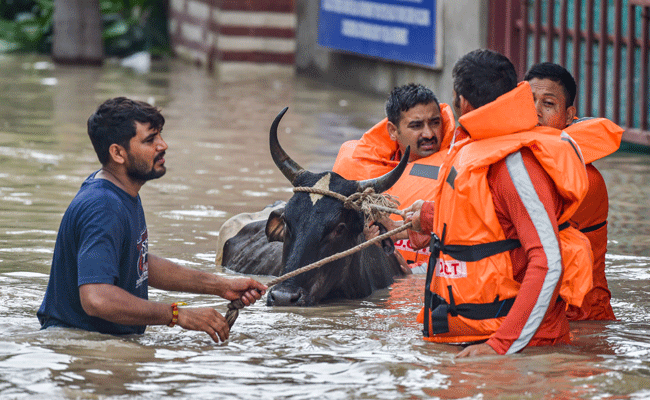
New Delhi(PTI): In March, her home was demolished in an anti-encroachment drive and now, her shanty on the bank of a swollen Yamuna is underwater. "Everything is lost again," says Beena Devi, who has been moved to a relief camp along with her family from a slum in the Rajghat area here.
Some utensils, essentials and quilts was all the 57-year-old, her husband, three children and daughter-in-law could carry out of their house as authorities raced to evacuate them and hundreds of families on Tuesday as the water levels in the river rapidly started rising, above the danger mark.
Delhi recorded a rapid increase in the Yamuna's water level over the past four days. It shot up from 203.14 metres at 11 am on Sunday to 205.4 at 5 pm on Monday, breaching the danger mark of 205.33 metres 18 hours earlier than expected.
The river exceeded the evacuation mark of 206 metres on Monday night, prompting the relocation of people residing in flood-prone areas to safer locations. The water level breached the previous all-time record of 207.49 metres by 1 pm on Wednesday and the 208-metre mark by 10 pm.
Sitting at the ITO relief camp, Devi recalled how in March bulldozers razed her pucca house and those of others in the Rajghat area to make way for beautification project ahead of the G20 Summit in the national capital.
"Everything is gone again. We are not sure whether we will be able to return," said Devi, whose family ekes out a living by growing vegetables on small piece of land, now submerged in the waters of the Yamuna.
"We moved from low-lying areas to upper areas after we saw the water levels rising. However, on July 11, government officials asked us to evacuate so we packed whatever we could and left," said the 57-year-old, who to supplement the family income ran a roadside shop, which too has been swept away by flood waters.
She said not only her family but many have lost their source of livelihood and income.
The Delhi government has set up relief camps -- tents supported by wooden poles -- on roadsides in areas along the Yamuna, and around 7,500 people have been evacuated to these camps. However, many complained of poor facilities and arrangements.
In a camp near the Yamuna Bridge, Tarawati, who has a farm at the Yamuna floodplains, said the flood has destroyed both her farm and her 'juggi' (shanty).
"We get food twice a day but there is no toilets here. We have to find places and have to sometimes go behind trees to relieve ourselves," said the 50-year-old, who was evacuated four days ago. Sangeeta, who was evacuated three days ago with her family, also complained of lack of toilets and explained the difficulties women have to face,
At the ITO camp, Devi said, "We are not getting proper food and water at the relief camp". She also claimed that women are forced to go outside due to lack of toilets.
Omprakash (35), who is staying at the Yamuna Bridge camp along with his mother, wife and four children, said he and many others have been living near the Yamuna river for years and farming is their only source of livelihood.
"We can't leave, everything is here. Our fields are here. If we don't farm how would we earn money? We haven't faced many problems in the camp, at least we get food two times a day," he said.
Though the Yamuna's water level stabilised after reaching 208.62 metres on Thursday, roads turned into rivers and water gushed into houses, crematoriums and shelter homes, impairing daily life in the national capital.
Delhi Civil Defence (DCD) members said around 130 families have been evacuated to the Yamuna Bridge camp.
Strong tents have been put up and people are being provided all facilities, and food and water, DCD member Rekhe said and added that "bathrooms, which is the main concern, will soon be taken care of".
"We have just set up the camps, it will take some time. We have also provided medical care, with doctors and medicines," she said.
Let the Truth be known. If you read VB and like VB, please be a VB Supporter and Help us deliver the Truth to one and all.
Bengaluru airport introduces AI-based system to enhance safety at vehicle-aircraft intersections

Bengaluru: Bangalore International Airport Limited (BIAL) has introduced an integrated smart airside safety system at Kempegowda International Airport to improve operational safety at key intersection zones.
According to The Hindu, the system has been designed to enhance safety at Cross Service Roads (CSRs), where aircraft and ground vehicle movements intersect.
According to BIAL, the system integrates AI-based computer vision, automation, and centralised monitoring to manage right-of-way movements and reduce the risk of human error.
“CRSs are among the most sensitive areas within airport operations, requiring precise and seamless coordination between aircraft and ground vehicles. Traditionally, right of way protection at these intersections relied on manual or semi-manual inset light activation, creating dependencies on human intervention, increasing the risk of delays and limiting operational visibility,” TH quoted BIAL as saying.
The new system uses real-time detection of vehicle movement, risk assessment, and automated signalling. AI-enabled cameras identify potential conflicts and trigger automated inset light signals to ensure aircraft priority. Normal operations resume once the area is confirmed clear.
“Based on these detections, the system triggers automated inset light activation to protect aircraft right‑of‑way and restores normal signalling once the intersection is confirmed clear. A centralised monitoring and analytics platform digitally logs all events, strengthening governance, compliance, and operational control,” BIAL said.
By embedding technology into operations, the system creates a data-driven separation layer between aircraft and ground vehicles, significantly reducing human error, especially during night and low-visibility conditions.
“Precision-led signal activation improves traffic flow, minimises unnecessary stoppage and enhances turnaround efficiency. It also establishes a scalable foundation for predictive safety analytics, enabling trend analysis, peak-hour optimisation, compliance mapping and risk forecasting to support continuous improvement and stronger airside governance,” BIAL said.