Delhi govt changed strategy on contact tracing & testing, leading to rise in cases: Jain

New Delhi: Delhi Health Minister Satyendar Jain on Thursday said the AAP government has changed its anti-Corona strategy by conducting aggressive tracing and testing in the city, citing it as one of the reasons for a sudden spike in COVID-19 cases in the past few days.
Jain said that this may be a third wave but it's too early to say that conclusively. He said one should wait for another week to see the trends before declaring the surge a third wave.
Amid the festive season and rising pollution levels, Delhi on Wednesday recorded over 5,600 COVID-19 cases, the first time the number crossed 5,000 in the national capital.
Talking to reporters about the new strategy which, he claimed, would be the "best strategy" to contain the virus, Jain said the Delhi government has started conducting aggressive tracing and testing of all family members and close contacts of those found infected with the novel coronavirus.
"And, we are at times, testing them twice after a gap of 4-5 days. We don't want to leave any positive case...we have changed our strategy that's why the number of cases has gone up. I believe that this strategy would be successful," Jain said.
Asked if the government was not conducting tests earlier on the family members of those found positive for COVID-19, the health minister said that authorities would conduct test only those who had coronavirus-like symptoms.
"Our main focus is that not a single (COVID-19) case should be left for testing. You can see a rise in number of cases, but it is a good strategy and its results should be seen soon," he said.
On being asked about the figure of 15,000 cases per day projected by experts in coming months, Jain said, "Figures have been projected by experts on surge in daily COVID-19 cases, but it may not reach that level. However, we want to be fully prepared."
As per the Wednesday bulletin, 5,665 beds were occupied and 10,100 still vacant in COVID-19 hospitals, Jain said.
He said that the number of RT-PCR tests, which are considered the gold standard for COVID-19 testing, is also going up in the national capital.
Officials cited some reasons -- festive season, cold, increase in RT-PCR testing and complacency in following anti coronavirus measures -- for the spike in cases.
Jain said that the situation of death due to COVID-19 is fine as of now in the national capital.
According to the health bulletin released on Wednesday, 40 deaths were reported, while 44 deaths were recorded on Tuesday, 54 deaths on Monday and 33 deaths on Sunday.
"Day-wise fatality is one thing, but if we look at the moving average of 10 days, death rate is 0.99 per cent and overall case fatality rate is 1.73 per cent," Jain said.
On the resident doctors association of LNJP Hospital requesting resumption of non-COVID-19 services, Jain said, "We will look into that after Diwali".
On Wednesday, 5,673 fresh cases came out of the 60,571 tests conducted the previous day, with the Delhi government scaling up RT-PCR tests, whose count stood at 17,284.
This is the first time when the number of daily cases in Delhi has crossed the 5,000-mark. The previous highest single-day spike of 4,853 cases was recorded on Tuesday.
The number of fresh cases recorded on Monday stood at 2,832, and 4,136 on Sunday, while the figures were 4,116 on Saturday and 4,086 on Friday. The active cases tally on Wednesday rose to 29,378 from 27,873 the previous day, according to the bulletin. It said that the total number of cases has climbed to 3,70,014.
Let the Truth be known. If you read VB and like VB, please be a VB Supporter and Help us deliver the Truth to one and all.
BJP, TMC hail SC directions on counting of votes for West Bengal polls
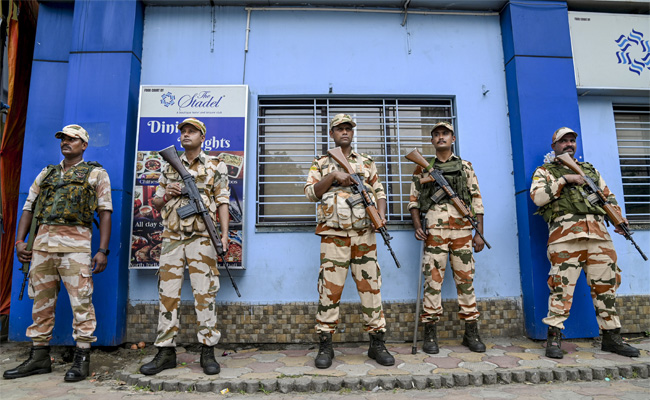
Kolkata (PTI): The BJP and TMC on Saturday both hailed the SC directions on the Election Commission's circular over the deployment of central government personnel for vote counting in West Bengal.
The apex court on Saturday said no further order was necessary on the TMC's plea challenging the Calcutta High Court's dismissal of its petition against the April 13 circular.
In a social media post, BJP leader Amit Malviya said, "In yet another legal setback, the Supreme Court has refused to intervene. The Trinamool Congress had approached the court challenging the exclusion of state government employees from vote-counting supervisor duties, and had sought an urgent hearing."
"The refusal to entertain this plea underscores a clear message -- attempts to influence or cast doubt over the integrity of the counting process will not find easy validation. Another day, another judicial rebuff for Mamata Banerjee," he added.
The TMC, however, claimed that the SC directions vindicated its stand.
"The issue raised before the Hon'ble Supreme Court pertained to the implementation of the said communication in a manner whereby only Central Government/Central PSU employees were being appointed as Counting Supervisors and Counting Assistants for counting of votes," the party said in a statement.
The TMC said it was highlighted that such an interpretation and implementation of the communication would be contrary to the framework of a fair and balanced counting process.
"After hearing the parties, the Hon'ble Supreme Court directed that Clause 1 of the communication dated 13.04.2026, relating to the appointment of Counting Supervisors and Counting Assistants, must be read along with the salient feature contained in the second page of the said communication, which provides for random selection of both State Government and Central Government employees," it said.
"The Hon'ble Supreme Court has further recorded the undertaking of Mr Dama Seshadri Naidu, learned Senior Advocate appearing for the Election Commission of India that the said communication shall be followed in its letter and spirit," it added.
The TMC said that in view of the directions, it is expected that the counting of votes shall be conducted in a fair, transparent, and balanced manner.
A special bench of Justices P S Narasimha and Joymalya Bagchi said the EC can choose the counting personnel, and its April 13 circular, which provides for deployment of state government employees as well, cannot be said to be incorrect.
The poll body said the apprehensions of TMC of any wrongdoing are misplaced, as the circular very clearly states that there will be a mix of central and state government employees.
The EC assured the court that the circular would be implemented in letter and spirit, and there would be state government employees also during the counting of votes on May 4.
Polling for the 294-member West Bengal assembly was held in two phases -- April 23 and April 29. The counting of votes will be taken up on May 4.
On April 30, the Calcutta High Court dismissed the TMC's petition against the Election Commission circular, saying there was no illegality in the poll panel's decision to appoint counting supervisors and assistants from Central government and Public Sector Undertaking (PSU) employees, instead of the state government staff.