Delhi govt constitutes expert committee to combat capital's hazardous air
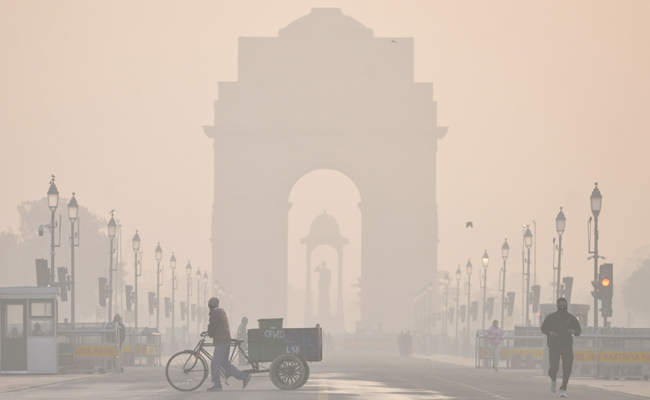
New Delhi (PTI): The Delhi government has constituted an expert committee to provide independent ideas, suggestions and solutions to tackle the capital's chronic air quality crisis, officials said on Monday.
The committee is key to the government's five-pronged pollution-control strategy, which focuses on innovation, scientific management of dust and solid waste, action against polluting industries, reduction of vehicular emissions, and long-term efforts to make Delhi greener and healthier.
Officials said the move marks a departure from earlier approaches that relied largely on regulatory orders without structured expert consultation.
To ensure faster execution of pollution-related decisions, the government has also set up the Implementation Committee on Control of Air Pollution (ICCAP), aimed at translating expert recommendations and government schemes into effective on-ground action.
According to officials, the Special Expert Committee comprises 11 members, including former secretaries, former chairpersons of the Delhi Pollution Control Committee (DPCC), secretaries of the environment and forest departments, representatives from the Commission for Air Quality Management (CAQM), and experts from institutions such as IIT Kanpur and IIT Delhi.
The implementation committee has 16 members, including the chief secretary, MCD commissioner, DDA vice-chairperson, NDMC chairperson, DUSIB chief executive officer, special commissioner of police (Traffic), and other senior officials.
Apart from this, the government has identified vehicular pollution as a key focus area, with large-scale road infrastructure upgrades currently underway, officials added.
According to official data, over 50,200 potholes have been repaired this year, compared to 36,629 last year.
Meanwhile, out of Delhi's 10,500-km road network, 2,180 km have been identified for redevelopment, while 469 km of roads under the MCD and PWD have already been recarpeted and strengthened. A policy decision has also been taken to ensure end-to-end pavement construction on all roads.
On Monday, the city's air quality worsened, slipping into the 'severe' category with an Air Quality Index (AQI) of 401 at 4 pm, compared to 390 recorded a day earlier, in the 'very poor' range.
According to Central Pollution Control Board (CPCB) standards, an AQI between 0 and 50 is considered 'good', 51 to 100 'satisfactory', 101 to 200 'moderate', 201 to 300 'poor', 301 to 400 'very poor', and 401 to 500 'severe'.
Let the Truth be known. If you read VB and like VB, please be a VB Supporter and Help us deliver the Truth to one and all.
Two injuries, one DNF, a DQ as India end messy World Relays campaign
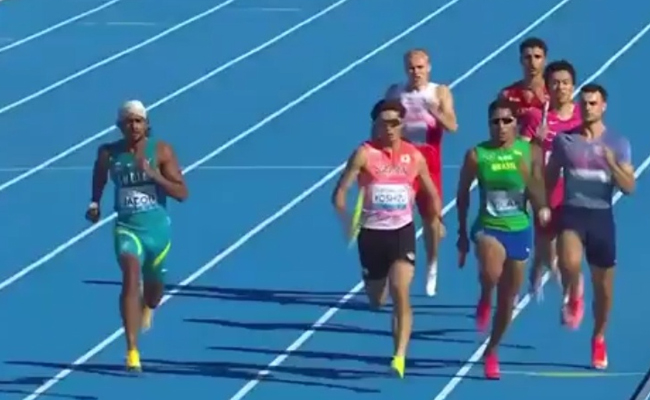
Gaborone (Botswana) (PTI): Amoj Jacob and Ragul Kumar got injured during the men's 4x400m and 4x100 races respectively as India ended their World Athletics Relays campaign in disappointment on the second day of competitions here on Sunday.
The Indian camp had high hopes of making the 2027 World Championships in the men's 4x400m relay but the team did not finish (DNF) the race as Jacob suffered cramps and pulled out of the race after taking the baton from the first leg runner Dharamveer Choudhary. Rajesh Ramesh and Vishal TK were to run in the third and fourth legs.
Those teams which could not qualify for the 2027 Beijing World Championships by reaching the final round of each of the six relay events on Saturday were given another chance in the second qualification round on Sunday.
The top two teams in each of the two heats (in all six relay events) booked the Beijing ticket on Sunday.
India will now have to try and qualify for the World Championships through the Top Lists of the World Athletics, which is a long and tedious process.
In the men's 4x100m race, third leg runner Ragul Kumar fell down the track after failing to hand over the baton inside the exchange zone to fourth leg runner Gurindervir Singh, which clearly showed the lack of coordination among the runners.
Harsh Santosh Raut and Animesh Kujur ran the first two legs.
The Indian quartet was disqualified and Kumar was seen being taken away from the Field of Play with the help of the volunteers.
It was a comedy of errors in the case of the women's 4x100m race, which saw the baton being dropped during an exchange between first leg runner Tamanna and second runner Nithya Gandhe, though the Indians finished the race in 53.09 seconds.
Gandhe started running quite a distance, but after realising that the baton was not in her hand, she turned and ran back to pick it up.
The only silver-lining for the Indian contingent was the national record time in the mixed 4x100m relay race, though the quartet of Ragul Kumar, Nithya Gandhe, Animesh Kujur and Sneha SS finished sixth in heat number two with a time of 41.35 seconds, bettering the previous national mark of 42.30 seconds set in March in Chandigarh.
The mixed 4x400m relay quartet of Theerthesh P Shetty, Kumari Saloni, Nihal William and Rashdeep Kaur ended at fifth in heat number one with a time of 3 minutes and 19.40 seconds.
On Saturday, all the five Indian relay teams had failed to make it to the respective final rounds and thus missed out on the 2027 World Championships berths.