Delhi govt hopes for 'meaningful' order by SC over green firecracker ban

New Delhi (PTI): Expecting a relief from the Supreme Court ahead of Diwali regarding the firecracker ban in the city, the Delhi government has planned extensive measures to make sure that pollution levels do not shoot up due to violations and the use of prohibited fireworks during the festival, officials said on Friday.
The Supreme Court earlier in the day said a complete ban on bursting of firecrackers in Delhi-NCR is "neither practical nor ideal" as such restrictions were often violated, and balancing of equities is needed.
The observations, which hinted towards relaxation on the ban, were made by a bench comprising Chief Justice B R Gavai and Justice K Vinod Chandran while reserving its order on a batch of pleas seeking permission to manufacture and sell "green" firecrackers in Delhi and the National Capital Region.
Delhi Environment Minister Manjinder Singh Sirsa said that the government wanted lifting of the ban at least for one hour each in the morning and the evening of Diwali and Guru Parab festivals.
"A ban on bursting of firecrackers on the festival in Delhi is not proper. We want relaxation so that people can celebrate by bursting green crackers," he said.
Culture and Tourism Minister Kapil Mishra said the court has been requested for permission for bursting green crackers in Delhi on the occasion of Diwali, while adhering to the prescribed pollution control standards.
"It's a matter of faith of crores of people and there are reports also that show firecracker bursting is not such a major cause of air pollution," he told reporters.
Mishra hoped the court will come up with a "meaningful" direction enabling people of Delhi to celebrate Diwali with traditional gaiety like people across the country.
Delhi government officials said that directions have been issued to take various measures to ensure implementation of all anti-pollution measures and to check any use of traditional firecrackers, if the court lifts the ban on bursting green firecrackers.
Various enforcement and monitoring protocols have already been planned for execution, including a dedicated control room during the festive period to receive complaints of violations.
Enforcement teams will be deployed with personnel from Delhi Police, Delhi Pollution Control Committee and MCD to prevent the sale and use of non-compliant firecrackers that are said to emit more pollutants, said a senior Delhi government officer.
Promotion of reporting by citizens through online platforms like Sameer App, Green Delhi App, and other official channels, will be taken up to strengthen enforcement, he said. An awareness campaign to educate people about the permissible type of green firecrackers will also be launched, he added.
The court has already been informed about these measures through an affidavit, he added.
Let the Truth be known. If you read VB and like VB, please be a VB Supporter and Help us deliver the Truth to one and all.
Mohsin's fifer helps LSG restrict KKR to 155/7 despite Rinku's 83
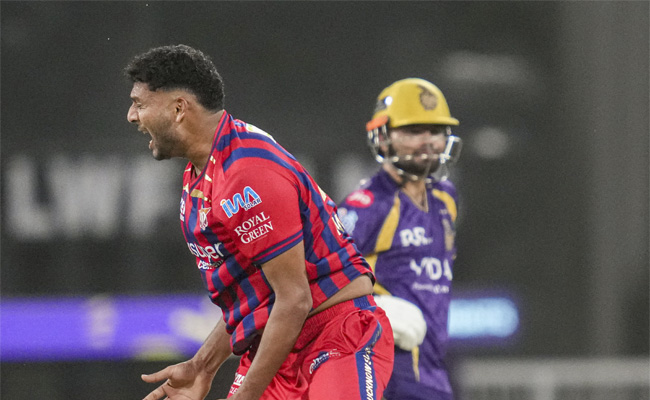
Lucknow (PTI): Lucknow Super Giants pacer Mohsin Khan added another sordid chapter to Kolkata Knight Riders' batting woes, taking five wickets to restrict the three-time champions to a modest 155 for seven in their IPL match here on Sunday.
Mohsin’s 5 for 23, a personal best for the left-arm pacer in this format, tore apart an already struggling KKR batting unit, as he snaffled the cream wickets of Ajinkya Rahane, Tim Seifert, Cameron Green, Rovman Powell and Anukul Roy.
Rinku Singh (83 not out, 51 balls) made a well-paced fifty and punished Mohammed Shami in the 19th over for 6, 4, 4 and the smoked four sixes in a row against spinner Digvesh Rathi as KKR made 43 runs in the last two overs to go past the 150-run mark.
But his fifty remained a lone act, as Mohsin firmly stood in the limelight.
His bowling ethos were rooted in simple tactics — bang the ball into the black soil pitch to gain bounce or use cutters at various pace to keep the batters guessing.
Mohsin, who started the night with a wicket maiden, showed his variety across two dismissals.
He followed Rahane with a fuller ball as the batter tried to go over the covers, but the ball’s trajectory forced the KKR skipper to just slice the ball up for a simple catch for Aiden Markram.
The 27-year-old stayed calm when Green, who looked comfortable out there while smashing George Linde for two successive sixes, slammed him for a huge maximum.
Two balls later, Mohsin dug one short, challenging Green (34) to go for the pull and the Australian all-rounder took the bait.
The into-the-body angle worked again as Green could only sky the ball to wicketkeeper Rishabh Pant.
Green’s ouster also ended a fifth wicket alliance worth 42 with Rinku Singh.
Bizarre dismissal of Raghuvanshi
=====================
If the existing turmoil was not enough, KKR had to bear the dejection of seeing Angkrish Raghuvanshi getting dismissed obstructing the field.
On the final ball of the fifth over from Prince Yadav, Raghuvanshi nudged one towards mid-on and set off for a single, only to be rejected by Green.
Raghuvanshi put in a dive to save himself but he came in the line of the throw from Shami.
Subsequently, third umpire Rohit Pandit accepted LSG’s appeal and decided that the batter’s turning radius was more than required, eventually resulting in the batter’s dismissal in a rare manner.