Delhi HC calls Juhi Chawla's suit against 5G technology defective', says filed for media publicity

New Delhi, Jun 2: The Delhi High Court on Wednesday termed as defective the suit of actress-environmentalist Juhi Chawla against setting up of 5G wireless networks in the country and said it was filed for media publicity.
The court also questioned Chawla for filing the suit without giving any representation to the government on her concerns related to the technology.
Justice J R Midha said the plaintiffs, Chawla and two others, were required to first approach the government for their rights and if denied, they should come to the court.
The court, which reserved order on the suit after hearing the arguments of various parties, also asked as to why as many as 33 parties have been added to the plaint and said it is not permitted under the law.
It is not the sweet will of the plaintiff to join as many parties and cause of action. Please see the memo of parties. Tell me how you have joined them. Every party cannot be arrayed in the suit, the judge said.
The court further said, It is a defective plaint. This suit has been filed only for media publicity and nothing more than that. It is very shocking.
Did you approach the government with a representation? If yes, is there any denial?, the court asked to which the plaintiffs' counsel replied in negative.
The court said in the suit, the plaintiff says I have personal knowledge of paragraphs 1 to 8' only.
Plaintiff has no personal knowledge of the plaint. I am surprised. How can it be? Is the suit permissible when the plaintiff has no personal knowledge of the averment? I have not seen a suit where a person says I don't know, please conduct an inquiry, the judge said.
The court asked about the knowledge of plaintiffs on the facts and warned to prosecute them on filing false claims.
The plea claimed that 5G wireless technology threatens to provoke serious, irreversible effects on humans and permanent damage to the earth's ecosystems.
The suit, filed by Chawla, social worker Veeresh Malik and Teena Vachani, said that if the telecom industry's plans for 5G come to fruition, no person, animal, bird, insect and plant on earth will be able to avoid exposure, 24 hours a day, 365 days a year, to levels of RF radiation that are 10x to 100x times greater than what exists today.
Advocate Deepak Khosla, representing the plaintiffs, said the 5G technology trials involving human population have been done and added that these are not "pigs and rats".
The court was hearing arguments only on several applications filed by the plaintiffs, including payment of court fees and permission to institute a suit.
Solicitor General Tushar Mehta and advocate Amit Mahajan, representing the Department of Telecommunications, said the 5G policy does not fall in the category of public nuisance and it is obviously not prohibited in law.
Mehta said the plaintiffs need to show how the technology is wrongful and termed the suit as an ill-conceived litigation.
Mahajan said the plaintiffs could have filed a PIL if they wanted to avoid depositing court fees.
What is the hidden agenda , he said, adding that a petition on similar issues was earlier filed by the plaintiffs before the Bombay High Court and it was not pending in the Supreme Court, which was the reason for not filing a PIL and instituting a private suit.
Senior advocate Kapil Sibal, representing private telecom companies, said launching of 5G technology is a policy of the government and as it is a policy, it cannot be a wrongful act.
On the issue of public nuisance, he said it has to be first established by the plaintiffs that the policy is a public nuisance and they cannot just make averments and get the relief.
They have to establish that the policy itself is wrong, he said.
Kholsa said the implementation of 5G technology should not be done at the cost of others.
On being asked by the court as to what was the special damage done to the plaintiffs, the counsel said, I am suffering radiation every time I use a cellphone .
The suit has sought a direction to the authorities to certify to the public at large that how 5G technology is safe to humans, animals and every type of living organism, flora and fauna.
This suit will reveal a complete sell-out by the regulatory agencies who, statutorily, have been tasked to protect the health and life of the public, but whose actions reveal an utter derogation of their own statutory duty in order to advance private interests..., the plea has alleged.
Since prevention' is well-accepted to be far better than cure', immediate measures must be taken to protect humanity and the environment, in accordance with ethical imperatives as well as formal international agreements, before such harm is actually unleashed, it said.
The plea said that in April 2019, Brussels became the first major city in the world to halt any further steps in the 5G rollout on account of health hazards.
In fact, as recently as on May 5, 2021, the Parliament of Belgium, still not willing to allow 5G rollout in Brussels, invited 45 ordinary citizens drawn at random to address it on their concerns, assuring them that the 5G roll-out will not be permitted till they are heard by Parliament and their concerns are properly and fully addressed, it said.
Let the Truth be known. If you read VB and like VB, please be a VB Supporter and Help us deliver the Truth to one and all.
Sujit Nair raises concerns over speculation of DMK-AIADMK understanding to block TVK
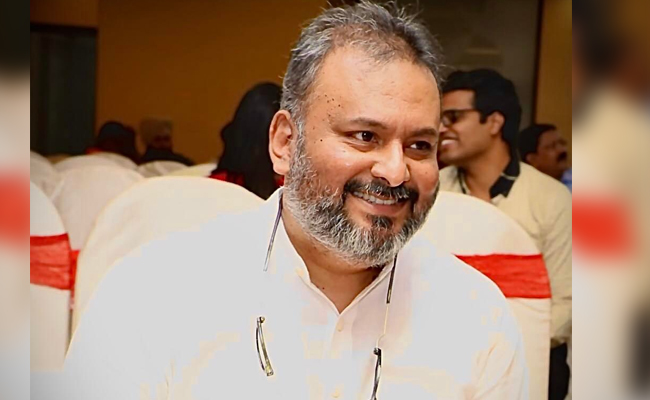
Chennai: Journalist and political commentator Sujit Nair has expressed concern over speculation that the Dravida Munnetra Kazhagam and the All India Anna Dravida Munnetra Kazhagam could explore a post-poll understanding to prevent Vijay-led Tamilaga Vettri Kazhagam from forming the government in Tamil Nadu.
In a social media post, Sujit Nair said the election verdict in Tamil Nadu reflected a clear public demand for political change and argued that the mandate should be respected irrespective of political preferences.
Referring to reports and political discussions surrounding a possible understanding between the DMK and AIADMK, he said he hoped such developments remained only speculative conversations and did not turn into reality.
Nair stated that if such an alliance were to take shape, it would raise serious questions about ideological politics in the country. He said TVK had emerged through a democratic electoral process and that the legitimacy to govern in a parliamentary democracy comes from the people’s verdict.
According to him, attempts to prevent an electoral winner from forming the government through unexpected political arrangements may be constitutionally valid, but many people could view them as politically opportunistic.
He further said that such a move could particularly affect the political image of the DMK, which has historically projected itself around ideology, social justice and opposition politics. Nair said that in ideological terms, the DMK appeared closer to TVK than to the AIADMK, and joining hands with its long-time political rival only to remain in power could weaken its broader political narrative.
He added that the same questions would apply to the AIADMK as well, as the party had spent decades positioning itself against the DMK and such an arrangement could create discomfort among its cadre and supporters.
Drawing a comparison with Maharashtra politics in 2019, Nair said he had expressed similar views when the Shiv Sena formed an alliance with the Indian National Congress and the Nationalist Congress Party after the Assembly elections.
He said post-poll alliances between long-standing political rivals often create a public perception that ideology and electoral mandates become secondary when political power equations come into play.
Nair also said such developments increase public cynicism towards politics and reinforce the belief among voters that ideology is often sidelined after elections.
He maintained that the Tamil Nadu verdict was emphatic and said respecting both the spirit and substance of the mandate was important for the credibility of democratic politics.