Delhi HC directs Facebook, Google, Twitter to globally remove links to defamatory video on Ramdev
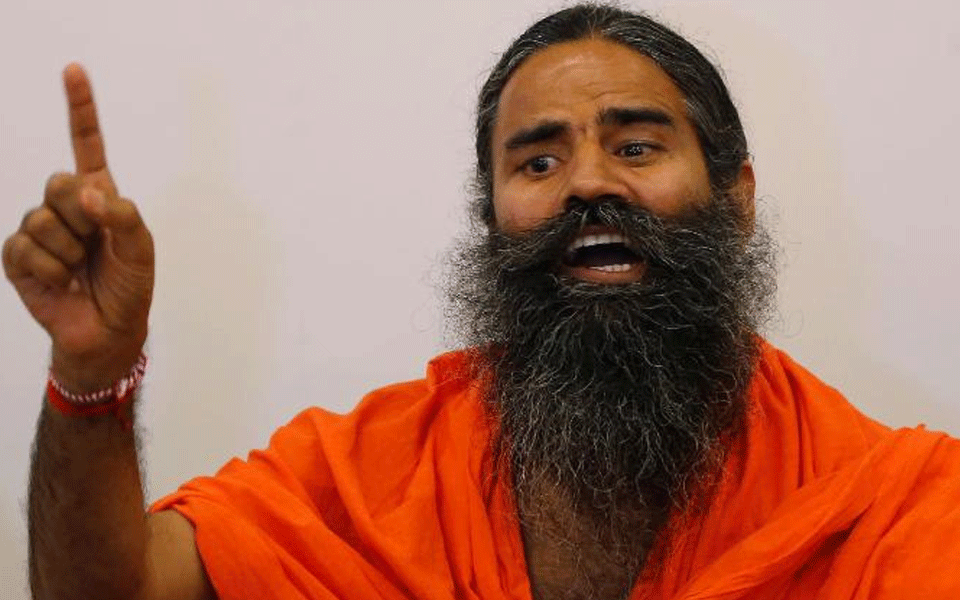
New Delhi, Oct 23: The Delhi High Court on Wednesday directed social media platforms Facebook, Google, its subsidiary YouTube, and Twitter to forthwith remove, block or disable on a global basis links to a video containing defamatory allegations against yoga guru Ramdev.
Justice Pratibha M Singh held that merely 'geo-blocking' or disabling access to the defamatory content to viewers from India, as agreed to by the social media platforms, would not be sufficient as users residing here can gain access to it by other means.
"There is an obligation upon the intermediary (social media platforms) to disable access, which would have to be read as meaning to completely disable access and not partially disable access," the court said.
Observing that "the race between technology and the law could be termed as a hare and tortoise race - as technology gallops, the law tries to keep pace,'' the court said the provisions of the Information Technology law have to be interpreted in a manner so as to ensure judicial orders are effective and "not toothless".
It said that the removal or disabling of access under section 79(3)(b) of the IT Act does not mean removal or disabling access only to users located in India.
"The removal or disabling is linked with 'that resource' and not with the location of the user or viewer. Thus, geo-blocking as is being suggested by the platforms would not be in consonance with section 79 or with the purport and intent of the Supreme Court in the judgement of Shreya Singhal," it said in its 76-page judgement.
The court directed the social media platforms that all the offending material which has been uploaded from within India on to the computer network of the platforms "would have to be disabled and blocked on a global basis".
"Since the unlawful act in case of content uploaded from India is committed from within India, a global injunction shall operate in respect of such content. In case of uploads which take place from outside India, the unlawful act would be the dissemination of such content in India, and thus in those cases the platforms may resort to geo-blocking," it said.
It further said, "The defendants (social media platforms) are directed to take down, remove block, restrict/disable access, on a global basis, to all such videos/ weblinks/URLs in the list annexed to the plaint, which have been uploaded from IP addresses within India.
"Insofar as the URLs/links in the list annexed to the plaint which were uploaded from outside India are concerned, the defendants are directed to block access and disable them from being viewed in the Indian domain and ensure that users in India are unable to access the same."
The court issued the direction after the social media platforms said that while they have no objection to blocking the URLs and disabling the same, insofar as access in India is concerned, they were opposed to removal/blocking/disabling the defamatory content on a global basis.
The defamatory video contained excerpts of a book on Ramdev that were ordered to be deleted by the high court in September last year.
The high court had on September 29, 2018 restrained the publisher and author of the book "Godman from Tycoon" from publishing it till the offending portions were deleted, the judge noted.
In the judgement, Justice Singh noted that viewing the video or reading its transcript give an impression that Ramdev "has been involved in various murders, financial irregularities, misuse of animal parts, etc".
"Thus, the content of the video to the extent it contains paraphrasing of content which was directed to be removed from the book is held to be defamatory. A perusal of the video transcript and the offending portion of the book show the clear similarity and prima facie, establish that the video is derived from the book and hence is defamatory.
"In any event, this issue is moot inasmuch as the video begins by stating that it is based on the book. Thus, the defamatory nature of the video cannot be disputed," the court said.
Let the Truth be known. If you read VB and like VB, please be a VB Supporter and Help us deliver the Truth to one and all.
4 workers die after being buried under coal slurry in Jharkhand's Dhanbad

Dhanbad (Jharkhand) (PTI): At least four workers died after being buried under coal slurry in Jharkhand's Dhanbad district on Saturday, a police official said.
The incident took place at Moonidih coal washery in the command area of Bharat Coking Coal Limited (BCCL).
"Bodies of all four workers were dug out of debris during a rescue operation," Putki police station in-charge Waqar Hussain told PTI.
The incident took place when coal slurry was being loaded into trucks by workers, during which a large chunk of slurry fell and trapped several workers underneath, officials said.
The deceased have been identified as Manik Bauri, Dinesh Bauri, Deepak Bauri, and Hemlal Gope.
Meanwhile, the family members of the deceased and local villagers placed the bodies in front of the washery gate and began a protest.
They demanded compensation, jobs for dependents and action against those responsible for the incident.
Police and administration officials are trying to pacify the protesters, an official said.