Delhi HC dismisses minister Satyendar Jain's plea challenging transfer of money laundering case
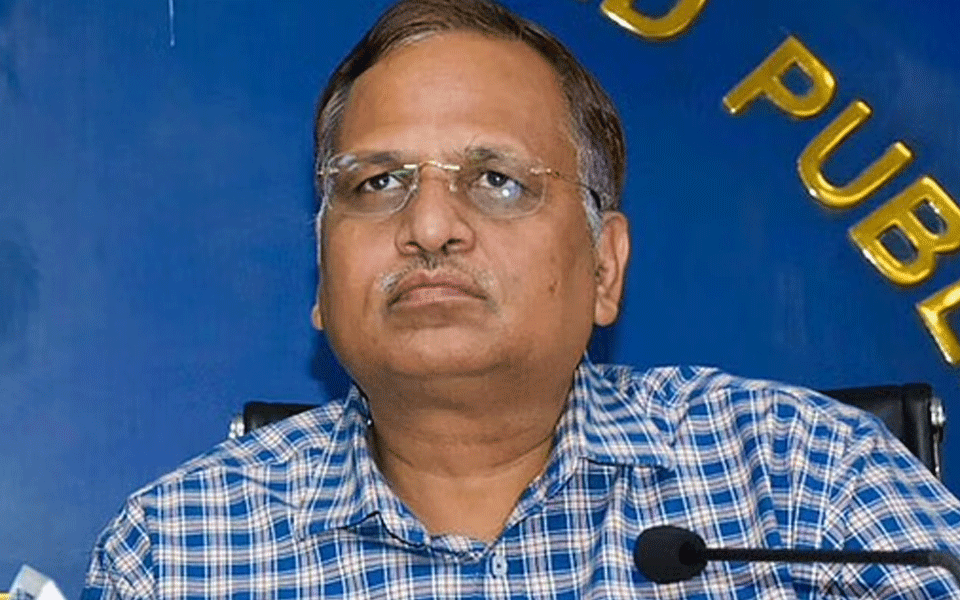
New Delhi(PTI): The Delhi High Court on Saturday dismissed a plea by minister Satyendar Jain challenging a lower court order to transfer the money laundering case against him to another court.
Justice Yogesh Khanna said all facts were duly considered by the Principal District and Sessions Judge while transferring the case, which is being probed by the Enforcement Directorate (ED), and it cannot be held that the decision suffered from any illegality or needed interference.
The judge noted that in view of certain circumstances, the ED had an apprehension that justice may not be done and was of the opnion that such an apprehension was to be seen from the the party's point of view and not that of the judge.
"The question is not of integrity or uprightness of the judge but is of an apprehension in the mind of a party," it said.
The court also said the apprehensions raised by the agency were not at a "belated stage" and "the facts show that the department did not merely harbour such apprehension but rather had acted upon it by rushing to this court (at an earlier occasion) ... hence it cannot be said to be flimsy or not reasonable".
"The petition is, therefore, dismissed," the court said in its order.
Jain had moved the high court last month challenging the September 23 order of Principal District and Sessions Judge Vinay Kumar Gupta transferring the money laundering case to Special Judge Vikas Dhull from Special Judge Geetanjali Goel, who was hearing his bail plea.
The district judge's order was passed on an application for transfer moved by the investigating agency.
The agency, in its transfer application before the district judge, had argued that while there was no complaint against the judge hearing the matter, it was "a case of probable bias" in favour of the Delhi minister and there was an apprehension that it might not get an independent and impartial hearing.
The AAP leader argued before the high court that the ED cannot be allowed to brow beat a judge and seek transfer of the money laundering case citing "bias" without any basis.
Senior advocate Kapil Sibal, appearing for Jain, contended that not interfering with the ED's conduct would bring anarchy and asserted that bias suddenly dawned on the agency after the special court judge did not agree at that stage with its request for constituting an independent board for Jain's medical examination.
Additional Solicitor General SV Raju, appearing for the ED, argued that the district court order warrants no interference as in spite of sufficiently demonstrating that the jail officials as well as doctors of Lok Nayak Jai Prakash Narayan Hospital were managed and were assisting the minister in feigning sickness for the purpose of granting interim bail, and the special judge looked the other way .
He, however, clarified that the agency was not casting any aspersions on the judge as it was nobody's case that bias has been proved .
The senior lawyer stated the transfer was sought after a cumulative assessment and justice should not only be done but also seem to have been done.
The ED had arrested Jain and two others in the money laundering case based on a Central Bureau of Investigation (CBI) FIR lodged against the AAP leader in 2017 under the Prevention of Corruption Act.
Jain is accused of having laundered money through four companies linked to him.
Let the Truth be known. If you read VB and like VB, please be a VB Supporter and Help us deliver the Truth to one and all.
Sujit Nair raises concerns over speculation of DMK-AIADMK understanding to block TVK
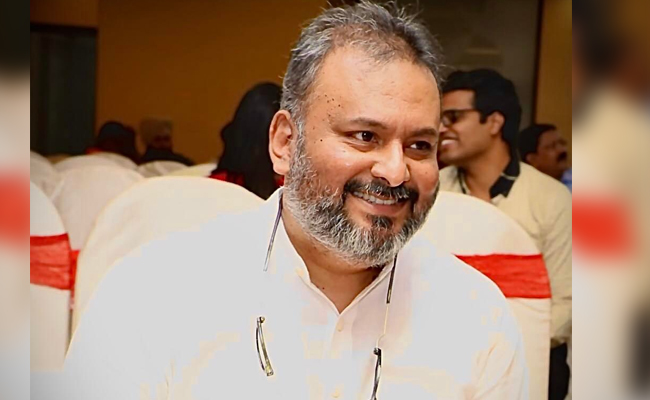
Chennai: Journalist and political commentator Sujit Nair has expressed concern over speculation that the Dravida Munnetra Kazhagam and the All India Anna Dravida Munnetra Kazhagam could explore a post-poll understanding to prevent Vijay-led Tamilaga Vettri Kazhagam from forming the government in Tamil Nadu.
In a social media post, Sujit Nair said the election verdict in Tamil Nadu reflected a clear public demand for political change and argued that the mandate should be respected irrespective of political preferences.
Referring to reports and political discussions surrounding a possible understanding between the DMK and AIADMK, he said he hoped such developments remained only speculative conversations and did not turn into reality.
Nair stated that if such an alliance were to take shape, it would raise serious questions about ideological politics in the country. He said TVK had emerged through a democratic electoral process and that the legitimacy to govern in a parliamentary democracy comes from the people’s verdict.
According to him, attempts to prevent an electoral winner from forming the government through unexpected political arrangements may be constitutionally valid, but many people could view them as politically opportunistic.
He further said that such a move could particularly affect the political image of the DMK, which has historically projected itself around ideology, social justice and opposition politics. Nair said that in ideological terms, the DMK appeared closer to TVK than to the AIADMK, and joining hands with its long-time political rival only to remain in power could weaken its broader political narrative.
He added that the same questions would apply to the AIADMK as well, as the party had spent decades positioning itself against the DMK and such an arrangement could create discomfort among its cadre and supporters.
Drawing a comparison with Maharashtra politics in 2019, Nair said he had expressed similar views when the Shiv Sena formed an alliance with the Indian National Congress and the Nationalist Congress Party after the Assembly elections.
He said post-poll alliances between long-standing political rivals often create a public perception that ideology and electoral mandates become secondary when political power equations come into play.
Nair also said such developments increase public cynicism towards politics and reinforce the belief among voters that ideology is often sidelined after elections.
He maintained that the Tamil Nadu verdict was emphatic and said respecting both the spirit and substance of the mandate was important for the credibility of democratic politics.