Delhi municipal bypolls: AAP wins 4 wards, Congress 1

New Delhi: The AAP won four out of five wards and the Congress one in the municipal bypolls in Delhi, results of which were announced on Wednesday.
The BJP, which had held one of these wards, failed to open its account in the bypolls. More than 50 per cent voters cast their votes in the municipal corporation bypolls in the five wards on Sunday.
Congress candidate Chaudhary Zubair Ahmad defeated AAP candidate Mohammad Ishraq Khan by 10,642 votes in Chauhan Bangar ward.
The AAP candidates won from Kalyanpuri, Rohin-C, Trilokpuri and Shalimar Bagh North wards.
Deputy Chief Minister Manish Sisodia in a tweet congratulated the party workers for the victory and said people were fed up with the BJP and would bring in Chief Minister Arvind Kejriwal's politics of honesty and work in the municipal corporation of Delhi (MCD) polls next year.
The BJP had retained all three municipal corporations in Delhi in the 2017 civic polls with the AAP finishing a distant second.
AAP candidate Dhirender Kumar won the Kalyanpuri ward by 7,043 votes. AAP's Vijay Kumar defeated BJP's Om Prakash by a margin of 4,986 votes in Trilokpuri.
AAP's Sunita Mishra defeated Surbhi Jaju of the BJP in Shalimar Bagh ward by 2,705 votes. The seat was earlier held by the BJP.
Ram Chander of the AAP defeated BJP candidate Rakesh Goyal by 2,985 votes in Rohini C ward.
Let the Truth be known. If you read VB and like VB, please be a VB Supporter and Help us deliver the Truth to one and all.
Bengaluru airport introduces AI-based system to enhance safety at vehicle-aircraft intersections
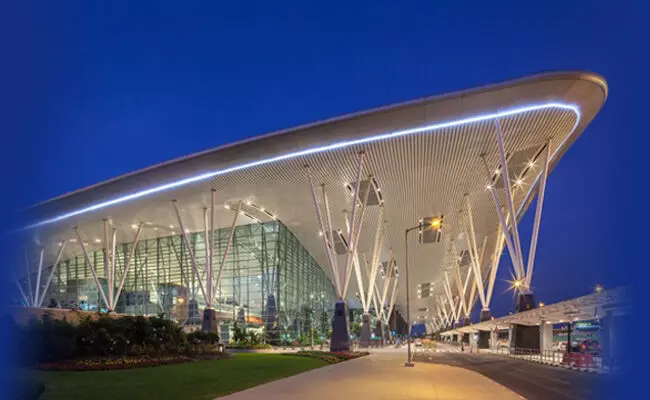
Bengaluru: Bangalore International Airport Limited (BIAL) has introduced an integrated smart airside safety system at Kempegowda International Airport to improve operational safety at key intersection zones.
According to The Hindu, the system has been designed to enhance safety at Cross Service Roads (CSRs), where aircraft and ground vehicle movements intersect.
According to BIAL, the system integrates AI-based computer vision, automation, and centralised monitoring to manage right-of-way movements and reduce the risk of human error.
“CRSs are among the most sensitive areas within airport operations, requiring precise and seamless coordination between aircraft and ground vehicles. Traditionally, right of way protection at these intersections relied on manual or semi-manual inset light activation, creating dependencies on human intervention, increasing the risk of delays and limiting operational visibility,” TH quoted BIAL as saying.
The new system uses real-time detection of vehicle movement, risk assessment, and automated signalling. AI-enabled cameras identify potential conflicts and trigger automated inset light signals to ensure aircraft priority. Normal operations resume once the area is confirmed clear.
“Based on these detections, the system triggers automated inset light activation to protect aircraft right‑of‑way and restores normal signalling once the intersection is confirmed clear. A centralised monitoring and analytics platform digitally logs all events, strengthening governance, compliance, and operational control,” BIAL said.
By embedding technology into operations, the system creates a data-driven separation layer between aircraft and ground vehicles, significantly reducing human error, especially during night and low-visibility conditions.
“Precision-led signal activation improves traffic flow, minimises unnecessary stoppage and enhances turnaround efficiency. It also establishes a scalable foundation for predictive safety analytics, enabling trend analysis, peak-hour optimisation, compliance mapping and risk forecasting to support continuous improvement and stronger airside governance,” BIAL said.