Delhi plans to induce artificial rain to control air pollution, says environment minister
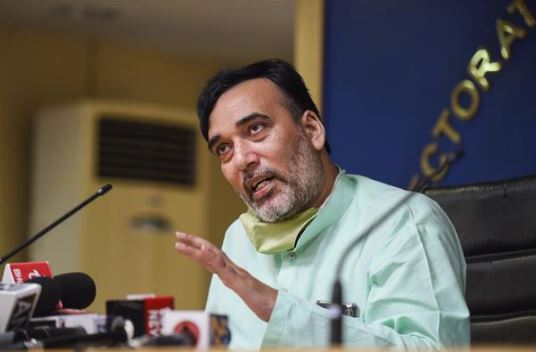
New Delhi, Nov 8: The Delhi government plans to induce artificial rain through cloud seeding this month to combat air pollution in the national capital, Environment Minister Gopal Rai said on Wednesday.
Rai held a meeting with scientists from IIT-Kanpur who explained that cloud seeding can only be attempted when there are clouds or moisture in the atmosphere.
"Experts anticipate that such conditions could develop around November 20-21. We have asked the scientists to prepare a proposal by Thursday that will be submitted to the Supreme Court," the minister told reporters.
Rai emphasised that obtaining the necessary clearances and permissions for using this technology from both the central and the state governments is a time-sensitive matter.
The IIT-Kanpur scientists, who have conducted research on artificial rain, delivered a presentation to the minister on September 12.
India Meteorological Department Director General Mrutyunjay Mohapatra told PTI that inducing artificial rain can only be attempted when there are clouds or moisture available.
"There have been a few attempts in India in this regard -- in Telangana, Tamil Nadu and Karnataka. Globally, research is being conducted on artificial rain ... the basic requirement is clouds or moisture. In India, research on artificial rain is ongoing but it has not made significant progress so far," he said.
Cloud seeding involves dispersing substances into the air to encourage condensation, resulting in precipitation. The most common substances used for cloud seeding include silver iodide, potassium iodide and dry ice (solid carbon dioxide). These agents provide the nuclei around which water vapour can condense, ultimately leading to the formation of rain or snow.
This weather modification technique has been utilised in various parts of the world, primarily in regions experiencing water scarcity or drought conditions.
Some of the countries and states that have employed the cloud seeding technology include the US, China, Australia, and the UAE.
However, the effectiveness and environmental impact of cloud seeding remain subjects of ongoing research and discussion.
Unfavourable meteorological conditions, combined with vehicular emission, paddy straw burning, lighting firecrackers and other local pollution sources contribute to hazardous air quality levels in Delhi-NCR every winter.
According to a Delhi Pollution Control Committee analysis, the national capital experiences peak pollution from November 1 to 15 when cases of stubble burning increases in Punjab and Haryana.
Air quality in Delhi-NCR declined over the last two weeks due to a gradual drop in temperatures, calm winds that trap pollution and a surge in paddy straw burning.
Delhi's air quality ranks among the worst in the world's capital cities.
A report by the Energy Policy Institute at the University of Chicago in August said air pollution is shortening lives in Delhi by almost 12 years.
Let the Truth be known. If you read VB and like VB, please be a VB Supporter and Help us deliver the Truth to one and all.
Rickelton's ton in vain as SRH beat MI by 6 wickets

Mumbai (PTI): Ryan Rickelton's whirlwind unbeaten ton was overshadowed by Heinrich Klaasen's unbeaten 65 as Sunrisers Hyderabad defeated Mumbai Indians by six wickets in an IPL match here on Wednesday.
Chasing an imposing 244-run target, Travis Head (76 off 30) and Abhishek Sharma (45 off 24) shared 129 runs for the opening wicket to set the platform for SRH.
Klaasen (65 not out off 30 balls) then displayed his all-round hitting abilities to guide SRH home with the help of Nitish Kumar Reddy (21) and Salil Arora (30 not out off 10) in 18.4 overs.
Earlier, Rickelton's knock powered MI to 243 for five.
MI rode on a 93-run stand between Rickelton (123 not out off 55 balls) and Will Jacks (46 off 22) in 7.1 overs for the opening stand to power the side.
MI skipper Hardik Pandya scored a valuable 31 off 15 balls before being dismissed.
Praful Hinge (2/54), Eshan Malinga (1/29), Sakib Hasan (1/39) and Nitish Kumar Reddy (1/31) were the wicket-takers for SRH.
Brief Scores:
Mumbai Indian: 243 for 5 in 20 overs (Ryan Rickelton 123 not out; Praful Hinge 2/54).
Sunrisers Hyderabad: 249 for 4 in 18.4 overs (Travis Head 76, Heinrich Klaasen 65 not out; AM Ghazanfar 2/51).