Delhi Police arrests two teens for stabbing man during altercation over breaking queue

New Delhi (PTI): Two teenagers have been arrested for allegedly stabbing a 22-year-old man during an altercation over breaking a queue at a gurudwara in northwest Delhi’s Shalimar Bagh, police said on Wednesday.
The incident took place on Monday, around 8.30 pm, when Rajeev was standing in a queue to collect milk at a gurdwara in Singalpur, an official said.
According to the complainant, the accused, Sumit Barman and Anuj Thakur – both aged 18 – attempted to break the queue, leading to a scuffle.
During the scuffle, Anuj allegedly restrained the victim from behind while Sumit stabbed him in the chest with a knife, police said.
The accused also assaulted Rajeev’s friend Arvind, who tried to intervene, before fleeing the spot, they added.
Upon receiving a PCR call, a police team reached the spot and rushed the injured to Lok Nayak Jai Prakash (LNJP) Hospital, where his statement was recorded, police said.
A case under Bharatiya Nyaya Sanhita sections 109(1) (attempt to murder) and 3(5) (joint liability) was registered on Tuesday, and an investigation was initiated, the officer said.
Local intelligence inputs and raids at suspected hideouts led to the arrest of the two accused, police said, adding that during interrogation they confessed to their involvement.
Based on Sumit’s confession, the knife used in the crime was recovered, police said.
They said both the accused were first-time offenders, and further investigation is underway.
Let the Truth be known. If you read VB and like VB, please be a VB Supporter and Help us deliver the Truth to one and all.
Kerala polls: ‘People rejected 10 years of misrule’, says AICC gen secy
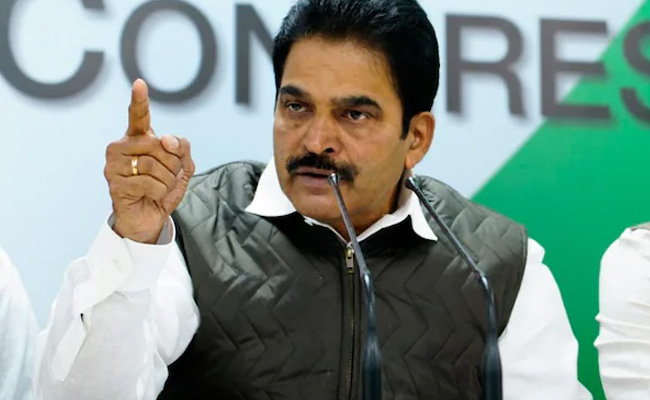
Thiruvananthapuram (PTI): AICC General Secretary K C Venugopal on Monday said the Congress-led UDF’s sweeping victory in the Kerala Assembly polls was a clear verdict against the “arrogance”, corruption, and nepotism of the CPI(M)-led LDF government headed by CM Pinarayi Vijayan.
Addressing a press conference as counting of votes for all 140 Assembly constituencies neared completion, Venugopal said the outcome reflected public anger against what he termed “10 years of misrule” by the Left government.
He claimed that Vijayan’s victory in his home constituency, Dharmadam, was “only technical”, alleging that the CM trailed the UDF candidate in the initial rounds of counting and failed to secure a majority in his own village.
“He just escaped. He suffered a setback even in his home turf. He was the only person who did not realise the people’s mood in this election,” Venugopal said.
Alleging that the CPI(M) and the LDF had resorted to “communal and opportunistic politics”, he further claimed that the ruling front had entered into a “secret understanding” with the BJP in a bid to retain power for a third consecutive term.
He said that when a government driven by power and arrogance attempts to align with anyone to stay in office, even its own cadre turns against it.
Referring to the results, Venugopal said that while the UDF expected rebel CPI(M) leaders, including K Kunhikrishnan in Payyannur, to impact the vote share, their victories came as a surprise.
Describing the UDF’s performance as a “historic victory”, he attributed it to coordinated teamwork, grassroots mobilisation, and the dedication of party workers, adding that the alliance accepted the mandate “with humility”.
Venugopal also credited Rahul Gandhi’s campaign guarantees, calling them a “trump card” that helped voters focus on real issues and reject what he described as the LDF’s “false narratives”.
He claimed that the Congress witnessed one of its lowest levels of rebellion in this election, which contributed to the alliance’s strong performance.
The senior Congress leader further alleged that the BJP managed to win two seats with the help of the CPI(M), and asserted that forces attempting to divide society on communal lines should “learn a lesson” from Kerala’s verdict.
“This is the real Kerala story,” he said.
On the question of the next Chief Minister, Venugopal said the party leadership would decide at the earliest after due consultations.
The counting of votes began on Monday morning for all 140 Assembly constituencies in Kerala, where the Congress-led UDF secured a decisive majority, defeating the CPI(M)-led LDF, which was seeking an unprecedented third consecutive term in office.
Congress MP Rahul Gandhi (@RahulGandhi) posts, "Thank you to my brothers and sisters in Keralam for a truly decisive mandate. Congratulations to every UDF leader and worker for a hard-fought, well-run campaign. As I said before, Keralam has the talent, Keralam has the potential… pic.twitter.com/6T4IZbEmp4
— Press Trust of India (@PTI_News) May 4, 2026