Delhi pollution: More areas in 'severe' category
fines of Rs 5.85 cr imposed as restrictions tightened
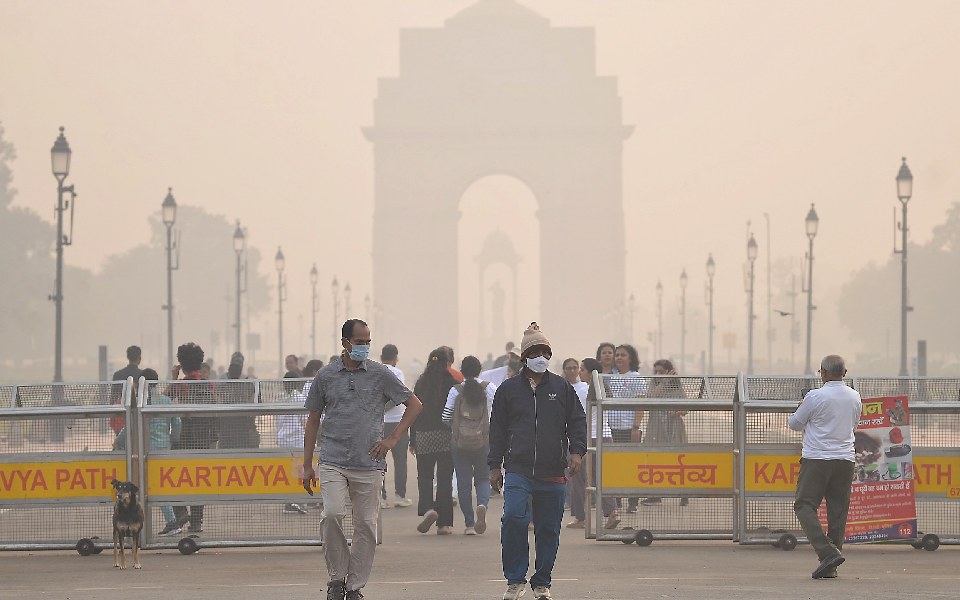
New Delhi, Nov 16: Delhi's air quality worsened further on Saturday, with many areas in the "severe" category, even as authorities intensified their action by imposing penalties of around Rs 5.85 crore on the first day of anti-pollution measures under the third stage of Graded Response Action Plan (GRAP).
The city's 24-hour Air Quality Index (AQI), recorded at 4 pm daily, stood at 417, making it the worst in the country. On Friday, the AQI level was 396.
According to the Central Pollution Control Board (CPCB), the "severe" category air poses risks to healthy individuals and severely impacts those with existing health conditions.
Out of Delhi's 39 monitoring stations, data shared by the CPCB showed that all except for Sri Aurobindo Marg reported air quality in the "severe" category, with AQI levels above 400.
An AQI between 0 and 50 is considered 'good', 51 and 100 'satisfactory', 101 and 200 'moderate', 201 and 300 'poor', 301 and 400 'very poor', 401 and 450 'severe' and above 450 'severe plus'.
As the restrictions under the third stage of GRAP came into force on Friday, authorities intensified action against those violating norms with teams of traffic police, transport department and others penalising violators.
On Friday, Delhi Traffic Police issued around 550 challans for violation of a ban on the plying of BS III petrol and BS IV diesel vehicles, imposing fines of over Rs 1 crore on the first day of restrictions under the third stage of GRAP.
Violation of this rule invites a penalty of Rs 20,000. Diesel and petrol inter-state buses, except for BS VI diesel, from the NCR cities to Delhi are also banned.
The police also cracked down on vehicles not having Pollution Under Control Certificates (PUCC), as it issued fines to 4,855 vehicles totalling Rs 4.85 crore on Friday.
A fine of Rs 10,000 is imposed on motorists for not having a valid pollution under control (PUC) certificate. These challans get released from courts.
During an inspection of buses at Kashmiri Gate inter-state bus terminal on Saturday, Delhi Environment Minister Gopal Rai alleged that BJP-ruled neighbouring states were exacerbating air pollution in the capital by sending BS-IV diesel buses despite a ban.
"The BJP governments are deliberately sending diesel buses to Delhi, which is prohibited under the current guidelines, to worsen air pollution," said Rai pointing to states like Haryana, Uttar Pradesh, and Rajasthan.
As part of efforts to combat pollution, Rai announced that a total of 84 enforcement teams from the Transport Department and 280 teams from the Traffic Police have been mobilised to ensure strict adherence to the ban.
Additionally, there is a stringent ban on construction and demolition activities, suspension of mining-related activities, and daily water sprinkling on major roads. City schools for classes up to 5 will shift to online mode after the weekend.
The GRAP for Delhi-NCR is divided into four stages of air quality: Stage 1 for "poor" air quality (AQI ranging from 201 to 300), Stage 2 for "very poor" air quality (AQI from 301 to 400), Stage 3 for "severe" air quality (AQI from 401 to 450), and Stage 4 for "severe plus" air quality (AQI above 450).
The air quality in neighbouring Haryana was no better, with Jind recording the second-worst AQI in the country with a reading of 394, while Bahadurgarh ranked third with a reading of 388. The Haryana government Saturday authorised deputy commissioners to discontinue physical classes for up to Class 5 in schools in their respective districts after assessing the prevailing situation in the wake of rising pollution.
Meanwhile, old age homes across Delhi are intensifying measures to protect the elderly which include strict restrictions on outdoor activities during peak pollution hours, mandatory mask use, and oxygen cylinders on standby for emergencies.
General Bhupendra Singh, Chairman of Aashirwad Old Age Home, said, "We do not allow anyone to step outside the premises due to the toxic air quality. The elderly, being the worst affected group, are strictly prohibited from venturing out during peak pollution hours, especially in the morning and evening."
"If they must go out for medical appointments, they are instructed to minimise outdoor time and wear masks for protection," he added.
Rajeshwari, a caregiver at the Sai Sahara old age home highlighted the additional precautions being taken.
"We are focusing on maintaining a healthy diet for the residents and have restricted outdoor activities, including morning walks, due to the severe air quality," she said.
According to the Centre's Decision Support System for Air Quality Management, stubble burning was the main contributor to Delhi's air pollution on Thursday, accounting for 37 per cent of the total pollution.
Vehicular emissions contributed approximately 12 per cent to the overall pollution, it said.
Meanwhile, the prominent pollutant was PM2.5, according to the CPCB.
PM2.5 refers to fine particles with a diameter of 2.5 micrometres or less, about the width of a human hair.
These particles are so small that they can penetrate deep into the lungs and even enter the bloodstream, posing significant health risks.
Let the Truth be known. If you read VB and like VB, please be a VB Supporter and Help us deliver the Truth to one and all.
Marxism will remain relevant despite Left electoral's losses, says general secretary M A Baby
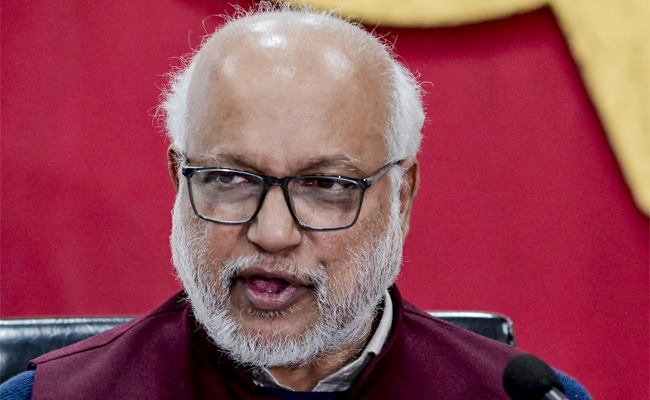
New Delhi (PTI): CPI(M) General Secretary M A Baby on Thursday asserted that the Left movement would remain relevant despite not being in power in any state, saying the ideology would continue to endure as long as social and economic inequalities persist.
Hitting back at BJP leader Rajeev Chandrasekhar over his reported remarks that Marxism had become irrelevant, Baby, in an interview with PTI Videos, said, "So long as there is division in society, so long as there is exploitation of the majority of workers, peasants and ordinary masses by a handful of billionaires, Marxism will remain relevant."
"That perhaps Mr Rajeev Chandrasekhar may not be able to understand, but this is the fact of the matter," he said.
Baby acknowledged that the CPI(M)-led Left was currently without an elected government in any state, but maintained that electoral setbacks would not diminish the movement's role.
"We may not have an elected government in any state. There were occasions when we didn't have a government. But the red flag and the commitment to organise and struggle for the rights of the dispossessed, marginalised and exploited will always be upheld by CPI(M) and the Left movement," he said.
He said the Left continued to enjoy support among workers, peasants, agricultural labourers, youth, students and women, and argued that the movement remained necessary because "oppression and assault" continued in society.
"So long as such problems exist in society, the red flag and the working class movement will continue to work among the masses," the Left leader said.
Exuding confidence on the Left's revival, Baby said the party would reflect on the reasons behind its electoral loss.
"We may be rejected in one election, but we will stage our comeback by understanding what went wrong with us," he said, adding, "We will listen to people and we will come back with higher strength."
Baby also criticised the Congress over reported factional tensions in Kerala after the Congress-led United Democratic Front's victory in the state.
"The way they are behaving is being watched by the people of Kerala," he said, referring to infighting within the Congress.
"Those who have given a massive majority to Congress and UDF would be watching all this," he added, while urging party leaders to "settle the problem in an amicable, democratic manner".
Referring to West Bengal, Baby alleged that violence had escalated following the BJP's victory in the state assembly polls.
"It is quite unfortunate that the moment BJP snatched a massive victory in West Bengal, violence has also started on a big scale," he said.
He also accused the Trinamool Congress of being "notorious for violent activities" and alleged that the "RSS-controlled BJP" had "unleashed violence in many places" after the election results.
"This is not good for Bengal, not good for the country. We wish and hope that normalcy would be restored as soon as possible," he said.
Baby said the CPI(M) and the Left in West Bengal would continue efforts to "pacify people" and avoid violence and confrontation.
Asked about former Kerala chief minister Pinarayi Vijayan not reacting publicly to the election results, Baby said Vijayan would respond "at an appropriate time".