Delhi records worst air quality of year after Diwali due to rampant bursting of crackers: Officials
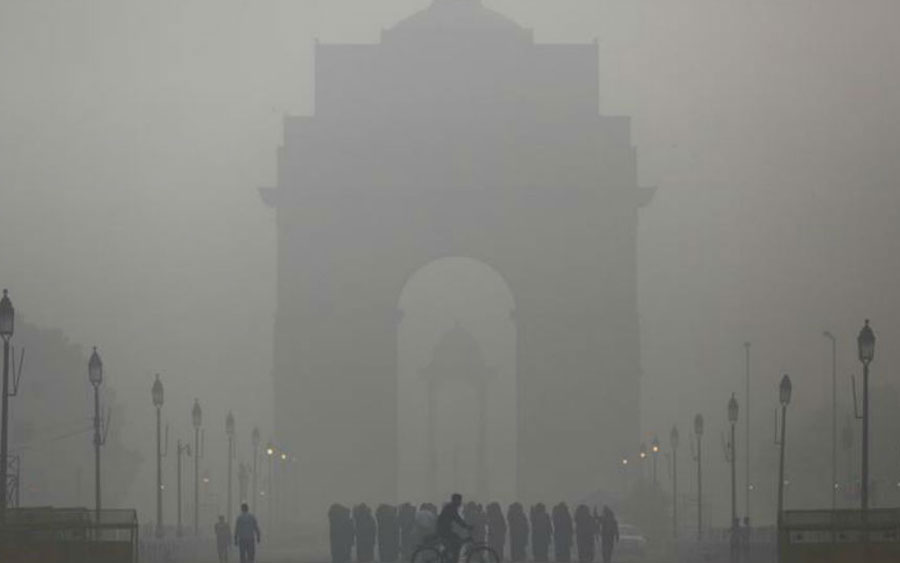
New Delhi, Nov 8: Delhi recorded its worst air quality of the year the morning after Diwali as the pollution level entered "severe-plus emergency" category due to rampant bursting of toxic firecrackers, authorities said on Thursday.
In a gross violation of a Supreme Court order, people in several cities burst firecrackers until at least midnight, two hours after the 10 PM deadline. Loud bangs rent the air in New Delhi. Violations were also recorded in Mumbai, Kolkata, Jaipur and other major cities.
Partly as a result of smoke from the firecrackers, the overall air quality index in Delhi jumped to 574 which falls in the "severe-plus emergency" category, according to data by the Centre-run SAFAR (System of Air Quality and Weather Forecasting And Research).
The sharp spike in pollution is caused by rampant burning of firecrackers that has led to the formation of a smoky layer across the national capital and drastically reduced visibility, the authorities said.
The SAFAR had warned that even if partial toxic firecrackers as compare to last year were burnt, then the air quality would fall in the severe category.
An AQI between 0 and 50 is considered "good", 51 and 100 "satisfactory", 101 and 200 "moderate", 201 and 300 "poor", 301 and 400 "very poor", and 401 and 500 "severe". Above 500 is "severe-plus emergency" category.
The Delhi Air Quality Index is around 574 at present. Air Quality Index entered in severe category at 2 AM after midnight on Thursday and will continue to remain in severe category until evening, a senior official said.
A 'severe plus emergency' air quality index (AQI) essentially means that even healthy people may suffer from respiratory illnesses on a prolonged exposure to such air. This air will seriously affect those with ailments, according to the advisory issued by SAFAR.
The Supreme Court has allowed people to burst firecrackers from 8 PM to 10 PM only on Diwali and other festivals. The Supreme Court also allowed manufacture and sale of just "green crackers" which have low emission of light, sound and harmful chemicals.
The court said the police should ensure that there is no sale of banned firecrackers and in case of any violation, the Station House Officer (SHO) of the police station of the area would be held personally liable and this would amount to committing contempt of the court.
But despite the Supreme Court's order, certain places recorded violations where firecrackers were burnt before and after the set timeframe.
The areas where the violations were recorded included Mayur Vihar Extension, Lajpat Nagar, Lutyens' Delhi, IP extension, Dwarka and Noida Sector 78.
The police admitted that violations have been observed and it would take serious legal action against the people violating the Supreme Court order. They said they were continuously patrolling the areas to check for violations.
Let the Truth be known. If you read VB and like VB, please be a VB Supporter and Help us deliver the Truth to one and all.
Himachal: Three killed, two injured as speeding car dashes against parked truck
Mandi (HP) (PTI): Three people were killed and two others sustained grievous injuries after a speeding car dashed against a stationary truck at Dadour near Nerchowk in Mandi district on Monday late at night, police said on Tuesday.
There were five people in the car when the tragedy struck. Three were declared dead in the hospital while two have been referred to AIIMS Bilaspur.
The deceased were identified as Anil Kumar (28), Rohit Kumar (26) and Subash Kumar (23), all residents of Mandi district, while the injured are Harish and Pankaj.
A case has been registered under relevant sections and investigations are underway, said Superintendent of Police (SP) Mandi Vinod Kumar.
He added that the bodies have been handed over to the family members of the deceased.
In a statement, Chief Minister Sukhvinder Singh Sukhu expressed grief over the loss of three lives in a road accident. He directed the district administration to ensure best possible treatment for the injured and wished them a speedy recovery.