Delhi riots: Court rejects Pinjra Tod activist Devangana Kalita's bail plea in UAPA case
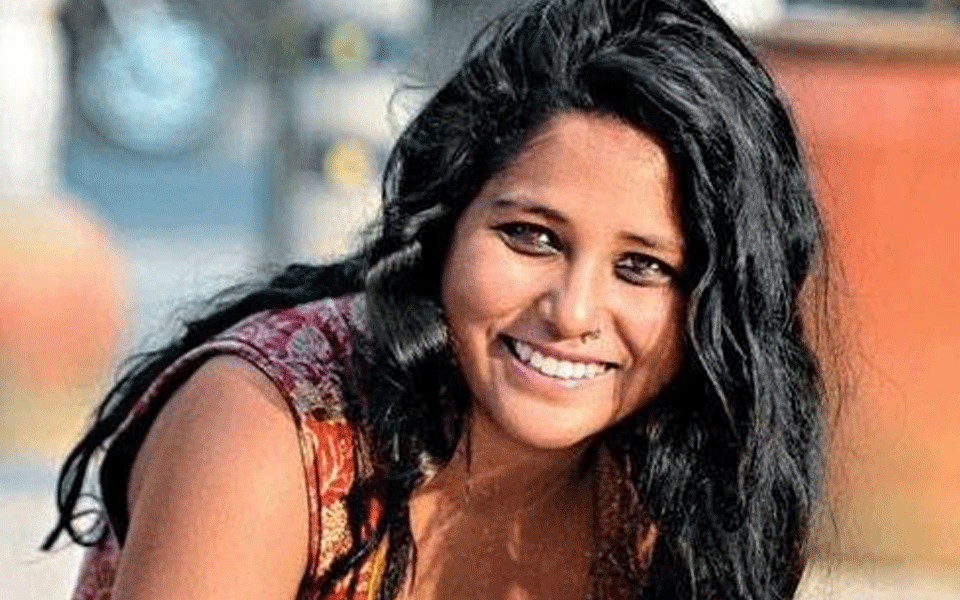
New Delhi: A court here has rejected the bail plea of Jawaharlal Nehru University (JNU) student and Pinjra Tod member Devangana Kalita, booked under the stringent Unlawful Activities (Prevention) Act (UAPA) in a northeast Delhi riots case, saying the allegations against her are prima facie and provisions of the anti-terror law have been rightly invoked in the case.
The court said the pre-planned vociferous agitation in the name of protesting against the Citizenship (Amendment) Bill, coupled with other resultant activities of confrontation and violence leading to riots, would show that it was meant to cause or intended to cause disaffection against India.
Additional Sessions Judge Amitabh Rawat said in a case of conspiracy of such a large scale, not having a video clip was not so vital as generally, a conspiracy, by its very nature, is hatched in secrecy and not having video clips of such a conspiracy was obvious rather than doubtful.
Kalita was arrested in the case for allegedly being part of a premeditated conspiracy behind the riots.
The court, in its order passed on Thursday, said in a case of conspiracy, the presence of an accused at a site is not sine qua non (essential condition) for establishing his or her role.
"In the present case, the presence of the accused is established over a period of time. Thus, on the perusal of the chargesheet and accompanying documents, for the limited purpose of bail, I am of the opinion that the allegations against accused Devangana Kalita are prima facie true," the judge said in his order.
The court said the entire alleged conspiracy, beginning from December 2019 when roads were intentionally blocked roads to cause inconvenience and disruption of the supply of essential services, resulting in violence, and then leading to the February 2020 riots would be covered by the definition of a "terrorist act".
It noted that there was no gainsaying the fact that according to the Constitution, all the citizens of the country have the right and freedom to protest, including the right to oppose any legislation. However, it is not an absolute right, but subject to reasonable restrictions.
"The contention of the counsel for the accused that the sanction was given in haste is not for this court to give an opinion on. What is important is that an independent authority has given its opinion about the applicability of UAPA in the present case," it said.
The court further said even if it took the arguments of the accused's counsel at face value that only one side of the road was blocked, it would still be a complete blockage, preventing ingress and egress of the people who were surrounded and for whom panic and terror was created.
"Hence, the provisions of UAPA have been rightly invoked in the present case," it said.
It said the reliance by Kalita's counsel on video clips or any other material not mentioned in the chargesheet was of no assistance.
In the order, the court said the references to various other persons, who according to the counsel for the accused had allegedly given incendiary speeches in the run-up to the Delhi polls or later on, was not as such germane to the bail application since the court was considering the bail plea of Kalita and not of others, particularly those who are not accused in the present case.
It said February 24, 2020 onwards, there was a flurry of calls between the accused and other persons who were not physically present with each other, but which showed a connection between them, and many of them coming together at a place points towards circumstances suggesting a conspiracy.
The court added that a linkage between the accused with other accused persons was shown by the prosecution.
It further said if it looks at the statement of the protected witnesses under section 164 (examination by magistrate) of the Code of Criminal Procedure (CrPC), it finds sufficient incriminating material against Kalita.
Advocate Adit S Pujari, appearing for Kalita, asked why would the accused, being a Hindu, organise violence and riots by instigating Muslims against her own community.
Special Public Prosecutor Amit Prasad, appearing for the Delhi Police, opposed the bail plea, saying Kalita had allegedly conspired with others to gather women protesters from Jahangirpuri, who resorted to violence.
Pinjra Tod (Break the Cage) was founded in 2015 with an aim to make hostels and paying-guest accommodations less restrictive for women.
Let the Truth be known. If you read VB and like VB, please be a VB Supporter and Help us deliver the Truth to one and all.
Vartha Bharati–Sankalp predictions align closely with Karnataka bypoll results
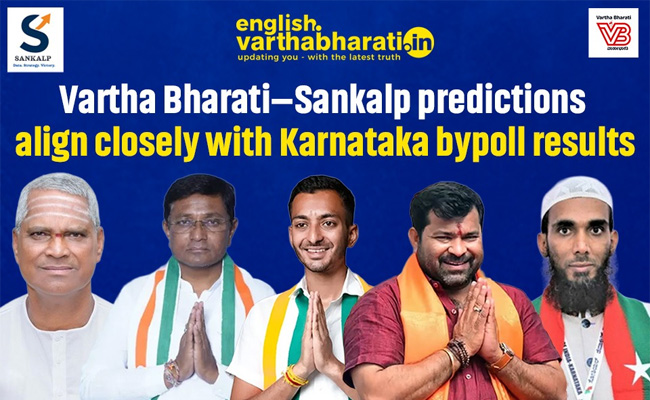
Bengaluru: The Vartha Bharati–Sankalp election analysis has shown a high level of accuracy in predicting the outcome of the recent Karnataka Assembly by-elections held in May 2026, correctly calling winners in both constituencies and closely estimating vote share trends.
The by-elections were held in Bagalkot and Davanagere South, drawing significant political attention as both seats were seen as key tests for the ruling Congress and opposition BJP.
According to the analysis, Vartha Bharati–Sankalp had made three major projections ahead of the results the winning party, vote share percentages, and margin of victory.
In both constituencies, the platform accurately predicted that the Congress would emerge victorious. The outcome matched the projections, with Congress candidates winning in Bagalkot and Davanagere South.
In terms of vote share, the predictions were largely in line with the final results. In Bagalkot, the BJP’s vote share was forecast in the range of 40 to 46 per cent, while the actual figure stood at 42.9 per cent. The Congress vote share, however, exceeded expectations, with the party securing 55.4 per cent against a projected range of 43 to 48 per cent.
The margin of victory in Bagalkot turned out to be significantly higher than anticipated. While the projection had placed the margin between 2,000 and 3,500 votes, the final margin was around 22,332 votes.
In Davanagere South, the predictions also remained largely accurate. The Congress vote share was projected between 43 and 51 per cent, and the final figure stood at 43.9 per cent. The BJP was expected to secure between 42 and 50 per cent but ended with 40.3 per cent.
The analysis had also identified the role of SDPI as a potential spoiler in the constituency. While its vote share was estimated around 6 per cent, the party eventually secured around 12 per cent of the vote.
The margin of victory in Davanagere South was predicted to be between 1,500 and 2,600 votes. The actual margin was higher at around 5,708 votes, though the contest remained relatively close as anticipated.
Overall, the performance of Vartha Bharati–Sankalp stood out for correctly identifying the winning parties in both seats and maintaining close accuracy in vote share estimates, with only limited deviations in specific cases.