Delhi riots: Court sends ex-JNU student leader Umar Khalid to 10-days pc in UAPA case
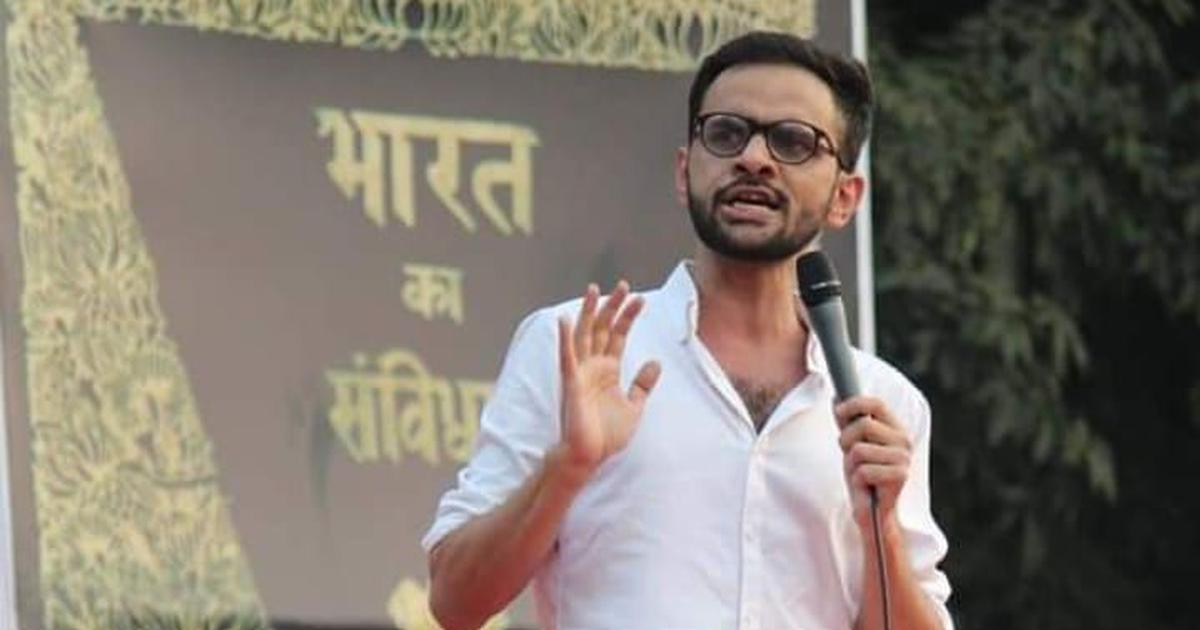
New Delhi: A Delhi court Monday sent former JNU student leader Umar Khalid, arrested under the stringent anti-terror law Unlawful Activities (Prevention) Act, to police custody for 10 days in a case related to the communal violence in northeast Delhi in February.
Khalid, who was arrested on Sunday night, was produced before Additional Sessions Judge Amitabh Rawat through video conferencing and was remanded for custodial interrogation till September 24.
The court allowed police to interrogate Umar Khalid in its custody saying it was a fit case for police custody remand.
It said the investigation in the present case of conspiracy for Delhi riots which took place in Delhi is continuing.
Police had sought his custody for 10 days, saying they wanted to confront him with documents running into 11 lakh pages.
Investigators alleged that during interrogation, his active involvement in anti-CAA/NPR/NCR protests with the support of several other radical groups or organizations which finally resulted in the recent riots was reconfirmed.
"Considering the nature of the case and role of accused Umar Khalid that has surfaced so far regarding the conspiracy and involvement in anti-CAA (anti-Citizenship Amendment Act)/NPR (National Population Register) /NRC (National Register for Citizens) protest with the support of several radical groups/organizations resulting in riots and the fact that the custodial interrogation has been sought of the accused Umar Khalid for confronting the huge technical data as well as material that has come during the investigation, I deem it fit that, for having an effective and proper investigation to allow the present application for seeking police custody remand of the accused of a period of 10 days," the judge said in his order.
In the FIR, police have alleged that the communal violence was a "premeditated conspiracy" which was allegedly hatched by Khalid and two others.
He has been booked for the offenses of sedition, murder, attempt to murder, promoting enmity between different groups on grounds of religion, and rioting.
The former JNU student leader had allegedly given provocative speeches at two different places and appealed to the citizens to come out on streets and block the roads during the visit of US President Donald Trump to spread propaganda at international level about how minorities in India are being tortured, the FIR alleged.
In its order, the court also said that since there was apprehension regarding Khalid's safety, in case he was taken out of the office, the Deputy Commissioner of Police (DCP) should make proper arrangements for his safety and security during the entire police custody remand and medically examined every 24 hours.
It allowed his counsel to confer with him for a period not exceeding half an hour at the beginning of the police custody and thereafter daily during police custody remand at a specified venue.
"The concerned police officials shall ensure that they remain outside the audible range during the period and all should follow the necessary distancing protocols in view of the outbreak of COVID-19," it said.
The remand application alleged that the ex-JNU student has been found actively involved behind the conspiracy hatched in setting up protests against the Citizenship Amendment Act (CAA) at various sites in Delhi.
During anti-CAA protests, he had hatched a conspiracy with other conspirators and different radical student groups against the government in connivance with other radical groups, it alleged.
His mobile phone was already seized in the case and more than 40GB data was extracted by the Computer Emergency Response Team (CERT-in), it said.
"Further interrogation was needed in order to unearth deep-rooted conspiracy and to collect clinching evidence to arrest the remaining conspirators behind these riots. During the course of the investigation, names of some more suspects have also cropped up and Khalid was required to be questioned at length about those suspects to obtain their exact particulars for further investigation," the police said.
Special Public Prosecutor Amit Prasad, appearing for the state, said since technical data and other material were substantial, which needed to be confronted, it was necessary that 10 days police custody of Khalid be granted.
The counsel for the accused opposed the remand application saying he was not in Delhi during February 23-26, when the riots took place.
He said the former JNU students union leader has already been interrogated twice in the case, first on July 31 for five hours and then on Sunday for about 12 hours.
He further said that the accused was previously attacked in 2016 in court premises so there was a threat to his life and submitted that his safety and security may be ensured.
The FIR alleged that in this conspiracy, firearms, petrol bombs, acid bottles, and stones were collected at numerous homes.
Co-accused Danish was allegedly given the responsibility to gather people from two different places to take part in the riots, police alleged.
JNU student Sharjeel Imam, Pinjra Tod members and JNU students Devangana Kalita and Natasha Narwal, Jamia Millia Islamia students Asif Iqbal Tanha and Gulfisha Khatoon, former Congress Councillor Ishrat Jahan, Jamia Coordination Committee members Safoora Zargar, Meeran Haider, President of Jamia Alumni Association Shifa-Ur-Rehman, suspended AAP Councillor Tahir Hussain and activist Khalid Saifi have also been booked under the anti-terror law in the case.
Let the Truth be known. If you read VB and like VB, please be a VB Supporter and Help us deliver the Truth to one and all.
Bank account in Ramgarh tracked for fraudulent fund transactions across 24 states, 4 arrested

Ramgarh (Jharkhand) (PTI): Jharkhand police on Thursday said it has unearthed a network of interstate cyber frauds and arrested four miscreants for fraudulent transactions through a bank account in Ramgarh district after complaints of 274 suspected transactions in 24 states.
The states where complaints for fraudulent transactions were registered included Maharashtra, Karnataka, West Bengal, Uttar Pradesh, Telangana, Tamil Nadu, Kerala and Andhra Pradesh.
The action followed inputs received through 'Samanvaya portal', a centralised, web-based platform launched by the Union Home Ministry to curb cybercrime.
"We arrested four cyber miscreants after a current account with Kuju (Ramgarh) branch of the State Bank of India was found to have registered suspected financial transactions in 24 states with the help of the Pratibimba portal of the Home Ministry through the Samanvaya portal," Ramgarh Superintendent of Police Mukesh Kumar Lunayat said.
During the probe, police found that the account was opened under the MSME Udyam Registration scheme in the name of Shree Ganesh Enterprises, he said.
The account had been linked to as many as 274 complaints from different states related to cyber fraud and illegal fund transfers.
The registered proprietors of the enterprise were identified as Rahul Gupta (37), Ravi Kumar Verma (34), and Ajay Sharma (33), all residents of Ramgarh district, a statement from the Ramgarh police said.
During interrogation, Rahul Gupta and Ravi Kumar Verma revealed that they had opened multiple current accounts at the behest of Ritesh Agrawal alias Munna (40) and Sonu Kumar Jha (34).
They admitted receiving Rs 1.2 lakh in exchange for facilitating the opening of these accounts.
"The accused further confessed to sharing OTPs, activating mobile banking services, and handing over control of the accounts to the main operators through WhatsApp and Telegram groups. These accounts were then allegedly used to route fraudulent transactions.
Police said mobile data analysis of the accused led to the recovery of crucial digital evidence, including details of SIM cards, bank accounts, passbooks, ATM cards, QR code scanners, Aadhaar cards, and PAN cards shared through messaging platforms.
A total of four accused have been arrested so far and sent to judicial custody.
A case has been registered at the Cyber Crime Police Station under relevant sections of the Bharatiya Nyaya Sanhita (BNS) 2023 and Sections 66C and 66D of the Information Technology Act, 2000.
Further investigation is underway, the police said.