Delhiites wake up to hazardous air, AQI crosses 400 at 27 stations
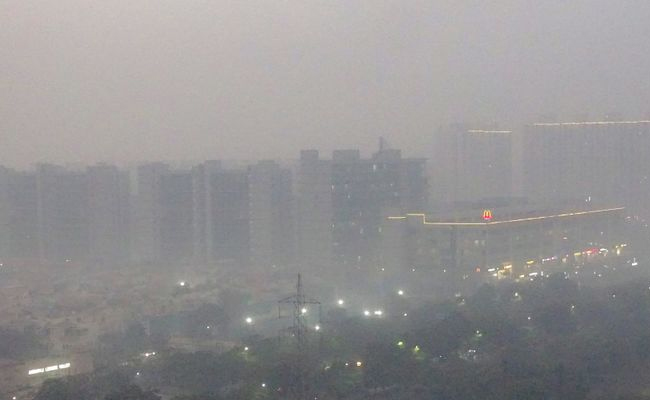
New Delhi (PTI): Delhi woke up to choking air on Tuesday morning as thick fog and haze engulfed the city, with AQI levels crossing 400 (severe category) at 27 monitoring stations and several others slipping into the 'severe plus' range, exposing residents to extremely hazardous pollution.
At 9 am on Tuesday, the city recorded an AQI of 415, slipping from the 'very poor' category a day earlier, as pollution levels continued their upward climb, according to data from the Central Pollution Control Board (CPCB).
Out of 40 monitoring stations, 27 recorded severe air quality with AQI readings above 400, a level known to have serious health impacts.
Five stations were in the 'severe plus' category with AQI readings above 450, with Anand Vihar recording an AQI of 470, Nehru Nagar (463), Okhla (459), Mundka (459) and Sirifort (450), as per data from the CPCB's SAMEER app.
ALSO READ: ‘Pay worker before sweat dries’: Madras HC invokes prophet’s teaching to settle lawyer’s dues
According to the CPCB standards, an AQI from 0-50 is considered 'good', 51-100 'satisfactory', 101-200 'moderate', 201-300 'poor', 301-400 'very poor', and 401-500 'severe'.
On the weather front, dense fog led to a sharp drop in visibility, with Palam recording 50 metres visibility under dense fog conditions with west-southwesterly winds at 5 kmph at 8 am, while Safdarjung reported 100 metres visibility with calm winds at the same time.
Visibility improved slightly by 8.30 am, with Palam recording 100 metres visibility under dense fog with west-southwesterly winds at 5 kmph and Safdarjung reporting 150 metres visibility with calm winds.
Delhi's minimum temperature dropped to 8.8 degrees Celsius, which is 1.3 degrees above normal, the India Meteorological Department (IMD) said.
The maximum temperature is expected to hover around 23 degrees Celsius, with the forecast indicating dense fog conditions during the day.
Let the Truth be known. If you read VB and like VB, please be a VB Supporter and Help us deliver the Truth to one and all.
Vartha Bharati–Sankalp predictions align closely with Karnataka bypoll results

Bengaluru: The Vartha Bharati–Sankalp election analysis has shown a high level of accuracy in predicting the outcome of the recent Karnataka Assembly by-elections held in May 2026, correctly calling winners in both constituencies and closely estimating vote share trends.
The by-elections were held in Bagalkot and Davanagere South, drawing significant political attention as both seats were seen as key tests for the ruling Congress and opposition BJP.
According to the analysis, Vartha Bharati–Sankalp had made three major projections ahead of the results the winning party, vote share percentages, and margin of victory.
In both constituencies, the platform accurately predicted that the Congress would emerge victorious. The outcome matched the projections, with Congress candidates winning in Bagalkot and Davanagere South.
In terms of vote share, the predictions were largely in line with the final results. In Bagalkot, the BJP’s vote share was forecast in the range of 40 to 46 per cent, while the actual figure stood at 42.9 per cent. The Congress vote share, however, exceeded expectations, with the party securing 55.4 per cent against a projected range of 43 to 48 per cent.
The margin of victory in Bagalkot turned out to be significantly higher than anticipated. While the projection had placed the margin between 2,000 and 3,500 votes, the final margin was around 22,332 votes.
In Davanagere South, the predictions also remained largely accurate. The Congress vote share was projected between 43 and 51 per cent, and the final figure stood at 43.9 per cent. The BJP was expected to secure between 42 and 50 per cent but ended with 40.3 per cent.
The analysis had also identified the role of SDPI as a potential spoiler in the constituency. While its vote share was estimated around 6 per cent, the party eventually secured around 12 per cent of the vote.
The margin of victory in Davanagere South was predicted to be between 1,500 and 2,600 votes. The actual margin was higher at around 5,708 votes, though the contest remained relatively close as anticipated.
Overall, the performance of Vartha Bharati–Sankalp stood out for correctly identifying the winning parties in both seats and maintaining close accuracy in vote share estimates, with only limited deviations in specific cases.