Delhi's air turns 'very poor' again
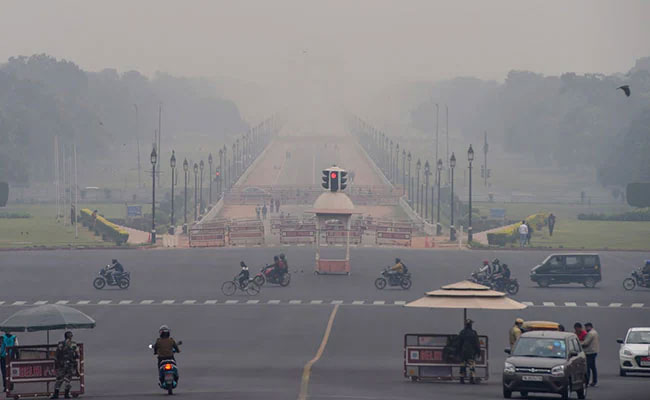
New Delhi (PTI): Delhi's air quality deteriorated to the "very poor" category on Saturday, and is predicted to worsen further due to unfavourable meteorological conditions, according to weather monitoring agencies.
The city's average Air Quality Index (AQI) stood at 301 at 12 noon, worsening from 261 on Friday, according to the Central Pollution Control Board.
The AQI was 286 in neighbouring Ghaziabad, 268 in Faridabad, 248 in Gurugram, 284 in Noida, and 349 in Greater Noida.
An AQI between zero and 50 is considered 'good', 51 to 100 'satisfactory', 101 to 200 'moderate', 201 to 300 'poor', 301 to 400 'very poor', and 401 to 500 'severe'.
According to the Centre's Air Quality Early Warning System for Delhi, the city's air quality deteriorated to the 'very poor' category due to slow wind speed at night and a dip in temperatures.
The air quality is expected to remain very poor till the end of the month, it said.
Unfavourable meteorological conditions and a cocktail of emissions from firecrackers and paddy straw burning, in addition to local sources of pollution, push Delhi-NCR's air quality to hazardous levels during winter.
According to an analysis conducted by the Delhi Pollution Control Committee, the capital experiences peak pollution from November 1 to November 15 when stubble burning incidents in Punjab and Haryana peak.
While Delhi is facing a sharp decline in air quality in the coming days, crucial data that helped the government prepare a strategy to mitigate the air pollution problem is missing.
The Ministry of Earth Sciences' System of Air Quality and Weather Forecasting and Research, which provided data about the contribution of smoke from farm fires to Delhi's air pollution, has not been providing updates, and associated officials are unaware of the reason.
"We are not aware of why updates on the SAFAR portal have stopped," said an official at the Indian Institute of Tropical Meteorology, which operates the website. Similarly, data from the Decision Support System, a numerical model-based framework capable of identifying sources of particulate matter pollution in Delhi, isn't accessible to the general public anymore.
Recently, Delhi Environment Minister Gopal Rai said the city government's study to determine pollution sources in the national capital has been halted "unilaterally and arbitrarily" on the orders of DPCC Chairman Ashwani Kumar.
The Delhi government had last month launched a 15-point action plan to mitigate air pollution in the capital during the winter season, with a strong emphasis on addressing dust pollution, vehicular emissions, and the open burning of garbage.
Special drives to check dust, vehicular and industrial pollution are already underway in the city.
In keeping with the practice of the last three years, Delhi had last month announced a comprehensive ban on the manufacture, storage, sale, and use of firecrackers within the city.
A public awareness campaign, 'Patakhe Nahi Diye Jalao,' will soon be reintroduced to discourage firecracker burning.
The government has also prepared a pollution mitigation plan for each of the 13 identified pollution hotspots -- Narela, Bawana, Mundka, Wazirpur, Rohini, R K Puram, Okhla, Jahangirpuri, Anand Vihar, Punjabi Bagh, Mayapuri, Dwarka.
Rai recently said the government has identified eight more pollution hotspots in addition to the existing 13 in the national capital and special teams will be deployed there to check pollution sources.
He said the government has also decided to use suppressant powder to prevent dust pollution in the city.
Dust suppressants could include chemical agents like calcium chloride, magnesium chloride, lignosulfonates and various polymers. These chemicals work by attracting and binding fine dust particles together, making them too heavy to become airborne.
Let the Truth be known. If you read VB and like VB, please be a VB Supporter and Help us deliver the Truth to one and all.
Body of UP girl who fell in Meghalaya waterfall recovered

Shillong (PTI): The body of a 15-year-old girl from Uttar Pradesh who fell into a waterfall in Meghalaya's Sohra area while trying to take snaps a day ago was recovered on Thursday morning, officials said.
The girl had gone missing on Wednesday after she reportedly slipped while trying to take photographs and fell into one of the deep natural pools at the Wei Sawdong Falls, they said.
Search operations were conducted through Wednesday but were called off after sunset.
Around 7.30 am on Thursday, locals spotted the body stuck between rocks near the waterfall, officials said. Following this, a joint team of Fire and Emergency Services and the Sohra Police recovered the body around 10 am.
"Local village volunteers resumed the search early this morning and spotted the body, following which we recovered the body," a senior official told PTI.
The body has been sent for post-mortem, he added.