Delhi's pollution level sharply spikes ahead of Diwali as thick haze engulfs city: Authorities
New Delhi, Nov 5 : Delhi's pollution level sharply spiked Monday as a thick haze engulfed the national capital ahead of Diwali due to high impact of stubble burning and pushed the air quality in the 'very poor' category, authorities said.
An official with the Centre-run System of Air Quality Forecasting and Research (SAFAR) said despite moderate wind speed, the pollution in Delhi rose due to stubble burning from the neighbouring states.
"As expected there is a significant intrusion of bio-mass generated pollution in Delhi which is increasing pollution levels and made it very poor in spite of moderate surface wind speed," he said.
"The contribution of stubble burning to pollution in the national capital is expected to be 24 per cent on Monday," another official said.
A thick haze also engulfed the national capital which reduced the visibility drastically, authorities said.
The overall air quality index of Delhi was registered at 345 which falls in the 'very poor' category. On Sunday, the air quality was registered at 171, which falls in moderate category, the lowest of three weeks, according to data of the Central Pollution Control Board.
An AQI between 0 and 50 is considered 'good', 51 and 100 'satisfactory', 101 and 200 'moderate', 201 and 300 'poor', 301 and 400 'very poor', and 401 and 500 'severe'.
On Monday, the PM2.5 (particles in the air with a diameter of less than 2.5 micrometres) level was recorded at 268 while the PM10 (particles in the air with a diameter of less than 10 micrometres) was recorded at 391.
The spike in the pollution level comes a day after the air quality had improved to moderate category due to meterological factors and the control measures implemented by the authorities in Delhi.
Delhi authorities have stepped up efforts to combat pollution which includes measures like halting construction activities and regulating traffic.
There is a halt on all construction activities involving excavation. Civil construction has also been suspended in Delhi and other NCR districts, besides closure of all stone crushers and hot mix plants generating dust pollution.
The Delhi Pollution Control Committee (DPCC) has also directed the Transport Department and the Traffic Police to intensify checking of polluting vehicles and control travel congestion in the region during November 1-10.
An aggressive 10-day-long 'Clean Air Campaign' from November 1-10 has also been launched to monitor and report polluting activities as well as to ensure quick action.
Under the campaign, a fine of over Rs 1 crore has been imposed in the last three days on people violating the norms causing pollution.
But despite that the air quality deteriorated to 'very poor' category due to increase in the contribution of stubble burning from the surrounding states of Punjab and Haryana, the authorities said.
The deterioration of air quality comes ahead of Diwali when a further spike in pollution is expected to hit the city.
Let the Truth be known. If you read VB and like VB, please be a VB Supporter and Help us deliver the Truth to one and all.
CM Siddaramaiah alleges ‘criminal conspiracy’ in Sringeri recount, vows legal action
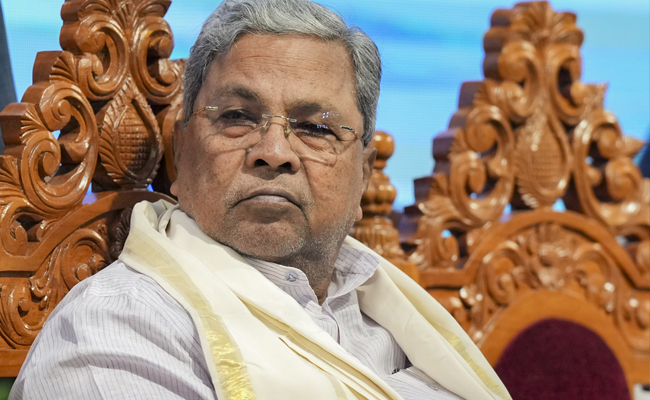
Bengaluru (PTI): Alleging a “criminal conspiracy” by BJP candidate D N Jeevaraj in the Sringeri Assembly poll recounting, Karnataka CM Siddaramaiah on Tuesday said the outcome was manipulated after valid postal ballot votes in favour of Congress leader T D Raje Gowda were tampered with during the recounting process.
Following a Karnataka High Court order on an election petition filed by Jeevaraj, challenging Raje Gowda’s election, the reverification and recounting were conducted on Saturday.
After the reverification and recount of postal ballots for the Sringeri Assembly constituency, votes polled in favour of Raje Gowda were reduced by 255, the returning officer said.
A report on the matter has been submitted to the Election Commission of India for further action, the officer added.
Congress leader Raje Gowda had won the 2023 Assembly polls from Sringeri by 201 votes, defeating his nearest rival Jeevaraj.
Addressing a press conference in Bengaluru, Siddaramaiah said the High Court had directed the recounting of postal ballots and that irregularities were noticed during the exercise conducted on May 2.
“This is a clear case of criminal conspiracy,” Siddaramaiah said, alleging that valid votes cast in favour of Raje Gowda were altered after being accepted by counting agents of all parties, including Congress, BJP, and JD(S).
He claimed that during the recounting of postal ballots, 255 votes were initially accepted as valid by all agents but were later tampered with by subordinate officials.
“There is a second mark on the votes polled in favour of Raje Gowda. They had accepted these as valid votes. Subsequently, another mark was made by officials. This is a clear case of criminal conspiracy,” he said.
When asked who was behind the alleged conspiracy, the CM replied, “It was hatched by Jeevaraj and others. It is planned.”
Siddaramaiah further alleged that the returning officer acted improperly by declaring the result despite the presence of an Election Commission observer during the recounting.
“Immediately after the counting, the returning officer announced the result. He should not have done so; this is against the law,” he said.
He pointed out that Raje Gowda had originally won by 201 votes, but after the recounting, the BJP candidate was declared the winner by 52 votes.
“The BJP has committed a criminal act of conspiracy. This is not vote chori but vote dacoity,” he alleged.
The CM said a police complaint had already been filed by Raje Gowda’s election agent, Sudhir Kumar, and emphasised the need for electoral integrity.
“We want transparency and free and fair elections. That is what our Constitution mandates,” he added.
Stating that the government would pursue legal remedies, Siddaramaiah said, “We are preparing an appeal challenging the returning officer’s announcement in a court of law.”
Responding to a separate query on elections in other states, the CM said there appeared to be an anti-incumbency factor in West Bengal, while results in Tamil Nadu were “surprising,” adding that Vijay’s party was emerging as the largest there.
Following the victory of party candidates in Bagalkote and Davanagere South, Siddaramaiah expressed confidence about future electoral prospects in Karnataka.
“Even in 2028, we will win the Assembly elections. We will come back,” the CM said.
Siddaramaiah added that he would order a forensic examination into the alleged tampering of postal ballots.