Delh's air quality drops to 'emergency' category first time since January
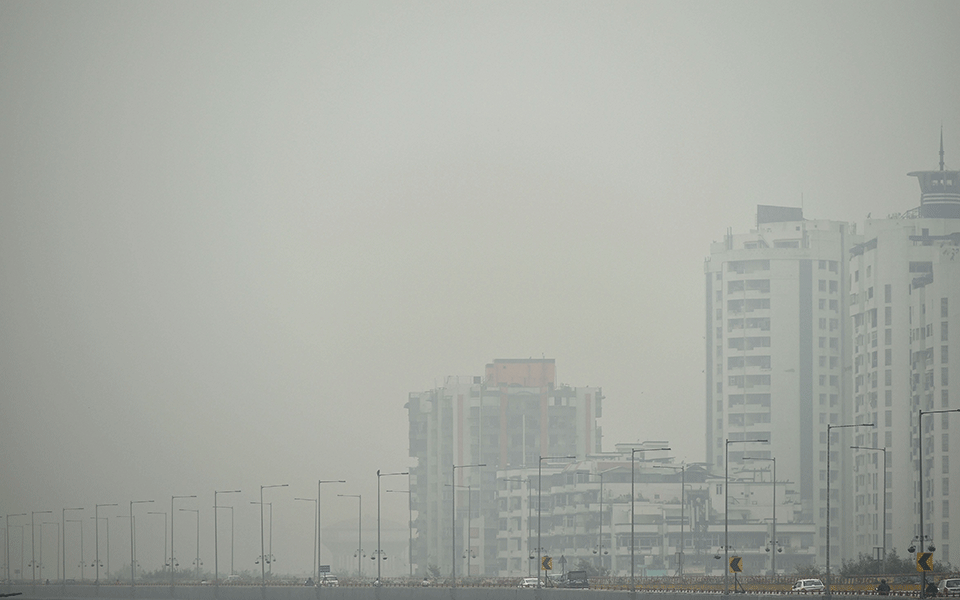
New Delhi: The blanket of haze over Delhi thickened on Friday morning with the national capital's pollution levels increasing overnight by around 50 points, taking the overall air quality index to 459.
A Central Pollution Control Board official said the AQI entered the "severe plus" or "emergency" category late Thursday night, the first time since January this year.
If the air quality persists in the "severe plus" category for more than 48 hours, emergency measures such as odd-even car rationing scheme, banning entry of trucks, construction activities and shutting down schools are taken under the Graded Response Action Plan, the official said.
The hazardous pollution levels forced a number of people to miss morning walks and other activities.
Shubhomoy Sikdar, a Delhi-based journalist, said the pollution levels gave him a throat infection and he had to skip his daily sports session.
Amanpreet Singh, a resident of Jangpura, said he has been avoiding morning and evening walks and preferring to stay indoors. The number of masked faces continued to grow as the city remained shrouded in pungent haze for the fourth consecutive day.
At 8.30 am, the capital's overall air quality index stood at 459. It was 410 at 8 pm on Thursday. All the 37 air quality monitoring stations across Delhi recorded the air quality in the severe category on Friday morning.
Bawana was the most-polluted area with an AQI of 497, followed by Delhi Technological University (487), Wazirpur (485), Anand Vihar (484) and Vivek Vihar (482).
Neighbouring Ghaziabad was the most-polluted city in the country, with the levels of PM2.5 -- tiny particulate matter less than 2.5 microns that can enter deep into the lungs -- reaching as high as 493.
Greater Noida (480), Noida (477), and Faridabad (432) also breathed extremely polluted air.
An AQI between 0-50 is considered good , 51-100 satisfactory , 101-200 moderate , 201-300 poor , 301-400 very poor , and 401-500 severe . Above 500 is severe-plus or emergency category.
Delhi is impatiently hoping for favourable meteorological conditions to blow away the toxic air, as health experts said the hazardous air pollution has become a serious health concern for about 2 crore residents.
"Intake of every 22 micrograms per cubic metre of polluted air is equivalent to smoking a cigarette. So whether the PM2.5 level is 700 or 300 units, the impact is still as bad. People need to take precautions, especially those suffering from asthma, bronchitis or other respiratory illness," said Dr Arvind Kumar, lung surgeon at Sir Ganga Ram Hospital here.
Weather experts said increased wind speed due to a fresh western disturbance approaching the northern region would help disperse pollutants faster from Saturday.
Parents are a worried lot as health experts say children breathe faster, taking in more pollutants. Many took to Twitter to demand that schools be shut till the situation ameliorates.
"We, as parents, request Delhi government to keep all schools (pvt and govt) shut for the time being," Anil Atri, a Delhi resident, posted on the microblogging site.
"Whole Delhi air at hazardous levels now. Pollution at its peak. Activate all emergency measures. Close down schools @msisodia (sic)," another resident tweeted.
Deputy Chief Minister Manish Sisodia had on Wednesday said the decision to shut schools would be taken "when the need arises". In November 2017, the government had shut schools for a few days due to the deteriorating air quality.
The government, however, started distributing 50 lakh N95 masks, considered one of the good quality masks for tackling smog, among school students in Delhi on Friday morning.
Meanwhile, the BCCI said it would carry on with the India-Bangladesh T20 at the Feroz Shah Kotla grounds on Sunday, disregarding concerns raised by environmentalists about the health of players and thousands of spectators.
The AQI takes into account five chief pollutants -- particulate matter with a diameter less than 10 micrometres (PM10), PM2.5, ozone (O3), nitrogen dioxide (NO2) and carbon monoxide (CO).
The higher the AQI value, the greater the level of air pollution and health concerns.
Let the Truth be known. If you read VB and like VB, please be a VB Supporter and Help us deliver the Truth to one and all.
Indian startup's 'Drishti' satellite launched aboard SpaceX rocket
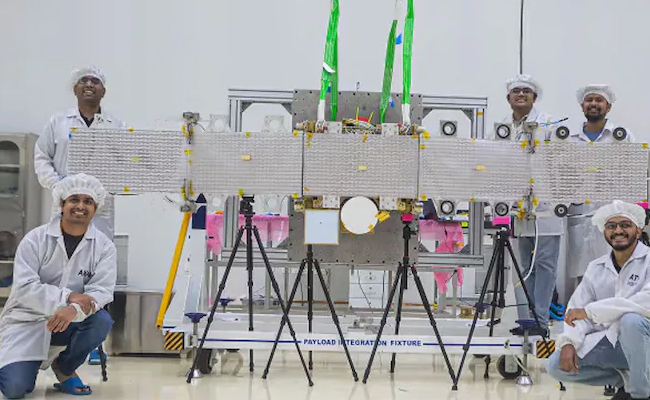
New Delhi (PTI): Bengaluru-based space start-up GalaxEye's Mission Drishti satellite was launched on Sunday aboard SpaceX's Falcon 9 rocket from California.
Mission Drishti is the world's first OptoSAR satellite, integrating electro-optical (EO) and synthetic aperture radar (SAR) sensors into a single operational platform, according to the company.
While EO sensors capture high-resolution images during sunlight and clear skies, SAR sensors provide all-weather and all-time images, using radar pulses.
In a statement, Suyash Singh, founder and CEO of GalaxEye, said, "With the satellite (Mission Drishti) now successfully in orbit, our immediate focus is on completing its commissioning. As we move through this phase, we are already witnessing strong global interest in the differentiated datasets enabled by our OptoSAR payload."
The satellite will help address long-standing limitations of conventional systems and enable more reliable and consistent data acquisition across diverse environmental conditions, the company said.
As a dual-use Earth observation satellite, the mission will support use cases across defence, agriculture, disaster management, maritime monitoring, and infrastructure planning.
The satellite is also expected to complement India's broader initiatives, including the 29 active Earth Observation satellites outlined in ISRO's recent annual report.
The launch came after five years of indigenous research and development, and extensive environmental testing and performance validation of the Mission Drishti.
In a statement, Lt Gen AK Bhatt (Retd), director general of Indian Space Association (ISpA), said, "GalaxEye has achieved what only a few global players have, which is seamlessly combining optical and SAR capabilities on a single platform to enable persistent, all-weather intelligence."
What stands out is not just the technology, but its broader impact on how downstream applications will increasingly define value in the space economy, particularly in Earth observation, where timely, decision-grade insights are critical," he added.
ISpA is the premier industry association of space and satellite companies in the country.
Union Minister Jitendra Singh also took note of the Mission Drishti launch, saying the development marked a significant milestone in India's space journey.
In a post on X, the minister said, "The successful launch of the world's first OptoSAR satellite, and the largest privately-built satellite in the country, reflects the immense potential of our young innovators driving nation-building."
GalaxEye aims to scale up Mission Drishti to a constellation of 10 satellites by 2030, developing a robust and sovereign Earth observation infrastructure for India.