Demonetisation Has Led To Tax Terrorism, Yashwant Sinha
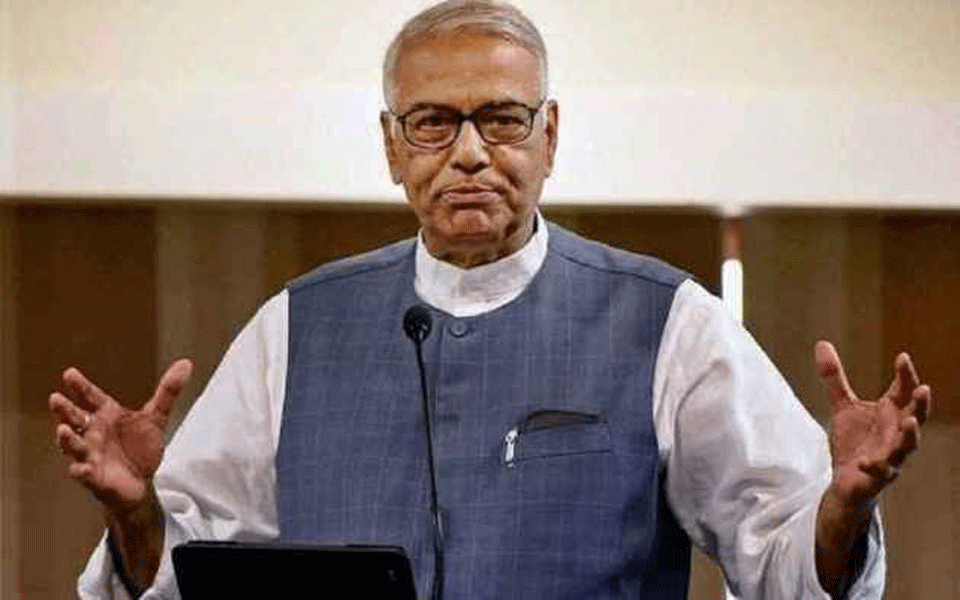
Dissident BJP leader and former Union finance minister Yashwant Sinha today said demonetisation had led to "tax terrorism" and likened Prime Minister Narendra Modi to a medieval era Delhi king known for his whimsical decisions.
Sinha made these remarks at the launch of a book, Demonetization and the Black Economy, by economist Arun Kumar, who has been critical of the exercise. Suspended BJD MP Baijayant 'Jay' Panda and Congress leader Prithiviraj Chavan were also participating in the panel discussion.
Though demonetisation failed to meet any of the stated objectives, the government had won the "perception battle", Sinha said.
The former finance minister derisively said that "not policy-makers but only one policy-maker" decides what has to be done.
With the passage of time, they can come to only one conclusion that demonetisation has "failed and failed comprehensively", he said.
"There was another case in the 16th century in Delhi about a ruler who was famous for shifting the capital from Delhi to Daulatabad. But we forget that he also had demonetised the currency in his time. We have gone back five centuries to repeat the mistake which that gentleman, that king had made," he said.
Asked by the moderator if he was comparing Modi to Muhammad bin Tughluq, Sinha said he was not taking any names.
Sinha said "tax terrorism", which the BJP was critical of when it was in the opposition, has returned because of the note ban, and claimed the income tax department registered 1.8 million cases following the decision and was ill-equipped to probe them all anytime soon.
"What has been the other side-effect? Tax-terrorism, which the BJP had criticised when we were in opposition. It has come back now. 1.8 million cases have been started by the income tax department (since demonetisation)" he said.
Is the department equipped to handle so many cases and how much time it is going to take to bring those cases to a final conclusion, he asked, claiming people will never know how much black money was actually recovered until investigation in all those cases are complete.
"This will go on and on like the counting of the notes by the Reserve Bank of India. It will never finish, not at least until the next Lok Sabha election so that the perception of this (demonetisation) having succeeded continues to hold," he said.
Asked how would he have tackled the flow of black money, Sinha quipped, "Demonetisation and the Goods and Services Tax (GST) are subjects to write books upon how things should not be done."
Published by Penguin India, 'Demonetization and the Black Economy' claims to explain the story of the note ban and its effects on the economy.
Let the Truth be known. If you read VB and like VB, please be a VB Supporter and Help us deliver the Truth to one and all.
Mohali schools receive bomb threat emails, Fortis Hospital also mentioned
Chandigarh (PTI): Some schools in Punjab's Mohali received bomb threat emails on Tuesday, which also mentioned Fortis Hospital, prompting police to launch search operation, officials said.
"The bomb threat to schools also mentioned the Fortis Hospital in Mohali, where we conducted anti-sabotage checks. Non-essential services were kept on hold while essential services continued," a senior police official said in Mohali.
He said the police were conducting checks in the schools.
Security had already been strengthened in and around Fortis hospital in Mohali after Chief Minister Bhagwant Mann was admitted there. Chief Minister Mann was re-admitted in the hospital on Monday evening, hours after he was discharged from the health facility. Mann was admitted again after he experienced exhaustion, said sources.
On Wednesday, sixteen private schools in Mohali had received bomb threat emails, triggering evacuation and prompting detailed anti-sabotage checks by police.
However, after detailed inspection, no suspicious or explosive material was found at any of the locations.
The latest scare comes close on the heels of similar threats in Chandigarh, Amritsar, Jalandhar, Patiala and Haryana schools. All threats turned out to be hoaxes.