Dense fog blankets Delhi, AQI stays in 'very poor' category
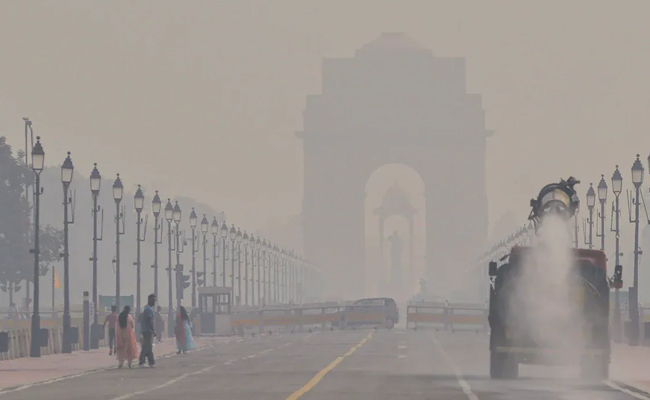
New Delhi (PTI): Delhi woke up shrouded in fog on Wednesday morning, with little visibility and 'very poor' air.
The India Meteorological Department (IMD) issued an orange alert for dense fog between 8.30 am and 10 am.
Visibility was recorded at 50 metres at both Palam and Safdarjung at 6.30 am, the weather office said. The national capital recorded a 24-hour average Air Quality Index (AQI) of 384, according to data from the Central Pollution Control Board (CPCB).
A station-wise breakdown showed that 21 monitoring stations recorded 'very poor' air quality, while 16 stations were in the 'severe' category, with Anand Vihar registering the worst AQI at 452, according to data from the CPCB's SAMEER app.
According to CPCB classification, an AQI between 0 and 50 is considered 'good', 51 to 100 'satisfactory', 101 to 200 'moderate', 201 to 300 'poor', 301 to 400 'very poor', and 401 to 500 'severe'.
The air quality outlook remains grim, the Air Quality Early Warning System said, with the AQI likely to deteriorate to the 'severe' category on January 1, before letting up to the 'very poor' category on January 2.
For the subsequent six days, air quality is expected to remain 'very poor', it said.
Officials attributed the poor air to an unfavourable ventilation index of below 6,000 square metres per second and average wind speeds of less than 10 kmph, which are not conducive to the dispersion of pollutants.
On Tuesday, the AQI stood at 388, marking a marginal improvement from Monday, when the city recorded a 'severe' reading of 401.
On Wednesday, the IMD said the minimum temperature at Safdarjung and Ayanagar was recorded at 6.4 degrees Celsius, 0.4 degrees Celsius below normal. The maximum temperature is expected to be around 23 degrees Celsius. Dense fog is likely to persist through the day.
Palam station logged a minimum of 7.7 degrees Celsius, Lodhi Road 6.8 degrees Celsius, and the Ridge 7.8 degrees Celsius, according to the IMD.
On New Year's Day, the weather office has forecast a generally cloudy sky with light rain over the national capital.
Let the Truth be known. If you read VB and like VB, please be a VB Supporter and Help us deliver the Truth to one and all.
Two injuries, one DNF, a DQ as India end messy World Relays campaign

Gaborone (Botswana) (PTI): Amoj Jacob and Ragul Kumar got injured during the men's 4x400m and 4x100 races respectively as India ended their World Athletics Relays campaign in disappointment on the second day of competitions here on Sunday.
The Indian camp had high hopes of making the 2027 World Championships in the men's 4x400m relay but the team did not finish (DNF) the race as Jacob suffered cramps and pulled out of the race after taking the baton from the first leg runner Dharamveer Choudhary. Rajesh Ramesh and Vishal TK were to run in the third and fourth legs.
Those teams which could not qualify for the 2027 Beijing World Championships by reaching the final round of each of the six relay events on Saturday were given another chance in the second qualification round on Sunday.
The top two teams in each of the two heats (in all six relay events) booked the Beijing ticket on Sunday.
India will now have to try and qualify for the World Championships through the Top Lists of the World Athletics, which is a long and tedious process.
In the men's 4x100m race, third leg runner Ragul Kumar fell down the track after failing to hand over the baton inside the exchange zone to fourth leg runner Gurindervir Singh, which clearly showed the lack of coordination among the runners.
Harsh Santosh Raut and Animesh Kujur ran the first two legs.
The Indian quartet was disqualified and Kumar was seen being taken away from the Field of Play with the help of the volunteers.
It was a comedy of errors in the case of the women's 4x100m race, which saw the baton being dropped during an exchange between first leg runner Tamanna and second runner Nithya Gandhe, though the Indians finished the race in 53.09 seconds.
Gandhe started running quite a distance, but after realising that the baton was not in her hand, she turned and ran back to pick it up.
The only silver-lining for the Indian contingent was the national record time in the mixed 4x100m relay race, though the quartet of Ragul Kumar, Nithya Gandhe, Animesh Kujur and Sneha SS finished sixth in heat number two with a time of 41.35 seconds, bettering the previous national mark of 42.30 seconds set in March in Chandigarh.
The mixed 4x400m relay quartet of Theerthesh P Shetty, Kumari Saloni, Nihal William and Rashdeep Kaur ended at fifth in heat number one with a time of 3 minutes and 19.40 seconds.
On Saturday, all the five Indian relay teams had failed to make it to the respective final rounds and thus missed out on the 2027 World Championships berths.