Dense fog hits Delhi, flights delayed; IndiGo halts Leh operations due to snowfall
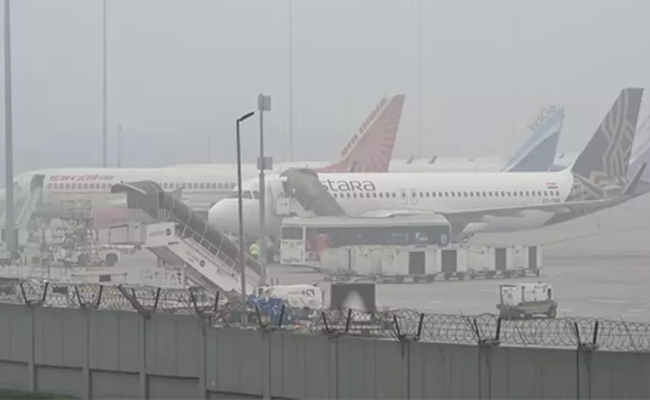
New Delhi: Dense fog blanketed parts of north India on Monday morning, disrupting flight operations at Indira Gandhi International Airport in Delhi, while IndiGo temporarily suspended flights to Leh due to heavy snowfall.
According to a report published by Hindustan Times, low visibility caused delays to several early-morning flights at Delhi airport, officials said. By 9 am, the city’s Air Quality Index (AQI) stood at 256, placing it in the ‘poor’ category, according to Central Pollution Control Board (CPCB) data.
In a travel advisory, IndiGo reportedly said flight operations to and from Leh were put on hold because of snowfall, affecting both take-offs and landings. The airline warned passengers of possible extended wait times and said boarding formalities may be completed in advance so that flights can depart quickly once clearance is granted. Passengers were advised to check their flight status before heading to the airport.
Within Delhi, pollution levels varied across locations, with several areas recording ‘poor’ to ‘very poor’ air quality, adding to visibility concerns. Authorities said foggy conditions were the primary reason for flight delays at IGI Airport.
Mumbai also witnessed hazy conditions at the start of the day. Visuals from the Bandra Kurla Complex and Bandra Reclamation showed smog hovering over the skyline. The AQI in these areas was recorded at 132, which falls under the ‘moderate’ category, according to CPCB data.
In the Northeast, Guwahati experienced a cold and foggy morning as a cold wave swept through the city. The AQI was measured at 72, categorised as ‘satisfactory’. The India Meteorological Department (IMD) predicted a minimum temperature of 14 degrees Celsius for Assam’s capital.
Meanwhile, Delhi authorities said Stage III restrictions under the Graded Response Action Plan (GRAP) were lifted on Friday evening after air quality showed improvement due to favourable weather conditions.
However, officials urged residents to continue following measures under Stages I and II of GRAP to prevent further deterioration. The government also clarified that construction and demolition sites shut down for violations will not be allowed to reopen without specific approval from the Commission.
Let the Truth be known. If you read VB and like VB, please be a VB Supporter and Help us deliver the Truth to one and all.
Mandaviya opens ESIC hospital in Doddaballapur, lays foundation for facility in Ballari
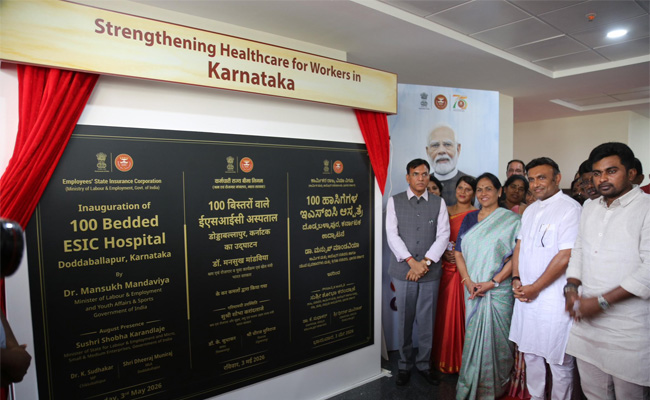
Bengaluru (PTI): Union Minister Mansukh Mandaviya on Sunday inaugurated the newly constructed 100-bedded ESIC Hospital at Doddaballapur near here.
He also laid the foundation stone for a 100-bedded ESIC Hospital at Ballari, remotely from Doddaballapur.
Union Minister of State for Labour and Employment Shobha Karandlaje, Chikkaballapura MP K. Sudhakar, and Doddaballapur MP Dheeraj Muniraju were among those present.
These healthcare facilities mark a significant milestone in strengthening healthcare delivery under the Employees’ State Insurance (ESI) Scheme in the region, officials said at the event.
As a special gesture, the union minister of labour and employment also honoured construction workers who contributed to the development of the hospital and disbursed cash benefits to ESI beneficiaries during the event.
The Doddaballapur facility will serve over 1,42,037 insured workers and their families, benefiting approximately 5.5 lakh beneficiaries across Bengaluru Rural, Chikkaballapur, Tumakuru, and Kolar districts, according to a release.
The Ballari facility, upon completion, will cater to the medical needs of around 64,000 workers and their families, benefiting over 2 lakh beneficiaries in the Ballari division, it said.
The ESIC Hospital at Doddaballapur in Bengaluru Rural is a 100-bedded multi-speciality secondary care facility built over 5 acres at Rs 101.14 crore.
It has 32 staff quarters and offers key services such as general medicine, surgery, obstetrics and gynaecology, paediatrics, orthopaedics, emergency care, and comprehensive diagnostic facilities, including radiology, laboratory, and blood bank.
The proposed ESIC Hospital at Ballari will be developed on 5.21 acres at an estimated cost of Rs 150 crore and will provide modern healthcare services to insured persons and their families under the ESI Scheme.