Despite progress, 12% of world still defecates in open: UNICEF chief

New Delhi, Oct 1 : UNICEF Executive Director Henrietta Fore on Monday broke inspiring news ahead of Mahatma Gandhis 150th birth year that India has driven the greatest increase in the use of toilets in South Asia "at any time in history" over the last decade with over 240 million people using them after abandoning open defecation.
The biggest contribution in this progress was by India with as many as 86 million rural households since 2014 having gained access to toilets for the first time. "Five lakh villages and hundreds of districts and 21 states and union territories are now open-defecation free," said Fore, who is on her maiden visit to India.
She was delivering the keynote address at the Mahatma Gandhi International Sanitation Convention. As many as 70 countries are participating in the four-day event, which began at the Pravasi Bharatiya Kendra here, on September 30.
The UNICEF chief said the overall progress made by several countries was inspiring. "We're also seeing rapid results in Indonesia, Ethiopia, Nepal and Cambodia - all on track to eliminating open defecation by 2030. Or even earlier," she pointed out.
"Or Nigeria, Kenya, Niger, Burkina Faso, Togo and Mozambique - all have national roadmaps to deliver total access to sanitation, no matter where people live, no matter how distant or hard-to-reach their community might be," Fore noted with satisfaction.
In all, since 1990, 2.1 billion people globally have gained access to improved sanitation facilities. "A great result. One that improves health and nutrition outcomes for children, empowers women, boosts economic prosperity and growth for entire nations," Fore said.
The UNICEF chief, however, warned that this was still no time to celebrate.
"As we mark this progress, we must face a difficult fact: without urgent acceleration of our efforts, many countries will not reach the 2030 goal of sanitation for all.
"Especially when one in three people - 2.3 billion in all - still lack even a basic sanitation service. When 12 per cent of the world's population still practices open defecation. Or when nearly one quarter of all schools worldwide lack basic sanitation - risking the health and the lives of over 620 million children," she said.
"This is obviously a tragedy for the people affected. The children in rural areas or urban slums who have no choice but to practise open defecation because their communities lack basic services. Those who risk poor health and disease. Those children who are stunted by malnutrition in the earliest years. Or the girls who are denied an education because their schools lack separate toilets, or proper sanitation."
As always, the poorest and most disadvantaged are hardest hit. Lack of sanitation unfairly puts them at greater risk of disease and even death. "We also know that 90 per cent of those still practicing open defecation around the world live in 26 specific countries."
Fore said besides the human and social costs of poor sanitation, there was a huge economic cost involved. "According to the World Bank, poor sanitation results in an estimated global GDP loss of $260 billion annually, because of health costs and productivity losses."
She said the benefits of improved sanitation were significant.
"A recent study by the government of India found that within open-defecation free environments, households can save up to 50,000 rupees per year thanks to medical costs averted and time saved."
She announced that UNICEF had evolved "a specific, time-bound target: by 2021, our goal is to have 250 million fewer people practicing open defecation. This means improving sanitation in all the countries where we work - and we're committed to this."
Let the Truth be known. If you read VB and like VB, please be a VB Supporter and Help us deliver the Truth to one and all.
Will vacate one of two assembly seats won in 10 days: BJP''s Suvendu
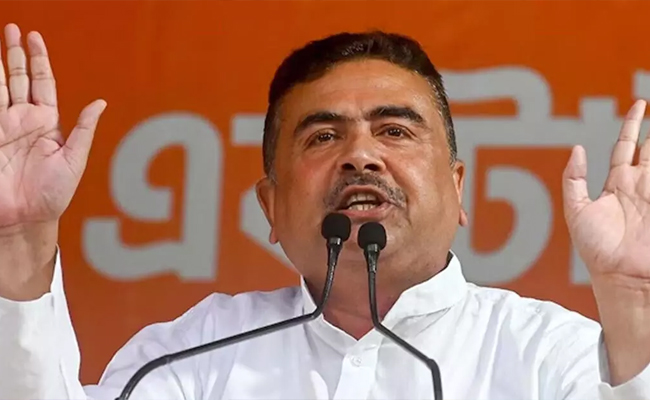
Kolkata (PTI): BJP leader Suvendu Adhikari, who defeated West Bengal Chief Minister Mamata Banerjee in Bhabanipur and secured Nandigram for three times in a row in the recent assembly polls, said on Wednesday that he would vacate one of the two constituencies within 10 days.
Adhikari also asserted that the party's central leadership would decide which constituency he would retain.
"I will vacate one seat within 10 days. The party will decide which one I retain. I will not forget my responsibility towards the people of Bhabanipur and Nandigram," he said.
Adhikari on Monday defeated Banerjee in Bhabanipur by over 15,000 votes, puncturing what was long seen as her safest political refuge and delivering a decisive psychological blow to the TMC, amid a sweeping BJP surge across West Bengal.
Addressing party workers and supporters in Nandigram in Purba Medinipur district, the BJP leader appealed to them not to take out victory processions immediately and instead maintain peace.
"Do not take out victory rallies now. Maintain peace and discipline. Celebrate after May 9, after taking permission," he told party workers.
State BJP president Samik Bhattacharya on Wednesday announced that the oath-taking ceremony of the new government will be held on May 9 at Brigade Parade Ground.
Referring to alleged attacks on BJP workers during the TMC regime, Adhikari said he would not forget the “atrocities" faced by them and assured them of taking appropriate action against perpetrators through legal processes.
"I was part of the 2011 ‘poribartan’ (change), and now I am part of the real change. I offer my gratitude to the people of Nandigram," Adhikari said.
He was referring to the TMC's victory in 2011 when the Mamata Banerjee party dismantled the 34-year Left Front regime in the state.
Adhikari offered prayers at a Hanuman statue in Nandigram and remembered the BJP workers, who had died in political violence.
"We will work in such a way that the BJP government in Bengal stays for 100 years," he said, expressing hope that the BJP’s vote share in the state would rise from the current 46 per cent to 60 per cent in future elections.
The BJP leader also assured residents of Nandigram of improved drinking water supply and better hospital and education infrastructure.