Diesel prices unchanged for 3rd straight day; petrol down 8 paise
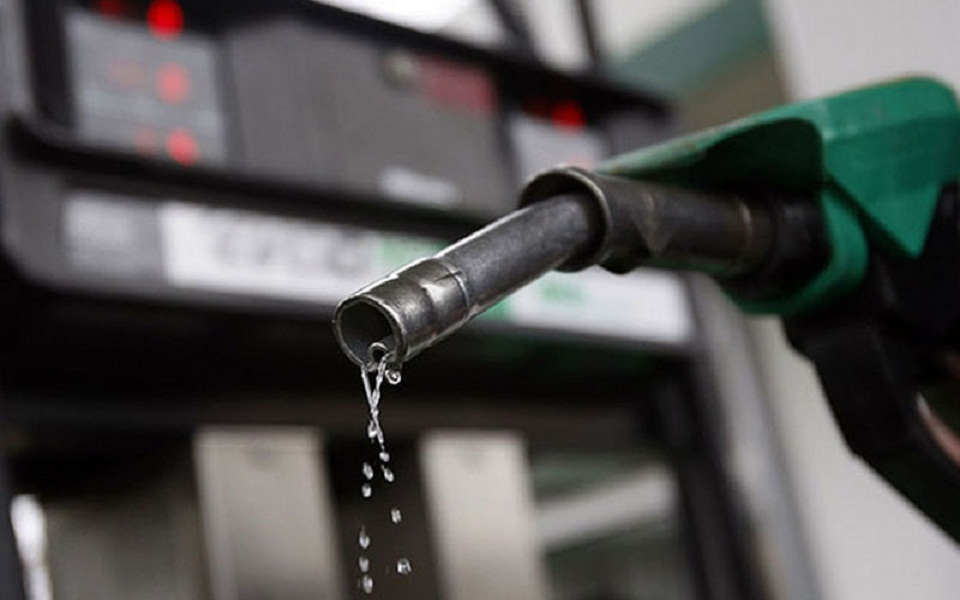
New Delhi, June 15: Diesel prices in the country's four metro cities remained stable for the third straight day on Friday but petrol prices declined around eight paise.
In the national capital, diesel was sold at Rs 67.85 per litre on Friday, unchanged since Wednesday, June 13.
Similarly, in the other key cities of Kolkata, Mumbai and Chennai, the fuel was sold at Rs 70.40, Rs 72.24 and Rs 71.62 per litre respectively, all at unchanged levels.
This stagnation comes after diesel prices fell by just over Re 1 in the metros during May 30-June 12 period.
Petrol prices, however, dropped by around eight paise a litre across the metros on Friday, after remaining unchanged for two days.
In Delhi, Kolkata and Mumbai, the key transportation fuel was sold at Rs 76.35, Rs 79.02 and Rs 84.18 per litre, all prices down eight paise from Thursday's level. In Chennai, price fell by nine paise to Rs 79.24 per litre.
Let the Truth be known. If you read VB and like VB, please be a VB Supporter and Help us deliver the Truth to one and all.
Women BJP MLAs protest against opposition in UP assembly premises
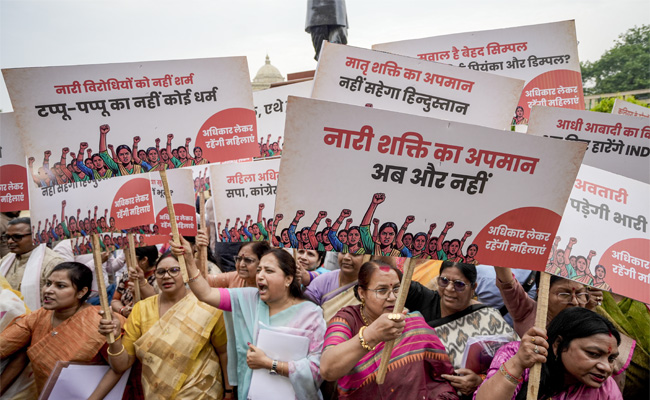
Lucknow (PTI): Women BJP MLAs held a protest in the Vidhan Bhawan complex before the one-day special session of Uttar Pradesh assembly, slamming the opposition for defeating the passage of a bill, which would have led to implementation of the Women's Reservation Law, in the Lok Sabha.
This followed another demonstration by Samajwadi Party MLAs, who alleged that the BJP was misleading public in the name of women's reservation.
The women BJP legislators assembled in front of Chaudhary Charan Singh's statue in the assembly premises, holding banners inscribed with the slogan "Insult to Matrushakti (women's power), India will not tolerate it". The protesting members entered the main hall of Vidhan Bhawan carrying the banners.
Participating in the protest, the state Minister for Women Welfare and Child Development, Baby Rani Maurya, told reporters that all opposition parties, including the Samajwadi Party and the Congress, had opposed the women's reservation, a stance for which they would have to pay a heavy political price.
"On this issue, all of us women stand united. We will ensure that we secure our reservation," she said.
BJP MLA Ketki Singh remarked that their protest represents the collective outrage of millions of women across the state.
Singh asserted that the opposition has betrayed women by creating hurdles in the path of women's reservation. The current demonstration is merely the beginning, and very soon, women from every street, intersection and household will join the protest movement, she said.
Minister Vijaylakshmi Gautam said, "We strongly condemn the despicable act committed by the Samajwadi Party and the Congress in an attempt to hold back 'half the population' (women). Their action was directed against the very bill that Prime Minister Narendra Modi had introduced to empower and strengthen Nari Shakti (women's power), and which he strived to pass expeditiously."
Uttar Pradesh assembly is holding a one-day special session on Thursday. During the session, the government is set to move a censure motion against the opposition parties over their failure to pass the Constitution Amendment Bill, which would have led to implementation of the Women's Reservation Act, in the Lok Sabha.