Digvijaya Singh opts out of Cong prez race, to back Kharge
_vb_12.gif)
New Delhi (PTI): Congress leader Digvijaya Singh on Friday announced that he will not contest the party president's election and would instead propose the candidature of his senior Mallikarjun Kharge.
He said he has worked for the Congress all his life and will continue to do so.
"Kharge ji is my leader and my senior. I had asked him yesterday if he wanted to contest. He said no. I met him again today. I told him I am with you fully if you are contesting. I can't think of contesting against him. He is filing his nomination and I will be his proposer," said Singh.
"There are some non-negotiables in my life. I don't compromise on issues related to Dalits, tribals and OBCs; I don't compromise with those who spoil communal harmony and I don't compromise my commitment to the Gandhi family," he said.
Singh had expressed his inclination to contest the top party post and had collected 10 sets of nomination papers on Thursday after Rajasthan Chief Minister Ashok Gehlot opted out of the race.
The 'one man, one post' formula will apply to Kharge, as in the case of Gehlot, who was asked to quit as chief minister if he contested for the top party post.
Thiruvananthapuram MP Shashi Tharoor will also file his nomination papers on Friday.
A tent has been set up in the lawns of the AICC headquarters here and party leaders can file their nomination papers between 11 am and 3 pm.
Polling will take place on October 17 and the result will be announced on October 19.
Let the Truth be known. If you read VB and like VB, please be a VB Supporter and Help us deliver the Truth to one and all.
Vijay secures majority support, set to stake claim to form Tamil Nadu govt
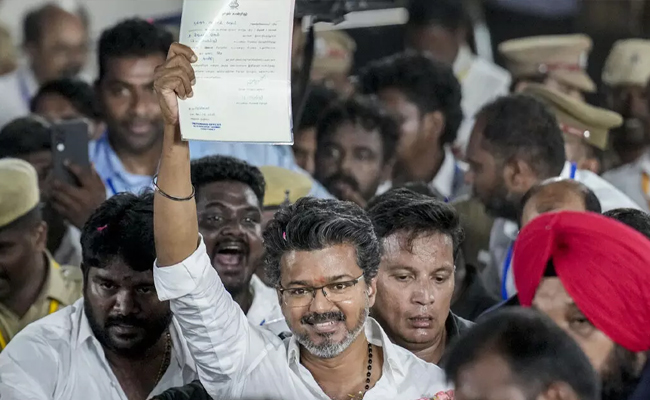
Chennai: After four days of political uncertainty and intense negotiations in Tamil Nadu, actor-politician Vijay is learnt to have secured the numbers required to form the government, sources said.
Supporters gathered outside Vijay’s residence in Chennai on Friday evening, raising slogans in support of Tamilaga Vettri Kazhagam soon after reports emerged that the party had managed to secure majority support.
Sources said Vijay is expected to meet Tamil Nadu Governor R. V. Arlekar on Friday evening to stake claim to form the government. The meeting is likely to take place around 6 pm.
In its electoral debut in the Tamil Nadu Assembly elections, TVK won 108 out of the 234 seats, dealing a major blow to the 62-year political dominance of Dravida Munnetra Kazhagam and All India Anna Dravida Munnetra Kazhagam.
However, Governor Arlekar had reportedly made it clear that the party would not be invited to form the government without proving a clear majority. Even after two rounds of discussions on Wednesday and Thursday, the Governor is learnt to have maintained his stand that letters of support from at least 118 MLAs must be submitted in the 234-member Assembly.
Apart from Vijay, TVK had the backing of 107 MLAs. Vijay had contested from Tiruchy (East) and Perambur constituencies and won both seats, meaning he would have to resign from one seat before taking oath. This increased the need for additional support.
Amid the political developments, five MLAs from the Congress party, which reportedly moved away from the DMK-led alliance, extended support to Vijay. Vijay also held discussions with leaders of Viduthalai Chiruthaigal Katchi, Communist Party of India (Marxist) and Communist Party of India.
The VCK, CPI(M) and CPI had so far been allies of the DMK. At the same time, political discussions intensified in the state over speculation that the DMK could even explore a post-poll understanding with its long-time rival AIADMK to prevent an alternative government from taking shape.
Reports had been circulating since Friday afternoon that the VCK and Left parties were likely to support Vijay. Sources later said that the VCK, CPI(M) and CPI agreed to extend the support of two MLAs each, helping TVK cross the required majority mark.
All eyes are now on the Governor’s next move and the official announcement regarding the formation of the new government in Tamil Nadu.