Doctor can abort over 20-week pregnancy to save woman's life: Bombay High Court
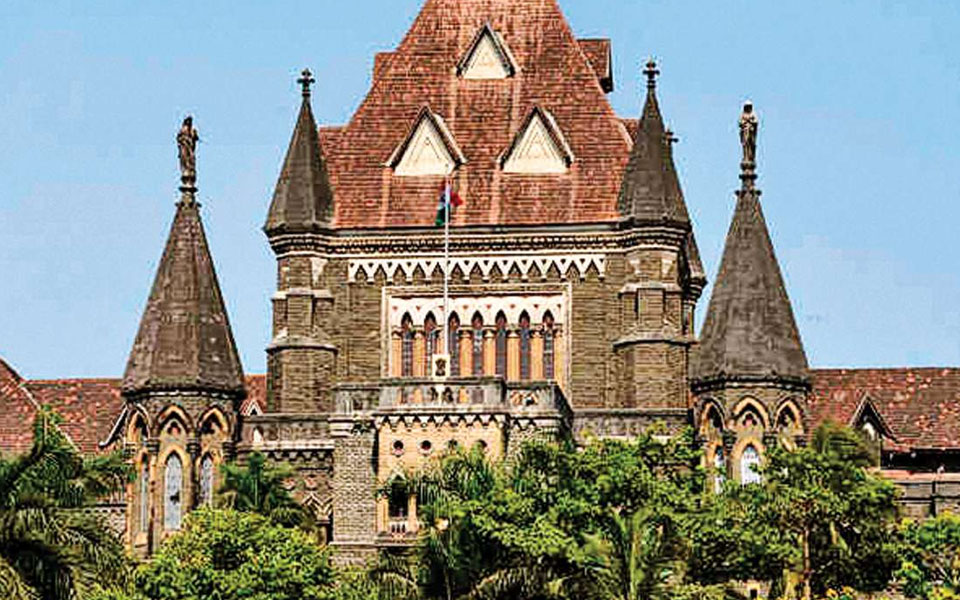
Mumbai: A registered doctor can terminate a pregnancy that has crossed the 20-week period without permission from the court only if it poses risk to the woman's life, the Bombay High Court has ruled.
A division bench of Justices A S Oka and M S Sonak in its judgement on Wednesday, however, said permission from either the HC or the Supreme Court will have to be sought when a pregnancy has exceeded 20 weeks and the woman feels its continuation would involve risk to her or the foetus' mental/ physical health.
The bench also directed the Maharashtra government to constitute medical boards at district levels within three months to examine pregnant women, who wish to terminate their pregnancy after it has crossed the 20-week period.
Under provisions of the Medical Termination of Pregnancy (MTP) Act, a pregnancy that has crossed the 20-week period cannot be terminated.
The bench in its order noted that there has been an increase in number of pleas in the high court by women seeking to terminate pregnancy either on grounds that the foetus developed abnormalities or because continuation of the pregnancy was causing mental or physical anguish.
The bench said high courts can permit women to undergo medical termination of their pregnancy in contingencies even though its length may have exceeded 20 weeks.
"In cases where a registered medical practitioner is of the opinion, formed in good faith, that termination of pregnancy, which has exceeded 20 weeks, is immediately necessary to save the life of the pregnant woman, there is no necessity for even seeking any permission," the court said.
"Thus, if a doctor is of the opinion that if the pregnancy is not medically terminated immediately the woman may die, then it is the duty of such a doctor to undertake the termination process and the MTP Act provisions will afford immunity to such doctors," it said.
The bench said permission from HC will be necessary if a woman seeks to medically terminate her pregnancy not on the grounds that are not immediately required to save her life, but on grounds like its continuance would involve grave injury to her physical/mental health and/or there is substantial risk that the child when born would suffer from abnormalities.
The court also made it clear that if despite attempts at medical termination of pregnancy the child is born alive, then the doctor and the hospital concerned will have to assume full responsibility to ensure the baby is offered the best medical treatment.
"Though there is a debate as to whether the foetus is a person entitled to rights, there is no debate on the issue that a child born alive is a person, in whom the right to life and personal liberty inheres," the court said.
"We make it clear that under no circumstances such a child must be neglected or left to perish, particularly where the woman or her family members may not be in a position to or not willing to assume responsibility," it said.
The court observed that in ideal situations, the instinct of the parents will no doubt take over when it comes to the love and care to be offered to such a child.
"However, in the unfortunate situation where, for several myriad factors, the parents are unwilling or genuinely not in a position to care for the child, then the state government will assume parental responsibility towards such a child," the court said.
The bench directed the government to frame a policy to address such situations and sought an affidavit of compliance from the state health secretary on July 8.
Let the Truth be known. If you read VB and like VB, please be a VB Supporter and Help us deliver the Truth to one and all.
Punjab CM Mann meets President Murmu, seeks cancellation of membership of 6 RS members
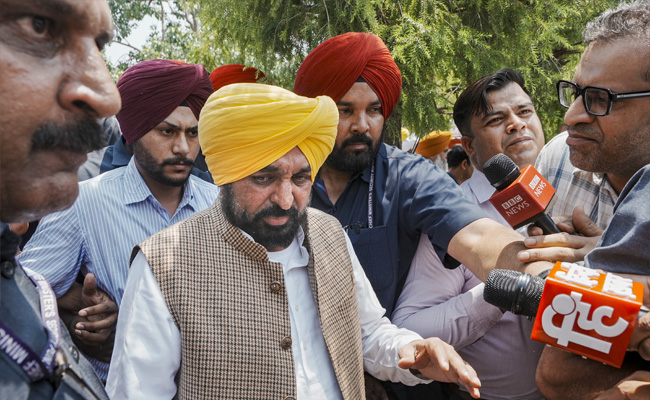
Chandigarh (PTI): Chief Minister Bhagwant Mann on Tuesday met President Droupadi Murmu, demanding the termination of the membership of six Rajya Sabha MPs from Punjab who defected to the BJP and also pressed for the introduction of a constitutional provision allowing for the recall of members.
Accompanied by party MLAs and ministers, Mann visited Rashtrapati Bhavan in Delhi.
This meeting followed a significant setback for the Aam Aadmi Party (AAP) on April 24, when seven of its 10 Rajya Sabha MPs -- Raghav Chadha, Ashok Mittal, Sandeep Pathak, Harbhajan Singh, Rajendra Gupta, Vikramjit Sahney and Swati Maliwal -- quit and merged with the BJP, alleging that the party had strayed from its principles, values and core morals. Six of the seven MPs who left AAP hailed from Punjab.
After he met with the President, Mann addressed the media here, describing the departure of the seven MPs as a "murder" of the Constitution. He stated, "Seven MPs merging with another party is completely unconstitutional. I spoke to Rashtrapati ji in detail."
Mann pointed out that he told the President that the BJP holds only two MLA seats (in Punjab), yet now has six MPs in the Rajya Sabha. He questioned, "How can this be possible? Isn't it a mockery of the Constitution?
"If they are such revolutionaries at heart, then they should have resigned from their six seats. The AAP could have sent someone else," Mann said, taking a swipe at them.
He emphasised the need for a recall provision in the Constitution, referencing MP Raghav Chadha's previous demands for such a measure when members fail to meet public expectations.
"Have you lived up to the expectations of the people?" Mann challenged the MPs during his statement.
Mann also presented a letter to the President, signed by all AAP MLAs. He differentiated between the terms 'elected' and 'selected,' stating, "They were 'selected.' Therefore, their membership should be cancelled."
The President assured Mann that she would consult constitutional experts before responding.
Earlier in the day, Mann, along with party MLAs, departed for Delhi from Chandigarh.
Speaking to reporters in Chandigarh, Mann affirmed that all AAP MLAs stand united with the party. "Only I have been given time for the meeting," Mann said.
"The President is the guardian of the Constitution. She is the constitutional head of the country," he added.
Later in a post on X in Hindi, Mann said, "Our struggle to protect Punjab's rights and interests continues. Today, along with all AAP MLAs, I have left to discuss Punjab's burning issues and present the state's strong voice before the President.
As your public servant, our government remains fully committed to Punjab's prosperity and the safeguarding of the rights of every section of society."
The MLAs and ministers gathered at the chief minister's residence in the morning before heading to Delhi, carrying placards that read 'Punjab Mann De Naal' and 'Punjab's Traitors.'
The legislators left for Delhi in buses.
Mann had previously sought an appointment with the President to meet with party MLAs and demand the "recall" of the Rajya Sabha MPs who defected to the BJP. However, only Mann was given a time slot for the meeting.