Doctor ends life, suicide note on palm claims cop raped her
Satara (PTI): A woman doctor working at a government hospital in Maharashtra’s Satara district has died by suicide, leaving a note on her palm, accusing two cops of rape and mental harassment, police said on Friday.
Chief Minister Devendra Fadnavis spoke to the Satara superintendent of police, ordering immediate suspension of the police officers named in the suicide note.
The 28-year-old doctor, who hailed from Beed district and worked at a government hospital in Phaltan tehsil, was found hanging in a hotel room at Phaltan late on Thursday night, an official said.
Fadnavis, who also holds the Home portfolio, has directed that strict action be taken against the accused, an official release said.
In a suicide note written on her palm, the doctor alleged that she had been raped and mentally harassed by two personnel of the Satara police over the last five months.
She wrote that sub-inspector Gopal Badane raped and sexually harassed her on multiple occasions, and another policeman Prashant Bankar mentally harassed her.
"We have registered a case, and the body has been sent for post-mortem. We are also investigating the allegations mentioned in the suicide note on the victim's hand," an official from the Satara police said.
Maharashtra Women's Commission chief Rupali Chakankar said, "We have taken cognisance of the matter and ordered Satara Police to take strict action against the accused.”
Maharashtra Legislative Council Deputy Chairperson Neelam Gorhe said the doctor’s suicide was a matter of concern. “This is a serious issue. I have written to CM Fadnavis, seeking stringent action against those involved,” Gorhe said.
“Environment minister Shambhuraj Desai, who hails from Satara district, has assured that there will be an impartial probe into the case,” Gorhe said.
Minister of state for health Meghna Bordikar said she spoke to the Satara civil surgeon and was informed that the doctor had never complained about facing any sort of harassment.
Describing the doctor’s suicide as a grave incident, Maharashtra Congress spokesperson Sachin Sawant said the incident highlights the breakdown of law and order situation in the state.
“The Fadnavis-led government has failed to protect women,” Sawant said.
Maharashtra minister Pankaja Munde said there should be no “media trial” in the doctor’s incident. “I am confident that CM Fadnavis, who also holds the Home portfolio, will ensure a thorough probe, including a detailed forensic investigation, in the case,” Munde said.
“She was bright and ambitious. We raised her since childhood and supported her education. She was under pressure at work and that is why she took this extreme step. The culprits must be punished,” said Prayaga Munde, the victim’s aunt.
Another aunt said, “Just two days ago, she mentioned being harassed by seniors at work.”
The doctor’s suicide has cast a pall of gloom in her Kotharban-Kavadgaon villages, where locals looked up to her as a symbol of determination and hope for rural girls.
They are now mourning her untimely demise.
Meanwhile, a relative of the doctor claimed that there was pressure on medical officials to change the post mortem report.
Let the Truth be known. If you read VB and like VB, please be a VB Supporter and Help us deliver the Truth to one and all.
Mamata alleges BJP disrupted her Bhabanipur rally, Suvendu claims 'she's nervous'
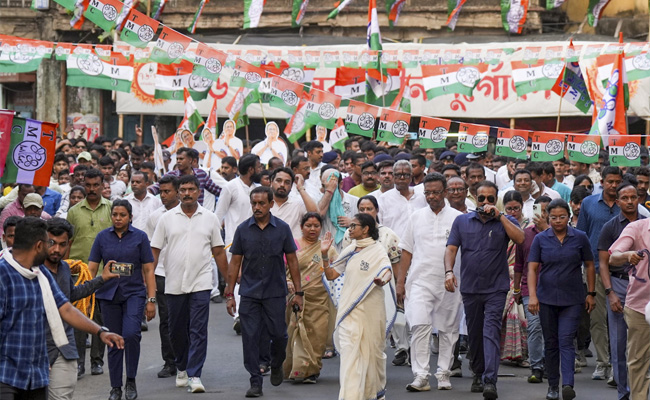
Kolkata (PTI): Chief Minister Mamata Banerjee cut short her speech at a rally in her Bhabanipur constituency, alleging that the BJP was deliberately playing loud music from a nearby public meeting.
A peeved Banerjee said despite having the required permission of the Election Commission, her rally in Chakraberia was disrupted by the BJP, "who want to capture Bengal by intimidation and threat".
"It is not possible for me to go ahead with this meeting. If they can do such a thing in my constituency, imagine how undemocratic the BJP is. If they behave like this, I have to take legal action," she said.
"This is an insult, humiliation. BJP is stepping on our toes to instigate trouble. Not possible to address the gathering in this situation. I am leaving the stage. Please vote for me in your protest," she added.
Banerjee was then seen calling someone over and venting her grievances.
Before leaving the stage, she said, "I will hold a rally tomorrow at the same spot."
TMC supporters then rushed towards the BJP rally, which was later addressed by Leader of the Opposition Suvendu Adhikari, but security personnel intervened and prevented the situation from escalating.
TMC workers later staged a demonstration outside the local police station and filed a complaint, alleging that the BJP violated the model code of conduct.
A senior TMC leader said another complaint will also be lodged with the Election Commission.
Asked about Banerjee's allegations, Adhikari told reporters after the rally he held nearby, "Her reaction shows she is nervous about the imminent loss."
"There was no violence, no obstruction in her meeting and her behaviour shows her nervousness. On May 4, people of Bhabanipur will celebrate the victory of the BJP," he claimed, alleging that the TMC also tried to disrupt his meeting by playing loud music.
South Kolkata's Bhabanipur, one of the battleground seats in the West Bengal elections, will vote in the second phase on April 29.