Doctor guides midwife over mobile to ensure safe delivery in flood-hit MP village
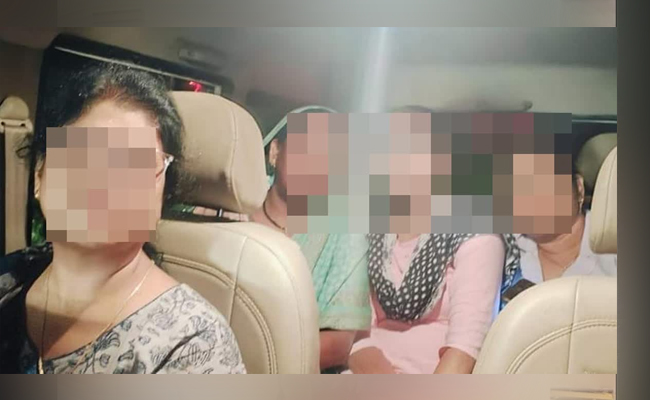
Seoni (MP) (PTI): A woman in labour; flooded streets; and a doctor giving step-by-step instructions over a mobile phone to ensure safe delivery.
The scene, reminiscent of one from the blockbuster ‘3 Idiots’, recently played out in Madhya Pradesh’s Seoni district, said health officials on Wednesday.
A lady doctor guided a midwife over a mobile phone after she could not reach a village due to flooded roads amid heavy rains, they said.
“There was a flood-like situation in the Jorawadi village on Monday when a woman, Raveena Uikey, went into labour. Her family decided to take her to the district hospital but could not succeed as the roads were inundated,” the official told PTI.
After being informed about Uikey’s condition, a team of health officials along with district health officer Dr Manisha Sirsam were sent to the village, but found all the approach roads waterlogged, he said.
When it became clear that the team would not be able to reach the village under any circumstances, Dr Sirsam phoned Uikey’s husband and asked him to call a trained midwife from the village to their house, the official said.
Sirsam then asked the midwife, Reshna Vanshkar, to follow her instructions over the phone for conducting the delivery of the “high-risk woman”. The midwife diligently followed them and ensured the safe birth of a pair of healthy twins, he said.
After the water level receded and roads became motorable, the woman and her newborn twins were admitted to the district hospital. “The mother and babies are doing fine,” said the health official.
However, unlike engineering students using a vacuum cleaner to conduct the delivery in the Amir Khan-starrer ‘3 Idiots’, the settings in Seoni were a bit real, quipped the official.
Let the Truth be known. If you read VB and like VB, please be a VB Supporter and Help us deliver the Truth to one and all.
SC to hear pleas for reviewing wages of priests, temple staff
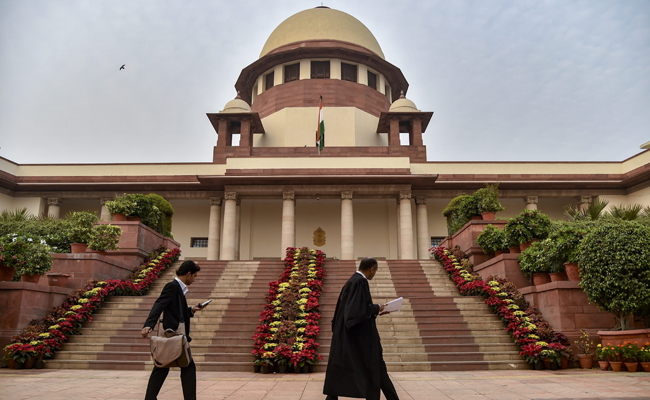
New Delhi (PTI): The Supreme Court is scheduled to hear on Monday a plea to constitute a judicial commission or an expert committee to review the wages and other benefits given to priests, 'sevadars' and temple staff in state-controlled temples.
A bench of Justices Vikram Nath and Sandeep Mehta is likely to hear the PIL filed by advocate Ashwini Upadhyay.
The plea, filed through advocate Ashwani Dubey, seeks directions to the Centre and states to constitute a judicial commission or an expert committee to review the remuneration and other benefits given to the priests and temple staff in state-controlled temples.
"Petitioner also seeks a declaration that priests and temple staff are employee' under Section 2(k) of the Code on Wages, 2019. Petitioner submits that once the State assumes the administrative, economic and financial control over temples, an employer-employee relationship arises and denial of dignified wages to priests and temple staff violates the right to livelihood guaranteed under Article 21," it said.
Upadhyay said the cause of action accrued on April 4, when he went to Varanasi to attend a public programme and after performing 'Rudrabhishek' in the Kashi Vishwanath temple, which is controlled by the state, he came to know that even the minimum wages to live with dignity are not given to the priests and temple staff.
"Recently, in Andhra Pradesh and Telangana, priests and temple staff organised a large-scale protest demanding the minimum wages. Priests and temple staff are not getting even the minimum wage prescribed by the State for unskilled and semi-skilled workers. This is a systemic exploitation. State is acting as a model employer through the endowments department, but violating the minimum wages Act and the directive principles of state policy (Article 43)," it said.
The plea further said the continued refusal to meet the minimum wages with the 2026 inflation-adjusted cost of living index has forced the petitioner to seek judicial intervention to prevent the further marginalisation of priests and temple staff.
Upadhyay further said the precarious nature of livelihood was starkly exposed on February 7, 2025, when a Tamil Nadu department issued a circular at the 'Dandayuthapani Swami Temple' in Madurai, strictly prohibiting priests from accepting 'dakshina' in 'aarti plates'.
"It is necessary to state that priests in such temples often receive no formal salary from the State and rely entirely on 'Dakshina'; the State's administrative order directly threatened them with starvation. Although withdrawn due to public outrage, the incident highlights the State's arbitrary power over the survival of the priests. This is also a bitter truth that States are controlling lakhs of temples but not a single mosque or church," the PIL claimed.
The petition, alternatively, sought direction to the Centre and states to take appropriate steps for the welfare of priests, sevadars and other temple staff in the spirit of the Allahabad High Court's earlier judgments.