Doctors' protest against National Medical Commission Bill continues
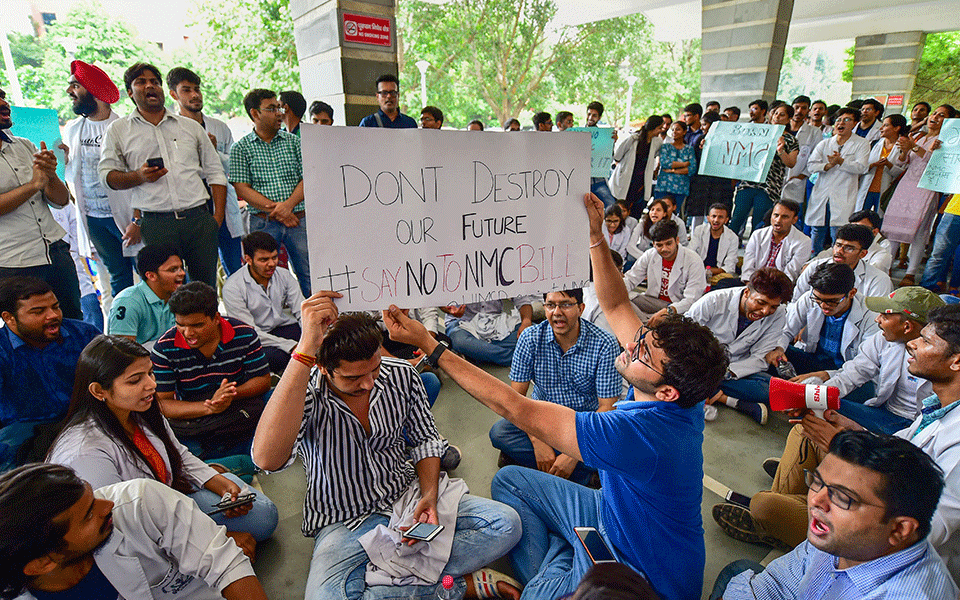
New Delhi: Healthcare services at many government hospitals were affected for the second consecutive day on Friday as resident doctors continued their strike and withdrew all services, including that at the emergency department, in protest against the National Medical Commission Bill.
They also threatened to continue their strike for an indefinite period if their concerns regarding the bill were not addressed.
The resident doctors' associations of AIIMS, Safdarjung, RML and those attached with FORDA and URDA decided to continue their strike following meetings held till late night, after the passage of the National Medical Commission Bill in Rajya Sabha.
A meeting between Union Health Minister Harsh Vardhan and a delegation of resident doctors of various hospitals was currently underway.
On Thursday, Rajya Sabha had passed the National Medical Commission Bill for replacing the corruption-plagued MCI with a new body, in what was described by the government as one of the biggest reforms for medical education in the country. The bill will now go to Lok Sabha again as two amendments need to be approved by it.
Hundreds of doctors at several government hospitals, including AIIMS, RML Hospital, Safdarjung Hospital and LNJP Hospital, boycotted work, held marches and raised slogans to protest against the bill.
Protests by resident doctors and undergraduate students of AIIMS and Safdarjung hospitals hit traffic on the stretch of road between Ring Road and Parliament as they tried to march towards Parliament on Thursday. They were detained by police and later let off.
Another group of doctors, associated with Federation of Resident Doctors' Association (FORDA), who had planned to march to Parliament from RML Hospital, were prevented from venturing out, FORDA's general secretary Dr Sunil Arora claimed.
Patients unaware of the stir reached hospitals only to return or wait interminably to be attended.
Resident doctors of Lok Nayak Jayaprakash Hospital, B R Ambedkar Medical College and Hospital, DDU Hospital and Sanjay Gandhi Memorial Hospital also boycotted work and joined the stir.
Hospitals in the national capital put in place contingency plans as regular services were severely affected.
The emergency departments and ICUs at many hospitals were managed with the help of faculty members, sponsored residents, pool officers, faculty members of other medical or surgical departments, while OPDs, radio-diagnosis and laboratory diagnosis services functioned on a "restricted basis" in some health facilities and shut at many other places.
Routine surgeries were cancelled and only emergency cases were being performed at several facilities, authorities said. The medical fraternity is opposing the bill saying it is "anti-poor, anti-student and undemocratic".
The Indian Medical Association, which has also expressed reservations over several sections of the bill, had given a call for a 24-hour withdrawal of non-essential services on Wednesday across the country.
"The provisions of the said bill are nothing short of draconian and promote gross incompetence and mockery of professionals currently working day and night and sacrificing their youth for this broken system," the AIIMS RDA, the FORDA and the Untied-RDA had said in a joint statement.
Let the Truth be known. If you read VB and like VB, please be a VB Supporter and Help us deliver the Truth to one and all.
Voting begins for Assam''s 126 assembly seats
_vb_85.jpeg)
Guwahati (PTI): Polling for all 126 Assam assembly constituencies began on Thursday to decide the electoral fate of 722 candidates, officials said.
In the high-stakes election, the ruling BJP is aiming for a third consecutive term in office, while the Congress seeks to wrest power after being ousted in 2016.
Polling, being held in a single phase, began at 7 am and will conclude at 5 pm. Long queues of voters were seen outside polling stations from early morning.
An electorate of 2.50 crore, including 1.25 crore women and 318 from the third gender, can exercise their franchise in 31,490 polling stations across the state.
Prominent candidates include Chief Minister Himanta Biswa Sarma, Congress state president Gaurav Gogoi, assembly Speaker Biswajit Daimary, Leader of the opposition Debabrata Saikia, AIUDF chief Badruddin Ajmal, Raijor Dal president Akhil Gogoi, and Assam Jatiya Parishad (AJP) chief Lurinjyoti Gogoi.
Several cabinet ministers, including the AGP’s Atul Bora and Keshav Mahanta, and the BPF’s Charan Boro are also in the fray.
The Congress has the highest of 99 contestants, followed by the BJP (90), AIUDF (30), NDA allies AGP (26) and BPF (11).
Opposition alliance’s Raijor Dal is contesting in 13, AJP in 10, CPI(M) in 3 and APHLC in 2. Outside the two coalitions, the AAP is contesting in 18 seats, UPPL in 18, TMC 22, JMM 16 and there are 258 independents.
The ruling NDA’s main constituents are the BJP, Asom Gana Parishad (AGP) and the Bodo Peoples’ Front (BPF) while the opposition alliance comprises the Congress, Raijor Dal, Assam Jatiya Parishad (AJP), CPI(M), All Party Hill Leaders Conference (APHLC) and CPI(ML).
The counting of votes is scheduled on May 4.
_vb_34.jpeg)
_vb_49.jpeg)