Don't allow Navlakha plea for house arrest otherwise HC will be flooded with such requests: NIA
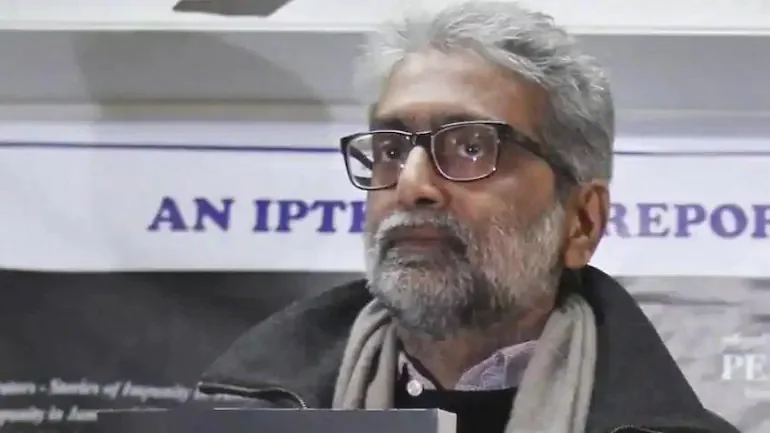
Mumbai, Apr 5: The National Investigation Agency (NIA) on Tuesday urged the Bombay High Court to not grant to jailed human rights activist Gautam Navlakha, an accused in the Elgar Parishad-Maoists link case, the relief of house arrest, arguing doing so would result in difficulties, including the inability to prevent him from using social media while out of prison.
Use of social media or the Internet by Navlakha could prove to be dangerous, NIA counsel, Additional Solicitor General Anil Singh, said while opposing the septuagenarian activist's plea that he be kept under house arrest.
Singh said if the court permitted Navlakha to be shifted out of jail and placed under house arrest until the trial in the case ended, Maharashtra and Union government authorities will have several difficulties in implementing such an order.
The Additional Solicitor General said the grounds cited by Navlakha's counsel, Yug Chaudhry, for house arrest were common grievances such as the Taloja prison in Navi Mumbai, where the activist is lodged, being overcrowded and his client suffering from hypertension.
"Today, issues like hypertension, diabetes are common. Where is the question of house arrest? Tomorrow, this court will be flooded, it will become like a market with thousands of jail inmates asking for house arrest," Singh said.
Chaudhry, however, termed Singh's apprehension of being flooded with requests for house arrest from jail inmates as unfounded.
"Police guards can be posted outside his (Navlakha's) house, but how will the court stop him from using social media, the Internet in his house? This is very dangerous. He is an accused in a matter concerning national security and he wants to stay in his house," Singh said.
The NIA counsel further said it was common knowledge that India was a crowded nation and that the city of Mumbai was overcrowded. Therefore, the Taloja prison being overcrowded was not an adequate reason for grant of house arrest.
The Maharashtra government, too, opposed Navlakha's plea and told a bench of Justices SB Shukre and GA Sanap that the prison authorities will provide requisite medical care to the activist.
The state's counsel, Sangeeta Shinde, refuted allegations of denial of basic medical care and other necessities made by Navlakha against the prison authorities. "He has been kept in a high security cell and he is the only one in his cell," she said.
Shinde maintained that Navlakha's allegations on the prison toilets being unhygienic were incorrect since those lodged in high security cells were required to clean their cells and toilets themselves. "He has been provided with phenyl and acid (for cleaning purposes)," Shinde said.
Responding to the HC's previous query on a book by noted English author and humorist PG Wodehouse being denied to Navlakha by jail officials on ground of security threat, the state counsel said the book had been sent by the activist's family at a time when the coronavirus pandemic was raging and as a security measure, no parcels from outside were allowed in the prison.
The HC, however, refused to accept the justification and pointed out that the prison authorities had merely mentioned "security threat" as ground for not allowing access of the book to the activist and not mentioned COVID-19 as a reason at all in their written affidavit filed before the court.
Advocate Chaudhry told the HC that the state and the NIA's apprehension of the court being flooded with requests for house arrest were unfounded since as per the NHRC data, only 1,874 inmates above the age of 50 were lodged as undertrials in Maharashtra and that just about 20 per cent of them were likely to be above the age of 70.
"Please don't let the fear of the dragon scare your lordships from implementing the green signal given by the Supreme Court on house arrest," Chaudhry told the bench.
The HC closed all arguments in the case and reserved its verdict on Navlakha's plea.
Let the Truth be known. If you read VB and like VB, please be a VB Supporter and Help us deliver the Truth to one and all.
Justice Swarana K Sharma starts contempt case against Kejriwal, Manish Sisodia over excise posts

New Delhi (PTI): Delhi High Court judge Justice Swarana Kanta Sharma on Thursday initiated criminal contempt proceedings against AAP leaders Arvind Kejriwal, Manish Sisodia, Durgesh Pathak, Sanjay Singh, Saurabh Bhardwaj and others over their "vilifying" social media posts against her in relation to the excise policy case.
Justice Sharma said the former Delhi chief minister "orchestrated a calculated campaign" of vilification against her on social media instead of pursuing his legal remedies and clarified that the CBI's petition against the discharge of all accused persons would now be taken up by another bench.
The judge took exception to several social media posts by the proposed contemnors that attributed "political allegiance" to her and allegedly targeted her by posting a misleading "edited" video of a speech given by her at an educational institution in Varanasi.
"Arvind Kejriwal sought to destroy my reputation instead of availing legal remedies after I refused to recuse and a deliberate attempt to lower the court's authority can't be permitted in guise of free speech," Justice Sharma said.
She clarified that she was not recusing herself but was only transferring the case to another bench as she has initiated the contempt proceedings.
Solicitor General Tushar Mehta, appearing for CBI, thanked Justice Sharma for upholding the institution's dignity.