Don't be distracted by contentious issues: President to citizens
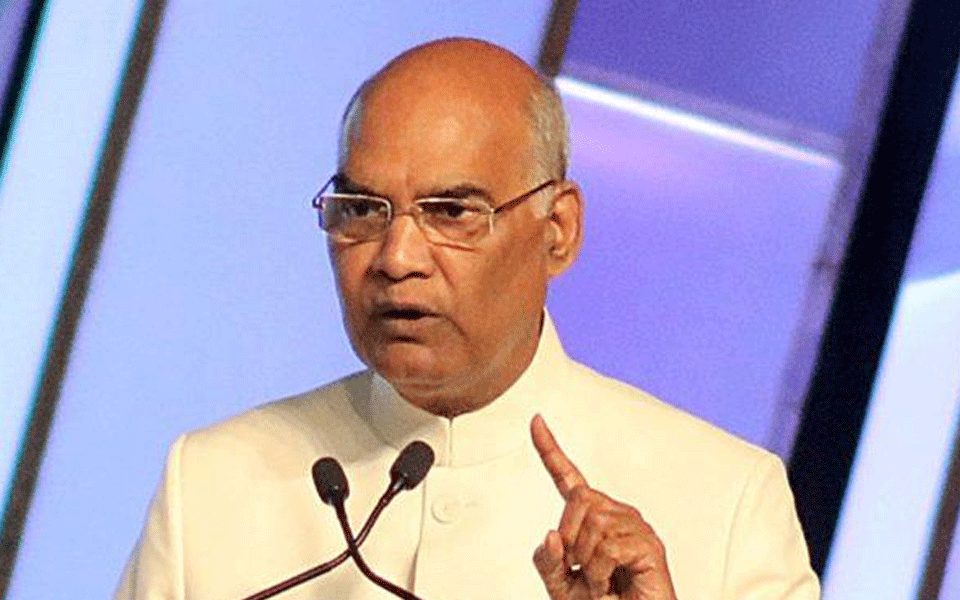
New Delhi, Aug 14 : Asserting that India was at the cusp of achieving many of its long-awaited goals, President Ram Nath Kovind on Tuesday said "contentious issues and extraneous debates" should not distract the people.
In his address to the nation on the eve of 72nd Independence Day, he referred to various issues and said these may have held true 10 or 20 years ago or even earlier to some extent but "even so we are at a juncture in our history that is different from any period that we have so far experienced".
"We are at the cusp of achieving many of our long-awaited goals. Universal access to electricity, the elimination of open defecation, the elimination of homelessness, the very elimination of extreme poverty is achievable and attainable. We are at a pivotal moment. Let contentious issues and extraneous debates not distract us," he said.
Kovind said if freedom was defined in narrow political terms, then August 15, 1947 marks a closure.
"But freedom is a broader concept. It is not fixed and finite. Freedom is a constant and relentless endeavour. Even decades after 1947, each one of us can contribute in the manner of a freedom fighter. We can do so if we expand the frontiers of freedom and of opportunity for our fellow Indians and our beloved India."
Referring to the resolve of various sections in nation building, the President said that the reality was that every Indian who does his or her job with sincerity and commitment, who contributes to society by being true to a professional ethic, be it the doctor's ethic, the nurse's ethic, the teacher's ethic, the public servant's ethic, the factory worker's ethic, the business person's ethic, the ethic of those who have to care for ageing parents - each of these and many others are in their own way upholding the values of freedom.
"They are providing the fruits and goods and services of freedom to fellow citizens. Every citizen of India who does his or her duty sincerely, fulfils a personal and professional obligation and keeps to a given word is, at a fundamental level, upholding the principles of our freedom struggle," he said.
"I would argue that every Indian who does not jump the queue and respects the civic space and rights of those ahead in the line also lives up to the principles of our freedom struggle. It's a very small gesture. Let us try and abide by it."
Kovind said the freedom that came at midnight on August 14-15, 1947 was the result of years and decades and centuries of sacrifice and valour on the part of India's ancestors and freedom fighters.
"They could easily have compromised and settled for some personal benefit, but they did not. Their commitment to India - to a free, sovereign, plural and egalitarian India - was absolute. It was my privilege to honour these freedom fighters on the anniversary of 'Quit India Day' on August 9 in Rashtrapati Bhavan."
The President said after four years India would be marking the 75th anniversary of Independence and in less than 30 years the people would celebrate the 100th anniversary of India as a free nation.
"The decisions we take today, the foundations we lay today, the projects we undertake today, the social and economic investments we make today - whether for the immediate future or for the medium term - will determine where we stand. The pace of change and development in our country is rapid and appreciable. And as per our civilisational traditions, it is driven by our people, by civil society and by a partnership between citizen and government. Its focus, again in keeping with the essence of Indian thought, is on a better life for the less fortunate," he said.
He also referred to the beginning of commemoration of the 150th birthday on Mahatma Gandhi on October 2 and said Gandhi did not just lead India's freedom struggle.
"He was and still is our moral compass. In my capacity as the President of India, I have been fortunate to have travelled around the world, particularly to a few countries of Africa. Everywhere, across continents, Gandhiji is mentioned, cherished and remembered as an icon for all humanity. He is the embodiment of India," he said.
Recalling Gandhi's cleaniness campaign along with his wife Kasturba in Bihar's Champaran even in the middle of struggle for freedom, the President quoted him as saying: "Struggle was not just for political power but for empowering the poorest of the poor, educating the uneducated and ensuring the right to a dignified life."
He also referred to Gandhi's principle of non-violence and said each Indian should adopt his ideas and maxims in everyday work and conduct.
"Together we can eliminate, illiteracy and inequality. We can and we must do this together. The government has a leading role but not the sole role. Let us use the government's programmes and projects to further our own efforts. Let us make that sense of ownership our motivation," the President said.
Let the Truth be known. If you read VB and like VB, please be a VB Supporter and Help us deliver the Truth to one and all.
TN polls: TVK pushes DMK behind with leads in 83 seats, AIADMK ahead in 54
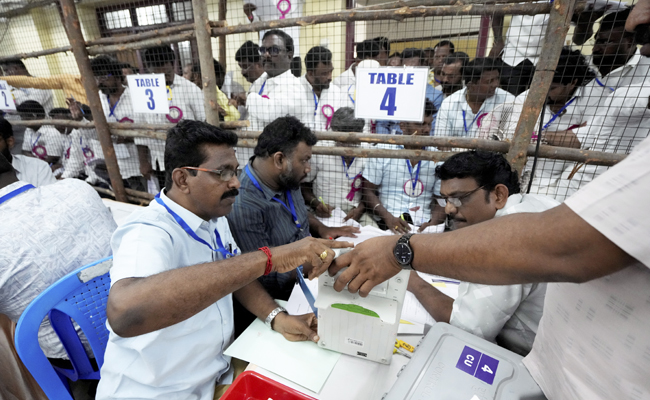
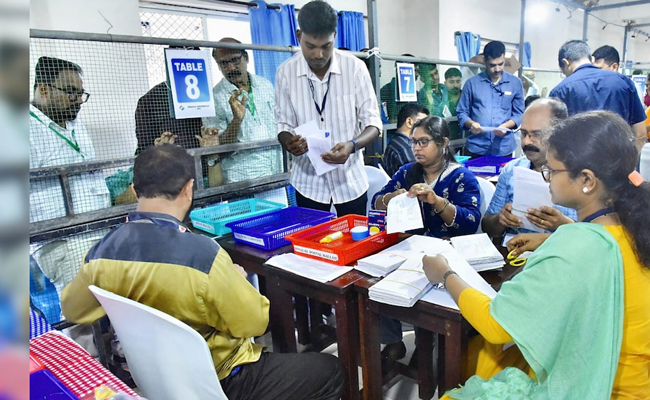
Chennai (PTI): New entrant TVK, led by actor-politician Vijay, was leading in as many as 83 constituencies on Monday when counting of votes polled in the April 23 Assembly polls was on across Tamil Nadu. The AIADMK was leading in 58 seats while the ruling DMK was ahead in 34, EC data showed.
About two hours after the postal ballots were counted and EVMs opened for multi-round counting, Vijay's Tamilaga Vettri Kazhagam surged ahead of its Dravidian rivals-- the DMK and the AIADMK, with the ruling party struggling to catch up.
If the trends maintain, Vijay could as well ensure the biggest electoral upset, something in lines with the "1967,1977" wins he had referred to in his campaign speeches.
While the Dravidian stalwart CN Annadurai brought the first non-Congress government in Tamil Nadu post-independence in 1967, the charismatic MG Ramachandran (MGR) installed the maiden AIADMK government 10 years later, unseating then DMK government under M Karunanidhi. TVK was leading in most Chennai segments, all considered DMK strongholds and currently represented by the party in the 234-member House.
A poor show by DMK could belie most exit polls giving an edge to it, riding on the number of populist measures Chief Minister M K Stalin had implemented in his five year "Dravidian model," inclusive governance.
According to EC and TV reports, 15 cabinet ministers, including Stalin were trailing. His son and deputy CM Udhayanidhi was also behind in his incumbent Chepauk-Tirvuvallikeni seat, according to a number of reports.
Stalin was trailing behind TVK's VS Babu by 1234 votes in Kolathur segment. Vijay was ahead in Tiruchirappalli East by over 3,000 votes at the end of two rounds of counting, according to EC data.
BJP is trailing in 26 constituencies and it is ahead in Thali segment alone. TVK is ahead in constituencies including Ponneri, Tiruvallur, Poonamalle, and Avadi.
AIADMK is leading in segments including Katpadi, and Guidyattam and party chief Edappadi K Palaniswami is ahead in Edappadi segment by 7003 votes.
DMK was leading in segments including Vellore, Anaikattu and Rishivandiyam.