Don't need BJP's money, Bengal has enough to rebuild Vidyasagar statue: Mamata Banerjee
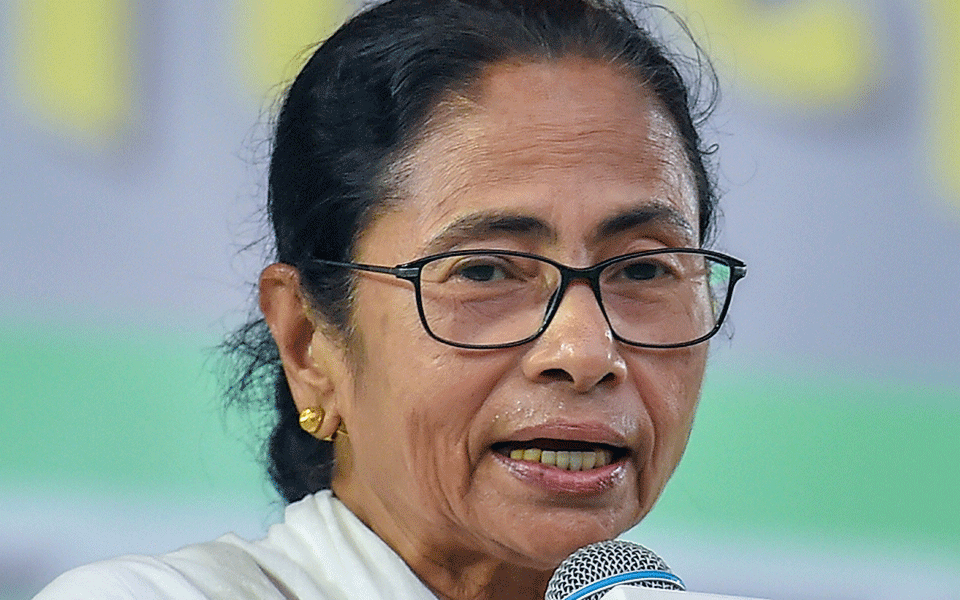
Mandirbazar (WB): Chief Minister Mamata Banerjee said Thursday Bengal does not need money from the BJP, it has enough resources to rebuild the Vidyasagar statue that was vandalised at a Kolkata college following Amit Shah's roadshow.
Prime Minister Narendra Modi, during a rally in Uttar Pradesh, had promised to install the statue at the same spot where it stood before being desecrated on Tuesday.
Addressing a rally here, Banerjee said, "Modi has promised to rebuild the Vidyasagar statue in Kolkata. Why should we take their (BJP's) money, Bengal has enough resources."
She also attacked the BJP, claiming that vandalising statues was one of its habits and that the party has done so in Tripura as well.
"The BJP has destroyed 200-year-old heritage of West Bengal, those supporting the party will not be accepted by the society," she warned.
Hitting out at the saffron party over its social media posts, the Trinamool Congress supremo also said that the BJP had been spreading canards over Facebook and Twitter.
"The BJP is trying to instigate people and cause riots with its fake posts on social media," she added.
Let the Truth be known. If you read VB and like VB, please be a VB Supporter and Help us deliver the Truth to one and all.
Four booked for tying 18-year-old to tree, beating him up in UP's Pratapgarh
Pratapgarh (UP) (PTI): Four people were booked here for the abduction and assault of a man who they allegedly tied to a tree and beat up, police said on Wednesday.
The incident, a video of which has gone viral, took place on Tuesday afternoon under the Kunda police station limits.
The FIR was registered on Wednesday evening based on a complaint from the victim's father.
According to Keshav Prasad Yadav, a resident of Mauli village, some people called his 18-year-old son Nikhil Yadav on the phone and asked him to come out of his house around 2.30 pm on Tuesday.
As he reached outside the village as instructed, the accused allegedly forced him into a car and took him towards the Tinpedwa forest area, where they tied him to a tree and assaulted, the complainant said.
The attackers also recorded a video of the incident and circulated it on social media. The purported video shows the men thrashing Nikhil one after another, while one of them is assumed to have recorded the act.
Kunda Station House Officer Manoj Pandey confirmed the incident and said efforts are underway to identify and arrest all the accused.
Meanwhile, Samajwadi Party president Akhilesh Yadav has shared the video on social media, describing the incident as reflective of a "dominant mindset" against the PDA (Pichda or Backward, Dalit, and Alpasankhyak or Minority), and demanded strict action against the accused.
_vb_80.png)