Don't worry about BJP's return to power: Owaisi to Muslims
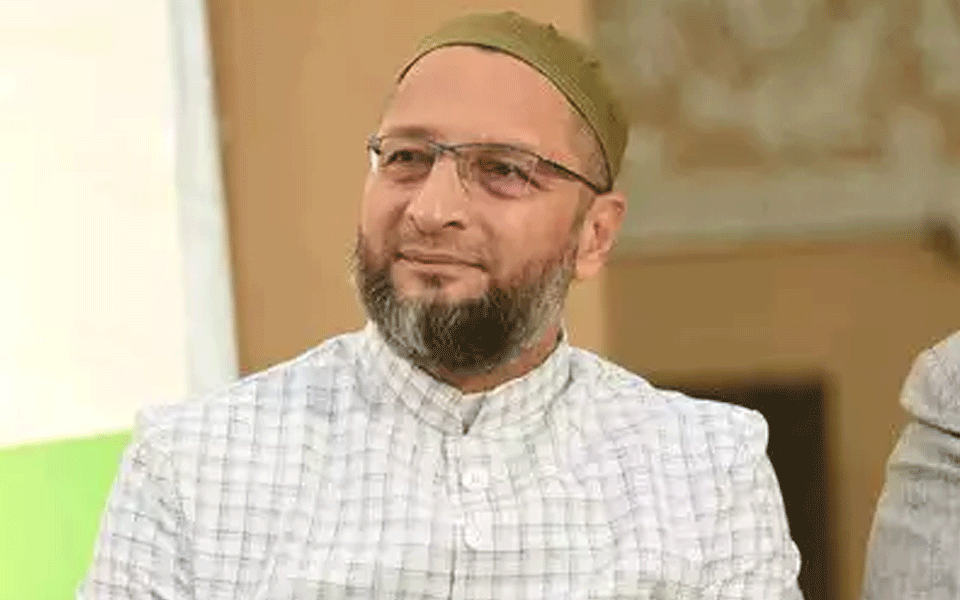
Hyderabad, May 31: AIMIM president Asaduddin Owaisi Friday said the country's Muslims should not worry about the BJP's return to power as the Constitution guarantees freedom of religion to every citizen.
The Hyderabad MP also hit out at the perpetrators of the April 21 Easter Sunday serial bomb blasts in Sri Lanka, which left more than 250 people dead.
The Bharatiya Janata Party capped a massive mandate by winning a total of 303 seats while the NDA has 353 MPs in the recently elected 17th Lok Sabha.
"India's law, Constitution gives us this permission that we follow our religion," the All India Majlis-e-Ittehadul Muslimeen chief said in his address to a gathering at the Makkah Masjid here.
"When India's Prime Minister Narendra Modi can go to a temple, you can proudly visit a mosque," he told the gathering.
Slamming those behind the terror attacks on churches and luxury hotels in the island nation, Owaisi said there was no place for violence in Islam.
The Islamic State group had claimed responsibility for the attack.
"Carrying out bomb blasts at a place of worship of someone else and killing more than 200 people, including 40 innocent children... what Islam are you talking about," Owaisi said.
The perpetrators were "following the teachings of the devil and not Islam", Owaisi added.
Let the Truth be known. If you read VB and like VB, please be a VB Supporter and Help us deliver the Truth to one and all.
Trump says EU has until July 4 to approve last year's trade deal or it will face higher tariffs
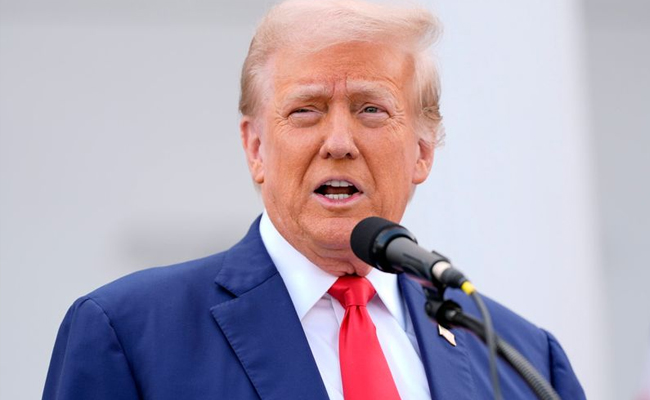
Washington (AP): President Donald Trump has said in a social media post that goods from the European Union would face higher tariff rates if the 27-member bloc fails to approve last year's trade framework by July 4.
The announcement on Thursday appeared to be a deadline extension after the president said last Friday that EU autos would face a higher 25 per cent tariff starting this week. Trump made the updated announcement after what he described as a "great call" with European Commission President Ursula von der Leyen.
Still, the US president was displeased that the European Parliament had yet to finalize the trade arrangement reached last year, which was further complicated in February by the US Supreme Court ruling that Trump lacked the legal authority to declare an economic emergency to impose the initial tariffs used to pressure the EU into talks.
"A promise was made that the EU would deliver their side of the Deal and, as per Agreement, cut their Tariffs to ZERO!" Trump posted. "I agreed to give her until our Country's 250th Birthday or, unfortunately, their Tariffs would immediately jump to much higher levels."
It was unclear from the post whether Trump was implying that the tariff rates would jump on all EU goods or the increase would only apply to autos.
His latest statement indicates he might be backing away from his earlier threat on EU autos by giving the European Parliament several more weeks to approve the agreement.
Under the original terms of the framework, the US would charge a 15 per cent tax on most goods imported from the EU.
But since the Supreme Court ruling, the administration has levied a 10 per cent tariff while investigating trade imbalances and national security issues, aiming to put in new tariffs to make up for lost revenues.