DRDO chief calls for synergy in developing explosive detectors
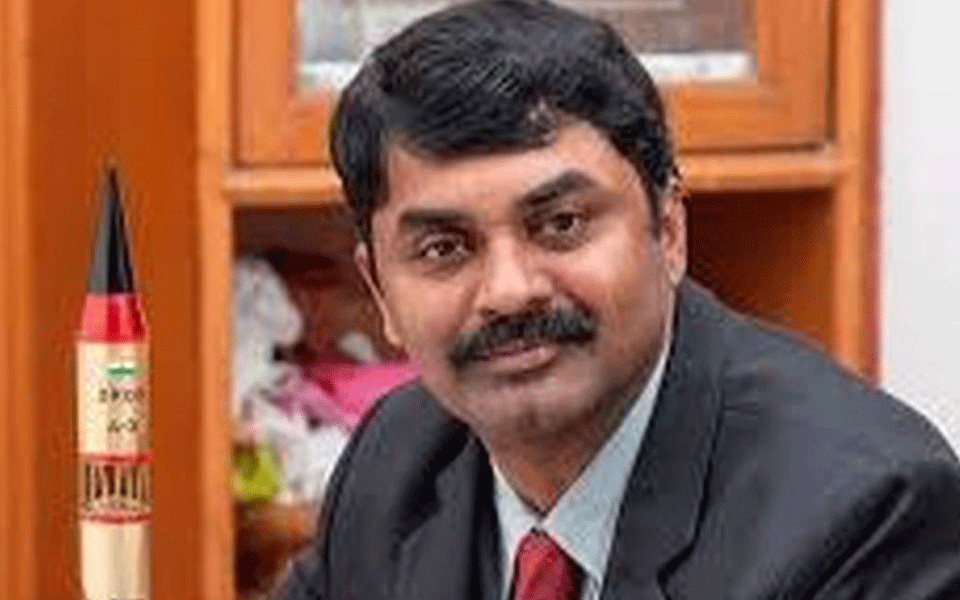
Pune: DRDO chairman Dr G Satheesh Reddy on Sunday said that with the rising terror activities, detection of explosives has become the need of the hour, and called upon the scientific institutes, academia and security forces to focus on explosive detection in bulk and trace forms.
He was speaking at a national workshop on Explosive Detection at the High Energy Material Research Laboratory (HEMRL) here.
"There is no universal solution in the field of explosive detection as it is constantly evolving. There is a need for a synergetic approach towards developing latest explosive detectors by bringing scientific institutes, academia, security agencies, armed forces and police on one platform," Reddy said.
"With increasing terrorist activities, detection of explosives became a compelling need of the hour. Security agencies are continuously suffering from Naxal and other attacks by inimical forces in various parts of the country," he said.
"To effectively thwart the attempts of these anti- social elements, academia, the Defence Research and Development Organisation (DRDO) and other scientific institutes must focus on the explosive detection in both bulk and trace forms," he added.
According to him, a number of technologies were evolving for detection of explosives.
"Particularly in a country like India, which is suffering from these attacks, both at the cross border and within, there has been continuous pressure from the nation and the security forces, agencies to develop various detection mechanism of these explosives," he said.
To fulfil the requirements, several labs under the DRDO, educational institutes have been trying to develop devices and instruments, Reddy added.
During a media interaction later, Reddy was asked if there was any possibility of a setting up a single entity in order to bring the efforts together. In his reply, he said that four laboratories under the DRDO were already working on it.
"We would like to have a steering committee, which will actually drive the outcome of this kind of conference, such as who will do what, the finance, requirements and other things," he said.
During the workshop, a new explosive detection device named 'Raider-X, developed by HEMRL, Pune and IIS Bangalore was launched. It is a rapid identification detector, used in the identification of wide range of explosives.
In his key-note address, Director of IISER, Bhopal, Dr Umapathy, mentioned that serious research on explosive detection technologies in academia started in India only a decade ago, which is now rapidly expanding.
He said no single technology would suffice to detect all types of explosives.
"Hence scientists should think of amalgamation of two or three technologies and come out with devices to provide a comprehensive solution," he added.
Jayant Naiknavare, DIG of ATS, Mumbai, called for the need to indigenously develop versatile explosive detection devices.
He said explosive detectors should be made available to the security agencies for countering the threats faced by the forces.
Around 250 delegates from different DRDO labs, Army, CRPF, CISF, BDDS, Police, academic institutes, industry and other security agencies took part in the workshop.
Let the Truth be known. If you read VB and like VB, please be a VB Supporter and Help us deliver the Truth to one and all.
Karnataka tanks hold strong water storage: Minister Boseraju
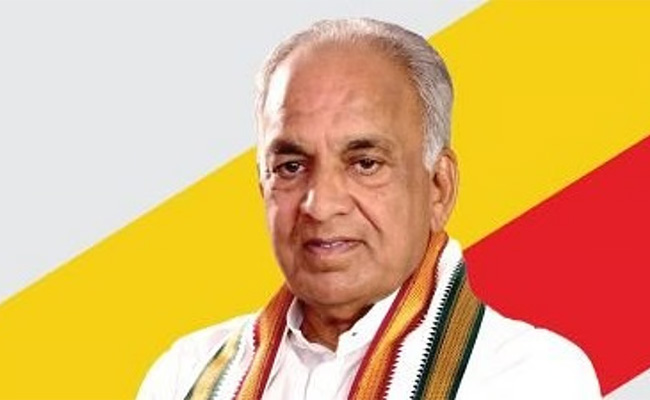
Bengaluru (PTI): Karnataka Minister N S Boseraju on Tuesday said that minor irrigation tanks across the state are holding good water storage levels, with the 3,788 tanks under the department’s jurisdiction providing life-sustaining water to a large agricultural command area of approximately 4,45,009 hectares.
In a statement, the Minister for Minor Irrigation, Boseraju, said that according to the latest data released by the department, a vast majority of the 3,788 minor irrigation tanks in the state have maintained good water levels.
Detailing the storage status, the report said that even in peak summer, 165 tanks are full.
Additionally, 1,355 tanks have retained more than 51 per cent capacity, 1,143 tanks have water levels up to 50 per cent, and 959 tanks are at roughly 30 per cent storage capacity.
District-wise, Davanagere leads the state in water storage, with 27 tanks remaining full even during summer. Chikkamagaluru follows closely with 46 full tanks, indicating strong water retention.
Other top-performing districts include Hassan, Tumakuru, and Kolar.
Boseraju, who also holds the portfolio of Science and Technology, said 1,184 tanks are being actively filled through 145 tank-filling lift irrigation projects under the Minor Irrigation Department.
He attributed the strong water retention to good monsoon rainfall and effective water management strategies of the government.
“It is encouraging to see such a substantial volume of water stored across our minor irrigation tanks by the end of March, remaining largely intact even as summer progresses. The fact that 1,355 tanks are nearly full and 165 tanks are brimming is a testament to the success of our tank-filling programmes and rejuvenation initiatives,” he said.
“By ensuring a continuous flow of water to these tanks through lift irrigation projects across departments, as well as supplying treated and surface water to the Bayaluseeme districts, we have taken proactive measures to prevent them from drying out during the summer,” the minister said.
According to him, these data points confirm that efforts to build a water-secure Karnataka are yielding strong results at the grassroots level.
“This water wealth preserved in our tanks will bring direct benefits to lakhs of farmers across the 4,45,009-hectare command area,” he added.