DRT directs Nirav Modi, aides to pay over Rs 7,200 cr to PNB and others
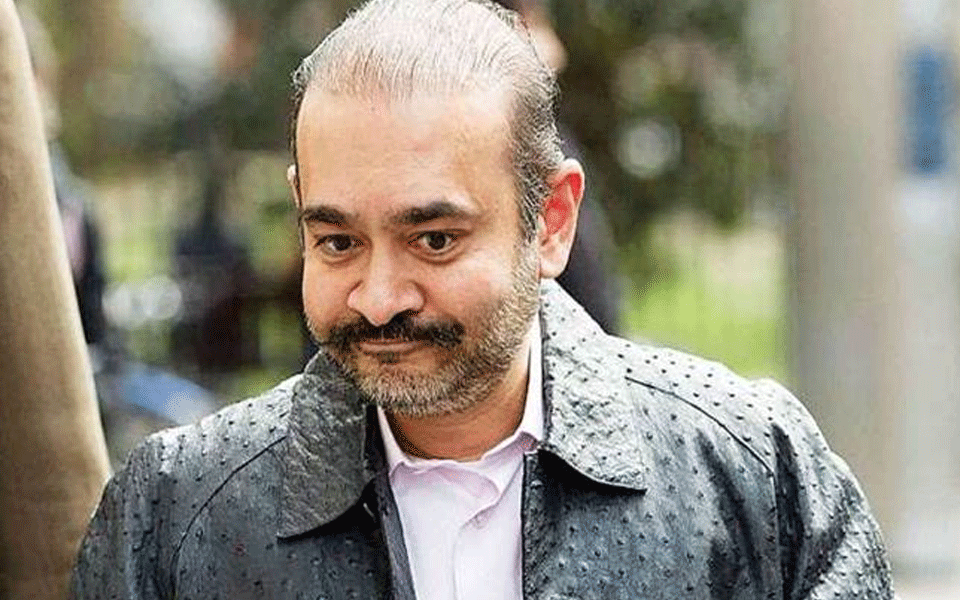
Pune, Jul 6: In fresh trouble for Nirav Modi, who is currently lodged in a London prison, the Pune bench of the Debt Recovery Tribunal (DRT) Saturday directed the fugitive diamond merchant and his aides to pay over Rs 7,200 crore with interest to the Punjab National Bank (PNB) and others.
Nirav Modi, 48, is wanted in India as the main accused in the PNB fraud and money laundering case amounting up to USD 2 billion.
On Saturday, Presiding Officer Deepak Thakkar, who holds additional charge of the Debt Recovery Tribunal (DRT), Mumbai, passed two orders in two cases in favour of the Punjab National Bank.
The PNB had approached the DRT last year seeking recovery of over Rs 7,029 crore.
Later, a consortium of banks, including the PNB, Oriental Bank of Commerce, Bank of India, Bank of Baroda, Bank of Maharashtra, UCO Bank, Corporation Bank and United Bank of India filed separate suits seeking recovery of Rs 232 crore.
"Defendant and his partners are ordered and directed to pay the applicant (PNB) either jointly or severally the aggregate sum of Rs 7,029 crore with interest of 14.30 per cent per annum from June 30, 2018," stated the DRT order.
In another order in the suit filed by the consortium of banks, the presiding officer directed Nirav Modi and others to pay Rs 232 crore to the applicant banks with the 16.20 per cent interest from July 27, 2018.
In both the suits, the judge granted liberty to applicant to publish the names of the defendants as per rule 15 (A) of the Debt Recovery Tribunal (Procedure) Rules.
In the suit filed by the PNB, the presiding officer also granted liberty to the applicant to apply for appointment of the receiver to implement the judgement in execution before the recovery officer as per the prayer clause of the application.
An official from the tribunal said the recovery officials with the DRT will initiate further action.
Nirav Modi was arrested by uniformed Scotland Yard officers in central London on March 19 this year. He faces extradition to India as the "principal beneficiary" of the fraudulent issuance of letters of undertaking (LoUs) as part of a conspiracy to defraud the PNB and then laundering the proceeds of crime.
The diamantaire has been behind bars at one of England's most overcrowded prisons-- Her Majesty's Prison (HMP) Wandsworth.
On July 2, the High Court of Singapore had ordered the freezing of bank deposits worth Rs 44.41 crore kept in that country by Nirav Modi's sister and brother-in-law as part of a money laundering probe in India.
On June 27, authorities in Switzerland had "frozen" four accounts belonging to Nirav Modi and his relatives as part of the criminal money laundering probe being conducted against them in India.
Nirav Modi and his uncle Mehul Choksi are wanted by the Enforcement Directorate (ED) and the Central Bureau of Investigation (CBI) for allegedly defrauding the PNB of Rs 13,400 crore.
Multiple investigation agencies, including the ED, Serious Fraud Investigation Office, CBI, Department of Revenue Intelligence and the Income Tax department, are currently investigating the fraud.
Let the Truth be known. If you read VB and like VB, please be a VB Supporter and Help us deliver the Truth to one and all.
Lok Sabha refers Corporate Laws (Amendment) Bill to JPC
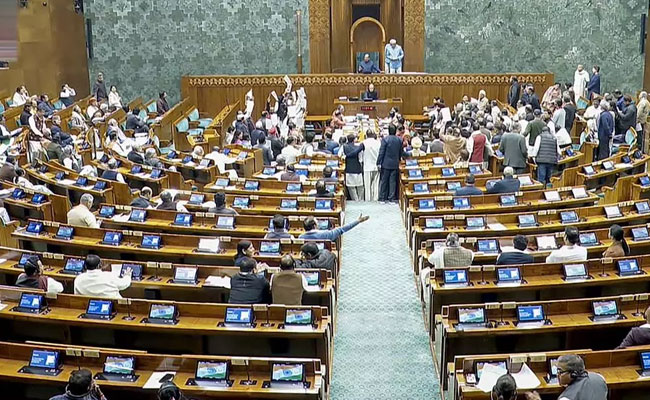
New Delhi (PTI): The Lok Sabha on Monday referred the Corporate Laws (Amendment) Bill, 2026, to a joint parliamentary committee comprising members from both Houses of Parliament for a detailed analysis and recommendations.
The decision was taken following a voice vote after Finance Minister Nirmala Sitharaman suggested it.
Earlier, after the Bill was introduced in Lok Sabha, opposition members Manish Tewari (Congress), Saugata Roy (Trinamool Congress) and T Sumathy (DMK) strongly opposed it, alleging that the legislation sought to dilute the provisions of law under which companies mandatorily have to pay 2 per cent of their profits towards corporate social responsibility (CSR).
The finance minister strongly refuted the allegations and said that the Bill has been introduced after two years of deliberations.
She said the apprehensions of the members were unfounded as the Bill seeks to amend only the criteria of net profits, not the entire clause related to CSR.
Sitharaman then suggested to Speaker Om Birla that the Bill be sent to a joint parliamentary committee (JPC) for extensive deliberations and proper suggestions.
At this, Tewari said that since a parliamentary standing committee on corporate affairs is already in place, the Bill should be sent to that panel rather than constituting a new JPC.
Intervening the Congress MP, Home Minister Amit Shah said that none of the opposition members talked about referring the legislation to a parliamentary committee, and now, when the finance minister herself has sought it, they were arguing as to which panel the Bill should be sent.
Speaker Birla then put the proposal of the finance minister to a vote, and it was approved with a voice vote by the House, sending the Bill to a JPC for which the members will be selected later.
The Corporate Laws (Amendment) Bill, 2026, aims to amend the Limited Liability Partnership (LLP) Act, 2008, and the Companies Act to facilitate ease of doing business and address the gaps identified by the Company Law Committee in its 2022 report.
The Union Cabinet had already okayed the proposed Bill, aimed at further easing the compliance burden on businesses and advancing the government’s agenda of decriminalising minor corporate offences.
The proposed amendments are expected to rationalise penalties, shift several minor procedural lapses from criminal liability to monetary penalties, and streamline regulatory processes to promote ease of doing business.
The reforms are also aimed at improving the overall corporate compliance framework while reducing litigation and encouraging a more facilitative regulatory environment for companies and LLPs.
Sitharaman also said the Bill is aimed at promoting further ease of doing business and ease of living for corporates by decriminalising more provisions and amending certain other provisions.
It is aimed at providing ease of compliance for ‘one person companies’, small companies, startups and producer companies, the minister said in the Bill's statement of objects and reasons.
According to Sitharaman, the amendments also seek to streamline the existing regulatory practices to strengthen as well as recognise new concepts in light of the rapidly evolving corporate landscape and changing business practices.