Drug addiction challenge to national security: Kovind
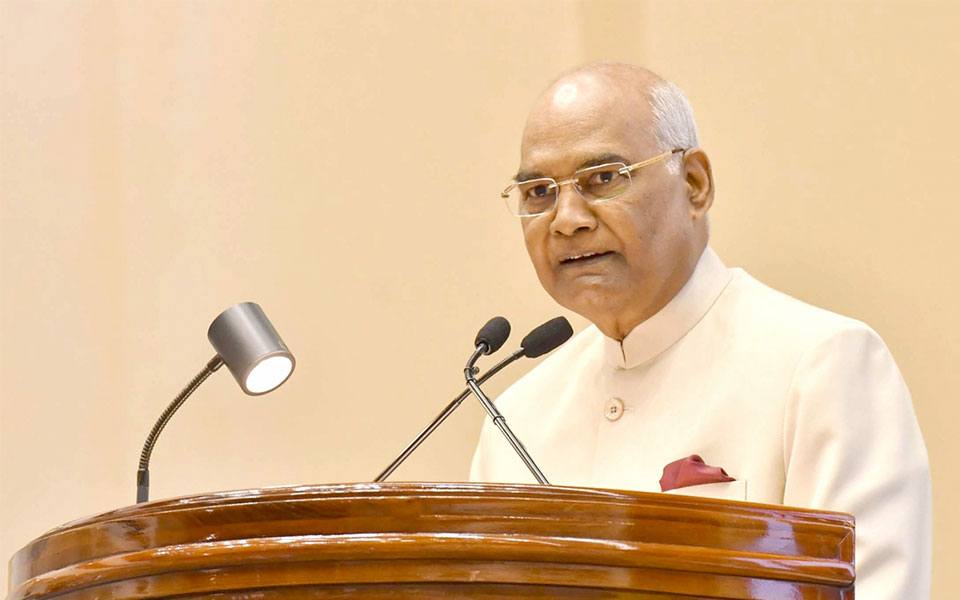
New Delhi, June 26: Increased drug trafficking in states with international borders poses challenge to national security, President Ram Nath Kovind said on Tuesday.
"Increase in drug trafficking and drug abuse in the border areas is also associated with issues of terrorism and political unrest. That is why there is a need to be more vigilant in border states like Punjab and Manipur," he said in his address at an event on the occasion of 'International Day against Drug Abuse and Illicit Trafficking'.
He also presented the national awards for outstanding services in the field of prevention of alcoholism and substance (drug) abuse.
Kovind also notes that the country's geographical location between Myanmar-Laos-Thailand's 'Golden Triangle' and Iran-Afghanistan-Pakistan's 'Golden Crescent', makes the problem of drug abuse and illicit trafficking even more acute and complicated.
He also said that problem of drugs addiction and alcoholism negatively impacts the individual, family and society in multiple domains such as health, culture, development and politics.
"Misuse of illegal drugs is creating health challenges especially for the young generation and school going children," he said.
About eradication of drug addiction and problems associated with drug abuse, the President said it can be solved by awareness, prevention, incentives, and support efforts.
"In these efforts compassion and sympathy for the drug addicts is also necessary. Parents, teachers, doctors, voluntary organizations should be associated in the medical and rehabilitation efforts," Kovind said.
Let the Truth be known. If you read VB and like VB, please be a VB Supporter and Help us deliver the Truth to one and all.
AIITA welcomes Karnataka’s ban on obscene songs in school events
Bhatkal: The Karnataka unit of the All India Ideal Teachers Association (AIITA) has welcomed the Karnataka government’s decision to strictly ban school children from dancing to obscene songs during educational and cultural programmes in government, aided, and private schools across the state.
AIITA Karnataka State President M. R. Manvi congratulated the government for taking what he termed an important step to preserve the sanctity of education.
“Such decisions to safeguard the dignity of school children and uphold the values of education are the need of the hour. This rule should not be limited to government schools alone but must be strictly implemented in all private educational institutions as well,” he said.
He further urged the government to address other concerns within school programmes.
“The government should not only prohibit obscene dances in the name of school anniversaries, but also ensure that plays and dialogues that incite religious hatred are avoided. Schools should be centres of harmony, not platforms for spreading hatred,” he added.
According to a recent circular issued by the Department of School Education and Literacy, obscene dances are adversely affecting the mental health and moral values of students.
In this regard, schools have been advised to use songs that promote nationalism, positive thinking, the greatness of Kannada culture, and value-based traditions instead of inappropriate content during programmes.
The circular also emphasises that students should be dressed in decent attire.
AIITA also backed the department’s warning that disciplinary action would be taken against head teachers if such guidelines are violated. The association has further demanded that district Deputy Directors of Public Instruction strictly monitor the implementation of these rules.