EAM Jaishankar justified blackout in Kashmir, says can't block internet only for terrorists
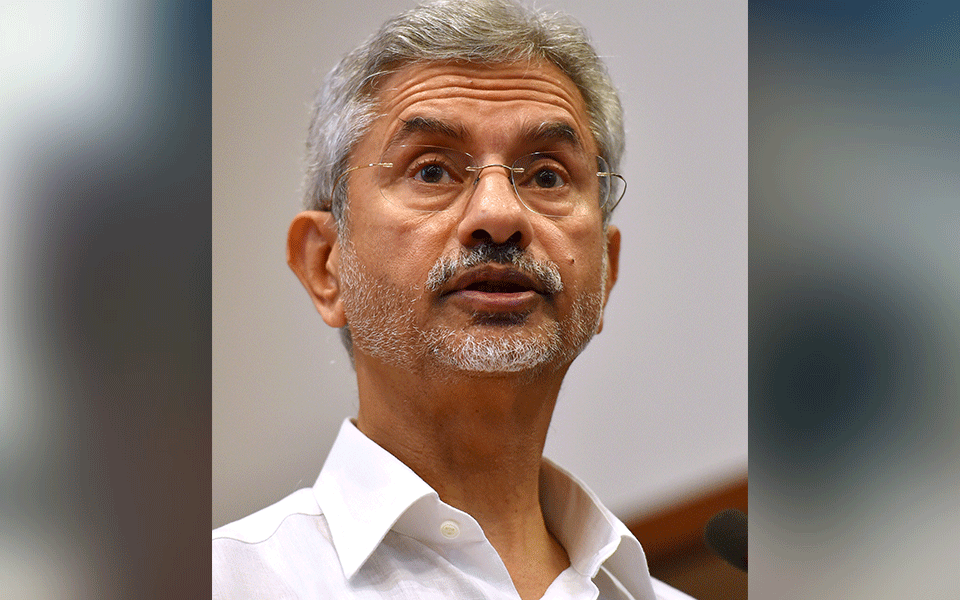
Srinagar: External Affairs Minister S Jaishankar has justified the restrictions on phone and mobile internet services in Kashmir, saying it was needed to stop communication between terrorists. "It wasn't possible to stop communications between militants without impacting all of Kashmir. How do I cut off communication between the terrorists and their masters on the one hand, but keep the Internet open for other people? I would be delighted to know," he said in an interview with Politico magazine in Brussels, Belgium, a few days ago.
Several countries including the United States have expressed concern over the security curbs in Jammu and Kashmir ever since its special status was scrapped through a presidential order. According to news agency PTI, European Union foreign policy chief Federica Mogherini urged for resumption of India-Pakistan talks and stressed on the need to "restore the rights and freedoms of the Kashmir population" in her meet with Mr Jaishankar recently.
However, the External Affairs Minister expressed confidence that security restrictions across the region would be eased in the "coming days". This would involve the redeployment of police to their original duties and a reduction in the number of additional security forces across Kashmir, Mr Jaishankar said, adding: "Frankly, they have other jobs and other things to do."
courtesy: ndtv.com
Let the Truth be known. If you read VB and like VB, please be a VB Supporter and Help us deliver the Truth to one and all.
Man arrested with Rs 2.54-crore heroin in Mumbai

Mumbai (PTI): Police have arrested a man and seized over 500 grams of heroin worth Rs 2.54 crore in the illicit market from him in Mumbai, officials said on Friday.
The police's Anti-Narcotics Cell (ANC) made the drug seizure in Santacruz in the western suburbs. The operation was conducted by the Kandivali unit of the ANC on Thursday as part of a special crackdown against drug trafficking in the area, they said.
Acting on specific inputs, an ANC team conducted a raid in Santacruz (East) and intercepted a man. During a search, the team recovered 508 grams of high-grade heroin from his possession, an official said.
The seized contraband, a highly addictive, opioid drug derived from morphine, is estimated to be worth Rs 2.54 crore in the international market, he informed.
Following the seizure, a case was registered against the man under relevant sections of the Narcotic Drugs and Psychotropic Substances (NDPS) Act, 1985, and he was formally placed under arrest in the early hours of Friday.
The police are currently investigating the source of the drug and trying to identify the intended recipients of the consignment, he said.