EC an independent body, govt doesn't make anyone dance to its tunes: Kiren Rijiju

Srinagar, Nov 17: Union Law Minister Kiren Rijiju on Thursday said the Election Commission is an independent body and while the government provides help to the poll panel for smooth functioning, it does not make anyone "dance" to its tunes.
Speaking to reporters in south Kashmir's Anantnag district, the minister also said the media does not talk about the development that has taken place in Jammu and Kashmir as a result of the DDC elections but only about assembly polls.
District Development Council elections were held in Jammu and Kashmir in 2020, a year after the erstwhile state lost its special status following the abrogation of Article 370 of the Constitution and was divided into two union territories.
Responding to a question about the Opposition's charge that the EC is acting on the directions of the government and the BJP, Rijiju said the poll panel is impartial and independent.
"Being the administrative minister incharge -- the Election Commission of India reports to the law ministry -- I want to say that the Election Commission of India is an impartial, transparent, empowered and independent body," he said.
The government's role in the poll panel, he said, is limited to making arrangements for its smooth functioning.
"The government provides help to the Election Commission because without government help neither the courts can function nor any other institution. It is the duty of the government to make arrangements so that these institutions can function but we do not make anyone dance to our tunes," he added.
Asked when assembly elections will be held in Jammu and Kashmir, Rijiju said they will be held at the right time.
"DDC elections were held in a wonderful manner and because of those elections so much good work is happening. You won't write about the development, you will only harp on about elections.
"Those elections will happen in time because the dates have not been announced yet," he said.
Let the Truth be known. If you read VB and like VB, please be a VB Supporter and Help us deliver the Truth to one and all.
Vartha Bharati–Sankalp predictions align closely with Karnataka bypoll results
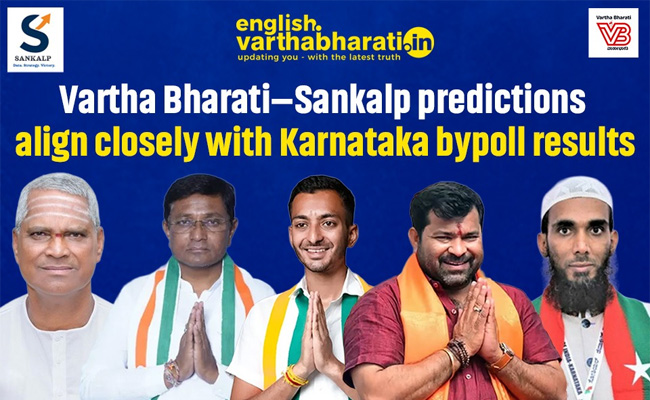
Bengaluru: The Vartha Bharati–Sankalp election analysis has shown a high level of accuracy in predicting the outcome of the recent Karnataka Assembly by-elections held in May 2026, correctly calling winners in both constituencies and closely estimating vote share trends.
The by-elections were held in Bagalkot and Davanagere South, drawing significant political attention as both seats were seen as key tests for the ruling Congress and opposition BJP.
According to the analysis, Vartha Bharati–Sankalp had made three major projections ahead of the results the winning party, vote share percentages, and margin of victory.
In both constituencies, the platform accurately predicted that the Congress would emerge victorious. The outcome matched the projections, with Congress candidates winning in Bagalkot and Davanagere South.
In terms of vote share, the predictions were largely in line with the final results. In Bagalkot, the BJP’s vote share was forecast in the range of 40 to 46 per cent, while the actual figure stood at 42.9 per cent. The Congress vote share, however, exceeded expectations, with the party securing 55.4 per cent against a projected range of 43 to 48 per cent.
The margin of victory in Bagalkot turned out to be significantly higher than anticipated. While the projection had placed the margin between 2,000 and 3,500 votes, the final margin was around 22,332 votes.
In Davanagere South, the predictions also remained largely accurate. The Congress vote share was projected between 43 and 51 per cent, and the final figure stood at 43.9 per cent. The BJP was expected to secure between 42 and 50 per cent but ended with 40.3 per cent.
The analysis had also identified the role of SDPI as a potential spoiler in the constituency. While its vote share was estimated around 6 per cent, the party eventually secured around 12 per cent of the vote.
The margin of victory in Davanagere South was predicted to be between 1,500 and 2,600 votes. The actual margin was higher at around 5,708 votes, though the contest remained relatively close as anticipated.
Overall, the performance of Vartha Bharati–Sankalp stood out for correctly identifying the winning parties in both seats and maintaining close accuracy in vote share estimates, with only limited deviations in specific cases.