EC has power, competence to undertake SIR of electoral rolls: Poll panel to SC
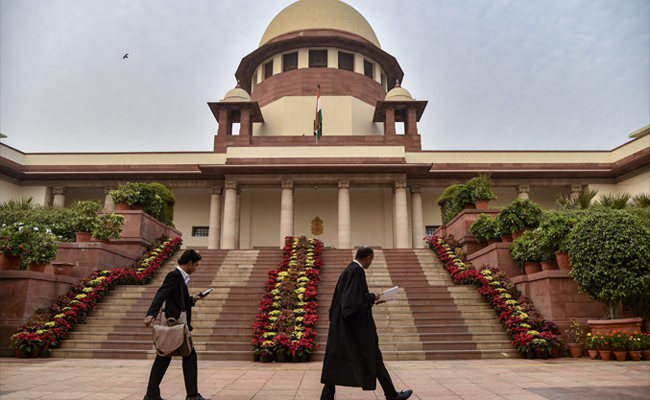
New Delhi (PTI): The Election Commission (EC) told the Supreme Court on Tuesday that it has the power and competence to undertake a Special Intensive Revision (SIR) of the electoral rolls, besides there is a constitutional duty to ensure that no foreigners are registered as voters.
The submissions were made by senior advocate Rakesh Dwivedi on behalf of the EC before a bench of Chief Justice Surya Kant and Justice Joymalya Bagchi.
The bench resumed final hearings on a batch of petitions challenging the EC's decision to undertake the SIR exercise in several states, including Bihar, raising significant constitutional questions on the scope of the poll panel's powers, citizenship and the right to vote.
ALSO READ: Specially abled girl 'gangraped' in Odisha’s Rayagada, 3 detained
Dwivedi pointed out that all key constitutional functionaries across the three organs of the State must be Indian citizens, citing provisions such as Article 124(3) of the Constitution relating to the appointment of Supreme Court and high court judges.
He said one of the key conditions for the appointment of top constitutional functionaries like the president, the vice president and the prime minister is that the person has to be an Indian citizen.
"All vital appointments ... no appointments can be made unless the person is a citizen, so our Constitution is citizen-centric predominantly," Dwivedi said.
Referring to constitutional schemes, he said, "The (constitutional) article, when it says citizens, that is something which has to be inquired by the competent authority. What should be the nature, summary etc., that is a different question.... There is a constitutional duty to ensure that on the electoral roll, there should not be any foreigners."
The poll panel is not supposed to respond to political parties' rhetoric, the senior advocate said. "I am not commenting on the political parties, as the Election Commission, our duty is that no foreigner should be there.... It is to be seen that the power is there and the competence is there," he added.
Resuming his arguments, Dwivedi posed a central constitutional question and asked "whether Article 324 of the Constitution, which vests the Election Commission with powers of superintendence, direction and control over elections, is entirely displaced by statutory provisions, or whether its application must be examined on a case-to-case basis".
He said Articles 324, 325 and 326 of the Constitution, read with section 16 of the Representation of the People Act, do not foreclose the EC's authority in the field of revision of electoral rolls.
"The field is not totally foreclosed," Dwivedi submitted, asserting that the EC retains constitutional competence to ensure the purity of the electoral rolls.
Tracing the evolution of the franchise, the lawyer took the bench through colonial-era electoral practices, beginning with the introduction of separate communal electorates in 1909 and the limited franchise under the Government of India Acts, where only about 15 per cent of the population had voting rights.
He submitted that the expansion of the franchise was a core element of India's freedom struggle.
"Not only Article 326, but the entire Constitution, when it speaks of a democratic republic, reflects an intention to create a citizen-centric polity," Dwivedi argued.
Addressing concerns that the SIR could amount to a parallel citizenship-determination exercise akin to the National Register of Citizens (NRC), he stressed that the electoral roll and the NRC serve fundamentally-different purposes.
"The NRC includes all persons, whereas the electoral roll includes only citizens above the age of 18," he said, adding that persons of unsound mind or otherwise disqualified cannot be included in the voter list.
"On the face of it, the electoral roll is not like the NRC," Dwivedi said. He maintained that Article 326 mandates that only citizens can vote and that citizenship must be acquired through a competent authority.
Even if there are 10 or thousands of foreigners on the rolls, they have to be excluded, he said, clarifying that the EC is not making political judgments but discharging its constitutional obligation.
Dwivedi would resume advancing his arguments on Thursday (January 8).
Earlier, the bench asked whether the EC is barred from conducting an inquiry in case of a doubtful citizen and if an inquisitorial process falls outside its constitutional power.
Let the Truth be known. If you read VB and like VB, please be a VB Supporter and Help us deliver the Truth to one and all.
US–Iran first round direct talks conclude in Islamabad: Report
_vb_48.jpeg)
The first round of direct talks between the United States and Iran, held in Islamabad, has concluded, Al Jazeera reported citing sources close to the development.
According to the report, following the discussions, delegations from both sides agreed to exchange written documents, a move aimed at ensuring clarity and consensus on the understandings reached during the meeting.
Both the Iranian and US delegations arrived in Islamabad on Saturday, April 11, amid high security for the peace talks.

_vb_17.jpeg)