EC seeks explanation from official for incorrect entry on complaint against PM's Balakot remark
New Delhi: The Election Commission is examining Prime Minister Narendra Modi's remarks urging youth to vote in the name of those who carried out Balakot air strikes, but its grievance redressal portal shows that the complaint has been "resolved".
Now, the Commission has sought an explanation from the concerned returning officer for the error.
"The status should have shown that the matter has been referred to Election Commission headquarters. But the entry reflected that the complaint as resolved ... it is being rectified," explained a senior EC functionary.
An explanation has been sought from the concerned official the functionary said.
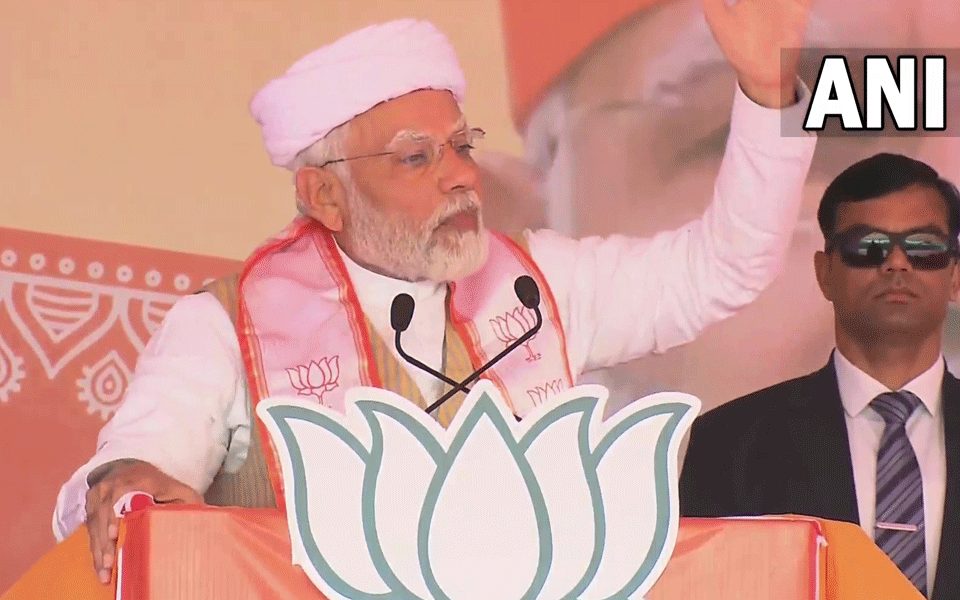
Addressing a rally in Ausa in Maharashtra's Latur on April 9, Modi said, "Can your first vote be dedicated to those who carried out the air strike."
"I want to tell the first-time voters: can your first vote be dedicated to the veer jawans (valiant soldiers) who carried out the air strike in Pakistan. Can your first vote be dedicated to the veer shaheed (brave martyrs) of Pulwama (terror attack)," Modi had said.
One Mahendra Singh had lodged a complaint on EC's 'National Grievances Service' portal.
The status shows that the complaint has been 'resolved'.
The Commission is examining the report from local poll authorities who have said that prima facie, the PM has violated EC's instructions against invoking armed forces in election campaign.
Yesterday, EC officials were asked at a press briefing as to why the complaint against PM and Congress president Rahul Gandhi were not available in the 'model code of conduct violation' section of the main EC website, Deputy EC Sandeep Saxena had said that the complaints are with the EC and their non-availability on the main website's MCC violation section does to mean the complaints have not been received.
The National Grievances Service portal is a stand alone website created to help citizens lodge "election and non-election" complaints.
Let the Truth be known. If you read VB and like VB, please be a VB Supporter and Help us deliver the Truth to one and all.
Gold, silver soar as US-Iran deal hopes lift bullion demand

New Delhi (PTI): Gold prices rebounded by Rs 2,900 to Rs 1.55 lakh per 10 grams in the national capital on Wednesday, while silver climbed to Rs 2.54 lakh per kilogram as easing geopolitical tensions triggered a pullback in oil rates, boosting demand for precious metals.
According to the All India Sarafa Association, the yellow metal of 99.9 per cent purity jumped by Rs 2,900, or nearly 2 per cent, to Rs 1,55,400 per 10 grams (inclusive of all taxes) from Tuesday's closing level of Rs 1,52,500 per 10 grams.
Traders attributed the surge in bullion prices to reports that Washington and Tehran are close to finalising a framework agreement to end months of conflict, raising the prospects of smoother flows through the Strait of Hormuz and easing inflation concerns tied to energy markets.
"Gold rallied strongly on Wednesday as easing geopolitical tensions triggered a sharp reversal in key macro drivers that had recently pressured precious metals," Saumil Gandhi, Senior Analyst - Commodities at HDFC Securities, said.
Silver prices also advanced for the third straight session by rising Rs 3,500, or 1.4 per cent, to Rs 2,54,500 per kg (inclusive of all taxes). The metal had settled at Rs 2,51,000 per kg in the previous session, as per the Association.
"The prospect of a diplomatic breakthrough triggered a steep decline in oil prices and the US dollar, easing concerns about inflation while boosting demand for precious metals," Gandhi said.
Globally, spot gold increased by USD 106.15, or 2.33 per cent, to USD 4,663.70 per ounce while silver gained USD 3.40, or 4.68 per cent, to USD 76.24 per ounce.
"Gold witnessed a sharp rally as markets reacted positively to reports that the US and Iran are moving closer to a one-page agreement framework aimed at ending the conflict," Jateen Trivedi, VP Research Analyst - Commodity and Currency, LKP Securities, said.
Despite strong international gains, rupee strength limited the upside in domestic gold prices. The market is now highly focused on final confirmation and execution of the proposed deal, he added.
Any negative surprise or breakdown in negotiations could trigger a sharp sell-off in gold, while a successful agreement and sustained ceasefire could push the bullion prices higher in the near-term, Trivedi said.