ED begins second round of questioning of Ahmed Patel in PMLA case
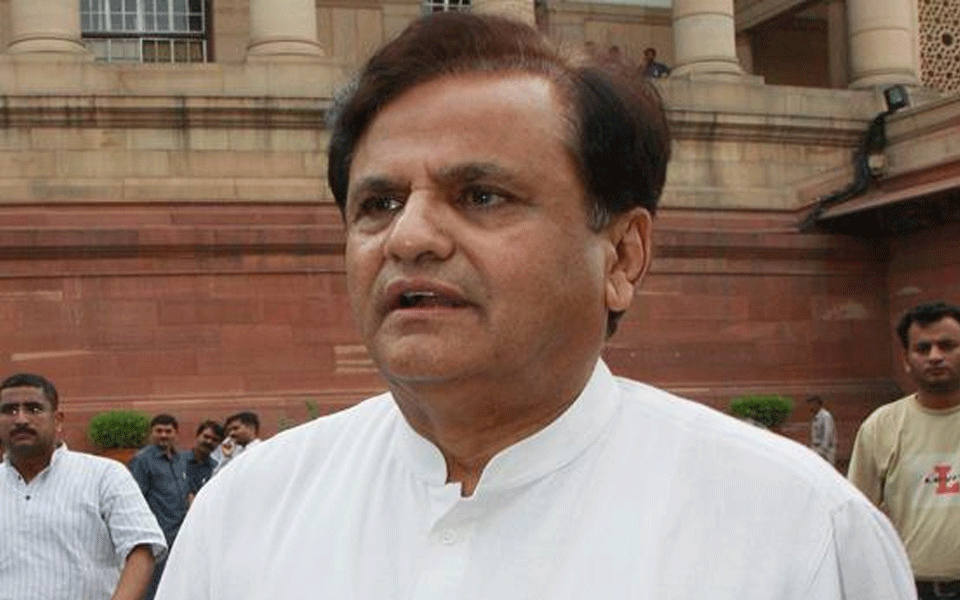
New Delhi: Enforcement Directorate (ED) investigators on Tuesday began the second round of questioning of senior Congress leader Ahmed Patel at his house here in connection with the Sandesara brothers bank fraud and money laundering case probe, officials said.
A three-member team of the central agency along with few other officials reached Patel's 23, Mother Teresa Crescent home in the Lutyens' zone of central Delhi around 10:30 am.
The team members were seen carrying files and wearing masks and gloves as a precautionary measure in view of the coronavirus pandemic.
Agency sleuths had questioned Patel, 70, for the first time for about eight hours at his residence on June 27 in this case.
He was allowed questioning at home by the agency after the Congress Rajya Sabha MP from Gujarat refused to visit the ED office citing prevailing COVID-19 guidelines that discourage senior citizens from going out.
Officials said Patel's statement is being recorded under the Prevention of Money Laundering Act (PMLA) during the latest session.
Patel, also the Congress party treasurer, has earlier served as the political secretary to UPA chairperson and Congress president Sonia Gandhi and was considered one of the most powerful persons in the grand old party.
This money laundering case pertains to the alleged Rs 14,500 crore bank loan fraud that is said to have been perpetrated by the Vadodara-based pharma firm Sterling Biotech and its main promoters and directors-- Nitin Jayantilal Sandesara, Chetankumar Jayantilal Sandesara and Deepti Sandesara -- all of whom are absconding.
Nitin and Chetankumar are brothers. The agency has alleged that this is a bigger bank scam in volume than the PNB fraud involving diamantaires Nirav Modi and Mehul Choksi.
The total fraud amount pegged in the PNB case is about Rs 13,400 crore.
The Sandesaras are also facing separate probes by the CBI and the Income Tax Department for their alleged nexus with some high-profile politicians and charges of corruption and tax evasion, respectively.
At present, they are stated to be based in Albania, from where India is trying to extradite them.
The ED registered a criminal case in connection with the alleged bank loan fraud on the basis of an FIR and a charge sheet filed by the CBI.
It is alleged that the company took loans of over Rs 5,383 crore from a domestic consortium led by the Andhra Bank, which had turned into non-performing assets.
Patel, while speaking to reporters on Saturday, had said he replied to the questions that the "guests" of the government posed to him.
"I am surprised that instead of fighting China... coronavirus and unemployment, the government is fighting the opposition," he had said.
The law should be allowed to take its course and someone who has not done any wrong should not fear, Patel had said. He had accused the government of "using probe agencies every time it faced a crisis or when there was an election".
Let the Truth be known. If you read VB and like VB, please be a VB Supporter and Help us deliver the Truth to one and all.
Putin meets Iran's FM Araghchi, says Russia ready to do its best to help bring peace to West Asia
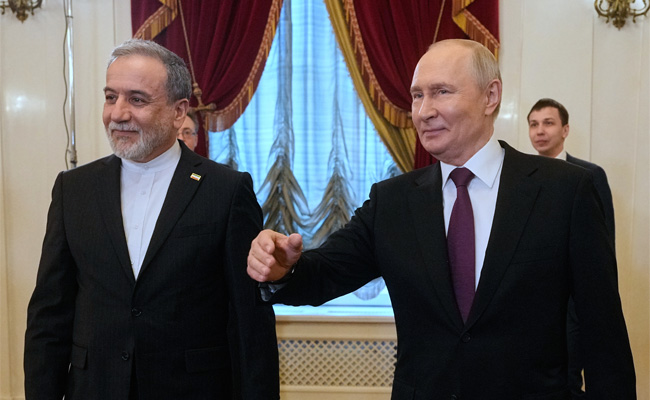
Moscow (PTI): Iran's Foreign Minister Abbas Araghchi on Monday met Russian President Vladimir Putin, who hailed the Iranian people for fighting bravely and heroically for their sovereignty and said Moscow is ready to do its best to help bring peace to West Asia as soon as possible.
Araghchi, who held talks with Omani and Pakistani leadership before arriving in Russia, met Putin in St. Petersburg and thanked him for supporting Iran, state-owned TASS news agency reported.
"Russia is ready to do everything in its power to ensure that peace in the Middle East is achieved as soon as possible," Putin said during his meeting with Araghchi, which was also attended by Russian Foreign Minister Sergey Lavrov.
Revealing that he received a message from Iranian Supreme Leader Mojtaba Khamenei last week, Putin asked Araghchi to convey his "gratitude for this message and best wishes for his health and well-being."
He praised the Iranian people for fighting "bravely and heroically" for their sovereignty, Iran's state-run PRESS TV reported.
"We really hope that, based on the courage and desire for independence, the Iranian people, under the guidance of the new leader, will weather this difficult period of trials and peace will come,” Putin said.
He also stressed that Russia “intends to maintain” its strategic relations with Iran.
Araghchi said that the world witnessed Iran’s strength in countering the US during the recent war, and that the Islamic Republic is a "stable and powerful establishment."
"With their courage, the Iranian people succeeded in resisting the US aggression and will be able to endure it,” he said.
He said that it became clear that Iran has “great friends and allies” like Russia, and conveyed “warmest greetings” from Supreme Leader Mojtaba Khamenei and President Masoud Pezeshkian to the Russian leader.
Araghchi said relations between Moscow and Tehran represent a “strategic partnership at the highest level” and will continue to develop "regardless of circumstances."
"We are grateful to you for the solid and strong positions in support of the Islamic Republic of Iran," he said.
Foreign Minister Lavrov said that the talks between President Putin and the Iranian Foreign Minister were "useful and constructive."
Kremlin Spokesman Dmitry Peskov later said that Russia is "ready to provide any good offices, any mediation services that are acceptable to the parties."
"We will be ready to do everything so that ultimately peace ensues, guaranteed peace, and that there is no return to hostilities," Peskov was quoted as saying by TASS.
He was asked how Moscow can assist in future negotiations on the Iranian settlement.
Araghchi arrived in Russia after his whirlwind trip to Islamabad, which, according to him, was “very productive” and involved “good consultations" with Pakistan's Army Chief Field Marshal Asim Munir, amid uncertainty over the second round of peace talks to resolve the war in West Asia.
"We held good consultations with our friends in Pakistan. The trip was successful. We assessed the outcome of our recent (meetings) and discussed in what direction and under what conditions talks can move on,” Araghchi said in a video posted on his Telegram channel upon his arrival in St Petersburg.
Referring to the second round of talks between the US and Iran to resolve the conflict in West Asia, Araghchi said: "Developments have taken place in the negotiations."
"Despite some progress in earlier rounds, the talks failed to reach their objectives due to the Americans' approach, the excessive demands they made, and the wrong approaches they adopted. Therefore, it was necessary to consult with our friends in Pakistan to review the latest situation,” Iran's official news agency IRNA quoted him as saying.
He said that the trip to Pakistan was a good opportunity to review developments related to the US-Israeli war against Iran, expressing confidence that “these consultations and coordination between the two countries will be highly significant.”
Araghchi arrived at St. Petersburg's Pulkovo Airport early Monday, where he was welcomed by Russian officials and Iran’s ambassador to Russia, Kazem Jalali, the report said.
The first round of peace talks between Iran and the US, held on April 11 and 12, failed to bring the desired result for the parties to the conflict.
The Iranian minister arrived in Islamabad for the second time on Sunday after a short visit to Oman, where he held talks with Sultan Haitham bin Tariq al-Said on security in the Strait of Hormuz and diplomatic efforts to end the Iran-US conflict.
After Araghchi left Pakistan for Oman on Saturday, President Donald Trump announced that US negotiators Steve Witkoff and Jared Kushner would no longer be going to Islamabad for talks with Iran, contending that Washington held all the cards on the matter.
Trump on Sunday reiterated that the US and Iranian officials can talk by phone for a peace solution to the conflict.
On Tuesday, Trump extended the two-week ceasefire with Iran indefinitely to give Tehran more time to prepare a unified proposal to end the war, just hours before the truce was set to expire.
The war began when the US and Israel jointly attacked Iran on February 28, killing Iranian Supreme Leader Ayatollah Ali Khamenei and several top commanders. The retaliation by the Islamic Republic extended the war to the entire Gulf region.