ED Director Sanjay K Mishra gets one-year extension, a day before his retirement
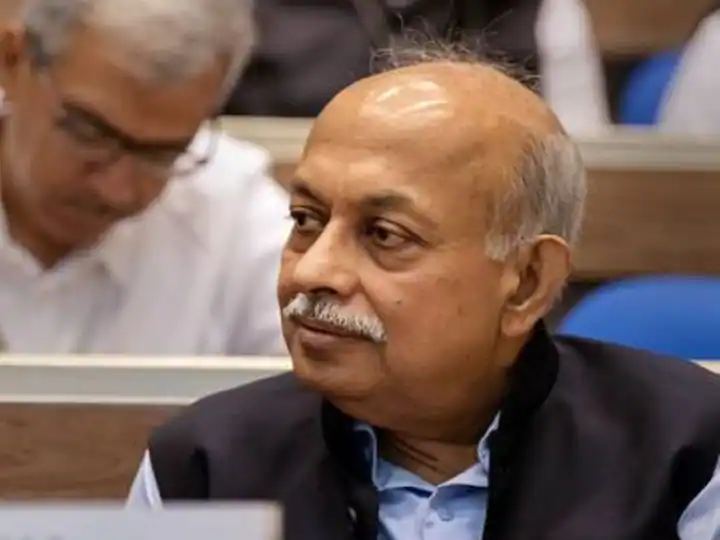
New Delhi, Nov 17: The Union government on Thursday extended by one year the tenure of ED Director Sanjay Kumar Mishra, according to an official order.
The order issued by the Personnel Ministry said the 1984-batch Indian Revenue Service (IRS) officer has been given the extension till November 18, 2023.
Mishra, 62, was appointed director of the Enforcement Directorate (ED) for a period of two years by an order on November 19, 2018.
Later, by an order of November 13, 2020, the appointment letter was modified retrospectively by the Central government and his term of two years was replaced by three years.
The government last year brought an ordinance allowing that the tenure of the directors of the ED and the Central Bureau of Investigation (CBI) can be extended by up to three years after the mandated term of two years.
Mishra was subsequently given a one-year extension then, his second.
"The Appointments Committee of the Cabinet has approved extension in tenure of Shri Sanjay Kumar Mishra, IRS (IT:84006) as Director of Enforcement in the Enforcement Directorate for a period of one year beyond 18.11.2022, ie upto 18.11.2023 or untill further orders, whichever is earlier," the Thursday order said.
The ED functions under the Union Finance Ministry and it enforces the criminal provisions of the Prevention of Money of Money Laundering Act (PMLA), the Fugitive Economic Offenders Act that was brought by the Modi government in 2018, and the civil sections of the Foreign Exchange Management Act (FEMA).
Let the Truth be known. If you read VB and like VB, please be a VB Supporter and Help us deliver the Truth to one and all.
Vartha Bharati–Sankalp predictions align closely with Karnataka bypoll results
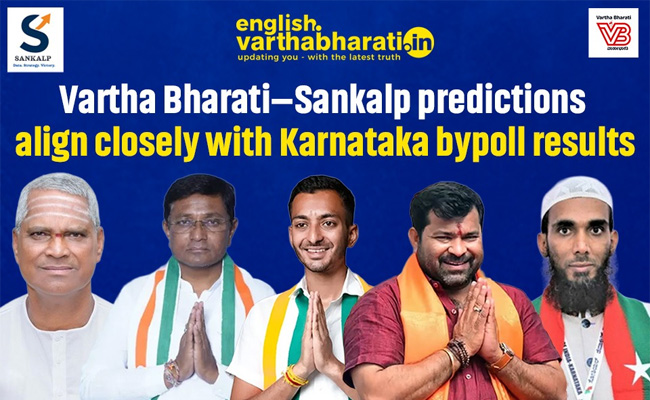
Bengaluru: The Vartha Bharati–Sankalp election analysis has shown a high level of accuracy in predicting the outcome of the recent Karnataka Assembly by-elections held in May 2026, correctly calling winners in both constituencies and closely estimating vote share trends.
The by-elections were held in Bagalkot and Davanagere South, drawing significant political attention as both seats were seen as key tests for the ruling Congress and opposition BJP.
According to the analysis, Vartha Bharati–Sankalp had made three major projections ahead of the results the winning party, vote share percentages, and margin of victory.
In both constituencies, the platform accurately predicted that the Congress would emerge victorious. The outcome matched the projections, with Congress candidates winning in Bagalkot and Davanagere South.
In terms of vote share, the predictions were largely in line with the final results. In Bagalkot, the BJP’s vote share was forecast in the range of 40 to 46 per cent, while the actual figure stood at 42.9 per cent. The Congress vote share, however, exceeded expectations, with the party securing 55.4 per cent against a projected range of 43 to 48 per cent.
The margin of victory in Bagalkot turned out to be significantly higher than anticipated. While the projection had placed the margin between 2,000 and 3,500 votes, the final margin was around 22,332 votes.
In Davanagere South, the predictions also remained largely accurate. The Congress vote share was projected between 43 and 51 per cent, and the final figure stood at 43.9 per cent. The BJP was expected to secure between 42 and 50 per cent but ended with 40.3 per cent.
The analysis had also identified the role of SDPI as a potential spoiler in the constituency. While its vote share was estimated around 6 per cent, the party eventually secured around 12 per cent of the vote.
The margin of victory in Davanagere South was predicted to be between 1,500 and 2,600 votes. The actual margin was higher at around 5,708 votes, though the contest remained relatively close as anticipated.
Overall, the performance of Vartha Bharati–Sankalp stood out for correctly identifying the winning parties in both seats and maintaining close accuracy in vote share estimates, with only limited deviations in specific cases.