ED undertakes first-ever searches in Ladakh in crypto fraud case
Srinagar (PTI): In its first ever raids in the Union Territory of Ladakh, the Enforcement Directorate on Friday conducted searches as part of its money laundering probe linked to a cryptocurrency fraud case in which investors lost more than Rs 7 crore worth of deposits, officials said.
The agency's zonal office here raided at least six premises in Leh town of Ladakh, Jammu in J-K and Sonipat in Haryana in the case against A R Mir and others.
It is alleged that 2,508 investors deposited more than Rs 7.34 crore in a fake cryptocurrency business in the name of "Emollient Coin Limited". They, however, did not get any returns or currency back, and these funds were laundered by the business' promoters to purchase land assets in Jammu.
The money laundering case stems from a March 2020 FIR registered in Leh and some other complaints filed in the Union Territory (UT) of Jammu and Kashmir (J-K) against Mir and Ajay Kumar Choudhary.
Police in Leh in their FIR stated that an inquiry was conducted by a committee formed by the local district magistrate against Mir and his agents who were running the "fake" cryptocurrency business (Emollient Coin Limited) from a office located at the Anjuman Moin-Ul-complex, opposite SNM Hospital, in Leh.
The committee sealed this office during inquiry on charges of "cheating many innocent individuals by assuring them to double their investment", according to the FIR.
The accused lured people of the UT of Ladakh and some other places to purchase "Emollient Coin" using cash or transferring money into bank accounts, according to Enforcement Directorate (ED) officials.
The depositors were also duped in the name of "Bitcoins" with the assurance of returns up to 40 per cent with a lock-in period of 10 months, the probe agency said.
Investors were dished out a commission of up to seven per cent of the investment made by the people on their reference in the business, thereby forming a multi-level marketing chain, the ED found.
A total of 2,508 people invested Rs 7,34,36,267 in the investment plan offered by Mir and the company (Emollient) floated by him that was incorporated in September 2017 and had its registered office in London. A man, Henry Maxwell, living in the UK capital, was its director.
The company had two promoters in India -- Naresh Gullia and Channi Singh. The company was "deliberately" dissolved in March 2019, and Mir along with Choudhary launched a real estate business and acquired lands in Jammu from the funds generated by the fake cryptocurrency trade, according to the ED.
Let the Truth be known. If you read VB and like VB, please be a VB Supporter and Help us deliver the Truth to one and all.
Two injuries, one DNF, a DQ as India end messy World Relays campaign
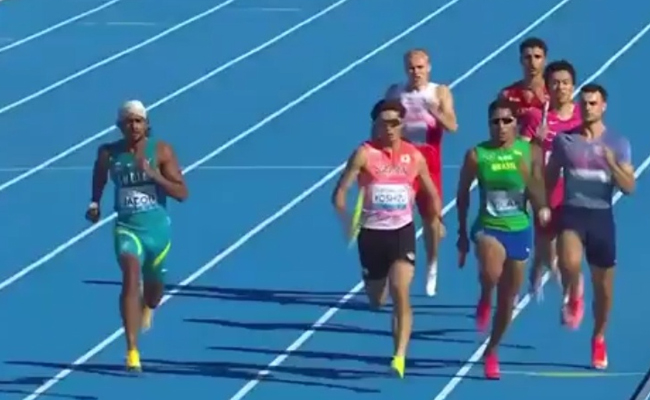
Gaborone (Botswana) (PTI): Amoj Jacob and Ragul Kumar got injured during the men's 4x400m and 4x100 races respectively as India ended their World Athletics Relays campaign in disappointment on the second day of competitions here on Sunday.
The Indian camp had high hopes of making the 2027 World Championships in the men's 4x400m relay but the team did not finish (DNF) the race as Jacob suffered cramps and pulled out of the race after taking the baton from the first leg runner Dharamveer Choudhary. Rajesh Ramesh and Vishal TK were to run in the third and fourth legs.
Those teams which could not qualify for the 2027 Beijing World Championships by reaching the final round of each of the six relay events on Saturday were given another chance in the second qualification round on Sunday.
The top two teams in each of the two heats (in all six relay events) booked the Beijing ticket on Sunday.
India will now have to try and qualify for the World Championships through the Top Lists of the World Athletics, which is a long and tedious process.
In the men's 4x100m race, third leg runner Ragul Kumar fell down the track after failing to hand over the baton inside the exchange zone to fourth leg runner Gurindervir Singh, which clearly showed the lack of coordination among the runners.
Harsh Santosh Raut and Animesh Kujur ran the first two legs.
The Indian quartet was disqualified and Kumar was seen being taken away from the Field of Play with the help of the volunteers.
It was a comedy of errors in the case of the women's 4x100m race, which saw the baton being dropped during an exchange between first leg runner Tamanna and second runner Nithya Gandhe, though the Indians finished the race in 53.09 seconds.
Gandhe started running quite a distance, but after realising that the baton was not in her hand, she turned and ran back to pick it up.
The only silver-lining for the Indian contingent was the national record time in the mixed 4x100m relay race, though the quartet of Ragul Kumar, Nithya Gandhe, Animesh Kujur and Sneha SS finished sixth in heat number two with a time of 41.35 seconds, bettering the previous national mark of 42.30 seconds set in March in Chandigarh.
The mixed 4x400m relay quartet of Theerthesh P Shetty, Kumari Saloni, Nihal William and Rashdeep Kaur ended at fifth in heat number one with a time of 3 minutes and 19.40 seconds.
On Saturday, all the five Indian relay teams had failed to make it to the respective final rounds and thus missed out on the 2027 World Championships berths.