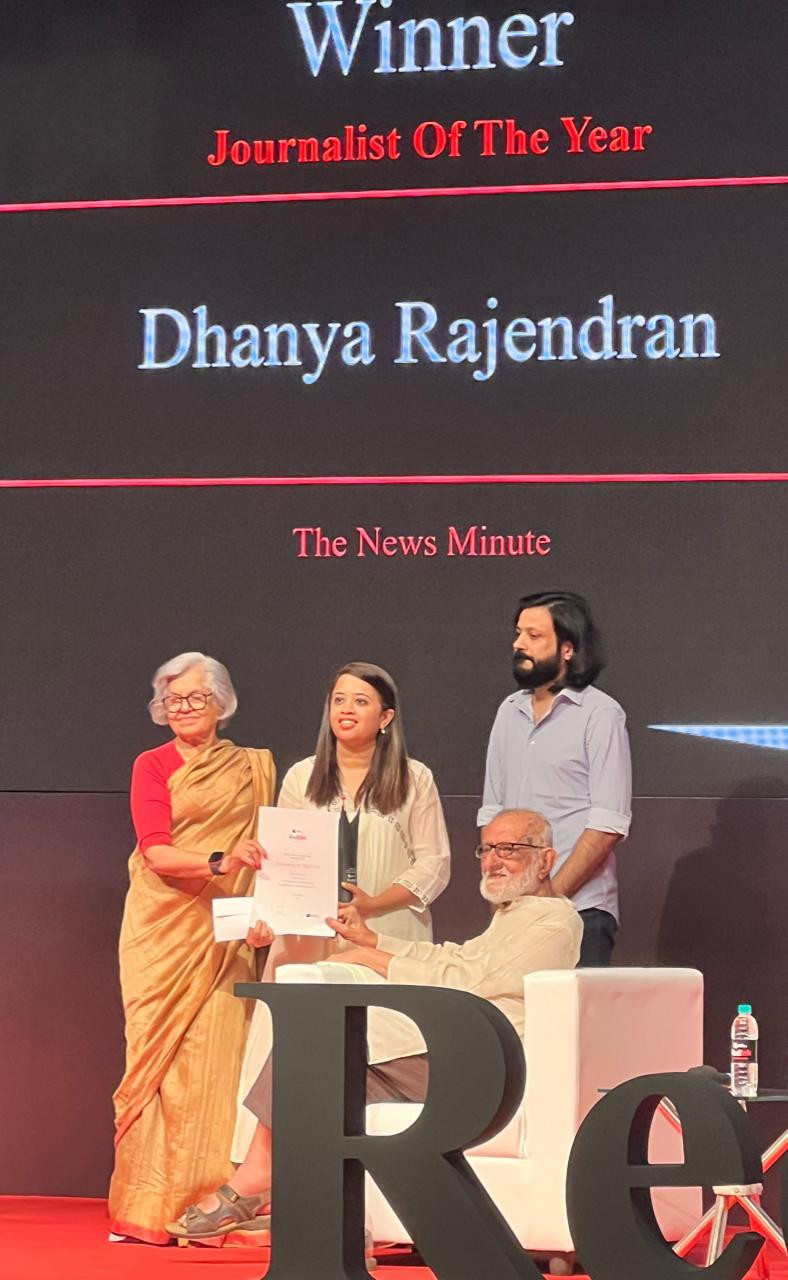
Editor-in-Chief of The News Minute Dhanya Rajendran gets RedInk 'Journalist of the Year' Award 2022
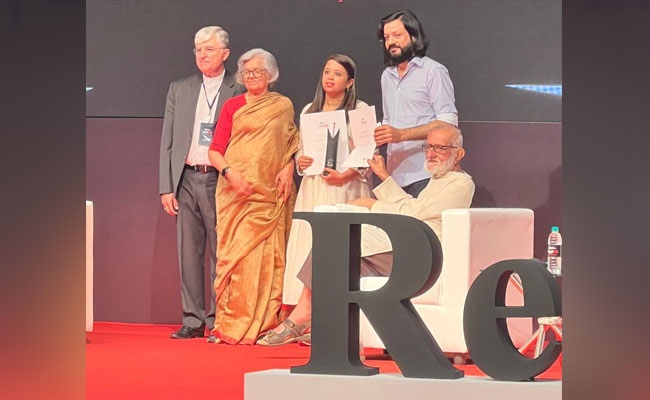
Mumbai: Dhanya Rajendran, co-founder, and editor-in-chief of The News Minute, has been honored with the 2022 National RedInk Award for 'Journalist of the Year' by the Mumbai Press Club. She received this recognition for leading her team in exposing the tampering of voter data in Karnataka ahead of the 2023 Assembly elections. Independent journalist Sharad Vyas has also been awarded the 'Journalist of the Year.'
The Journalist of the Year Award, an accolade for outstanding journalism in 2022, is a key component of the Redink Awards for Excellence in Journalism, instituted by the Mumbai Press Club 12 years ago. Past recipients include prominent journalists like Srinivasan Jain of NDTV 24X7, Ravish Kumar of NDTV India, Raj Kamal Jha of Indian Express, Faye D’Souza of Mirror Now, and the late Danish Siddiqui of Reuters.
The Mumbai Press Club stated, “Dhanya led a team of journalists who did a series of investigations during the Karnataka elections that confirmed what had been suspected all along – that the election process in India is not always free and fair.”
In November 2022, Dhanya spearheaded The News Minute’s investigation into electoral data fraud in Karnataka, uncovering malpractices ahead of the 2023 elections. The investigation prompted the Election Commission to order a review of voter lists in three constituencies in Bengaluru and led to the arrest of Krishnappa Ravikumar, the director of Chilume, the NGO behind the voter data fraud. Subsequently, the local government prohibited private organizations from collecting voter data.
The Mumbai Press Club’s statement noted, “The investigation uncovered a working prototype of how the electioneering process can be tampered with and then illustrated it through one constituency in Bengaluru to show how voter data was being manipulated.”
Dhanya, with over 20 years of journalism experience, has covered significant and overlooked news stories from South India throughout her career. Her focus on women’s rights, child sexual abuse, politics and elections, climate disasters, and human rights has garnered attention for several important stories at a national level.
Co-recipient of the 'Journalist of the Year' award, Sharad Vyas, "unearthed and published how the Indian Government's Intelligence Bureau imported the spy software Pegasus from an Israeli company, which had been officially denied all along."
Veteran journalist, columnist, and author Neerja Chowdhury received the RedInk 'Lifetime Achievement' award "for her contribution of over four decades as a reporter and analyst of political affairs and government."
The awards ceremony took place at the Royal Opera House in Mumbai on Saturday, December 2, where the honors were presented by Swantatra Senani GG Parikh and former Additional Solicitor General of India Indira Jaising.
Let the Truth be known. If you read VB and like VB, please be a VB Supporter and Help us deliver the Truth to one and all.
4 held for sexually assaulting woman, girl on moving bus after social media alert in UP's Agra

Agra (UP) (PTI): Four people were arrested, after a prompt response by police following a social media alert, for allegedly sexually assaulting a woman and a girl inside a moving bus here, officials said on Tuesday.
According to an official police statement, at 12:27 am on April 27, information was received on the social media platform X about an incident of sexual assault on a bus travelling from Kanpur to Ahmedabad, which was approaching Namner crossing in Agra.
Acting under the direction of Police Commissioner Deepak Kumar, the Agra Police social media team immediately alerted the Rakabganj police station within minutes and coordinated with the victims to confirm the incident and obtain the exact location, it stated.
Police teams launched intensive checking at Namner crossing and intercepted the bus as it reached the spot. The four accused involved in the incident were apprehended on the spot, and legal action was initiated against them, the statement said.
The police said the swift response and coordination between the social media team and field units ensured timely action, bringing relief to the victims and other passengers, who expressed gratitude towards the police, it added.