ED's power confined to probe money laundering offence, can't assume predicate offence committed: HC
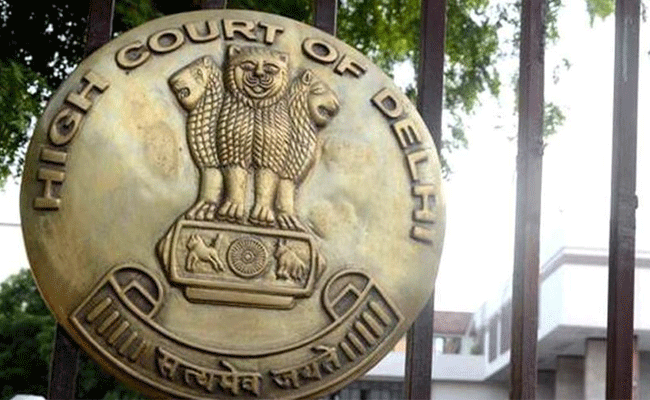
New Delhi (PTI): The Delhi High Court has held that the Enforcement Directorate (ED) has the power to investigate and inquire into an offence of money laundering under the Prevention of Money Laundering Act (PMLA) only and it cannot assume that a predicate offence has been committed.
The high court said the predicate offence has to be necessarily investigated and tried by the authorities empowered by law in that regard and the ED cannot possibly arrogate unto itself the power to investigate into the alleged commission of those offences.
"What needs to be emphasised is that the PMLA empowers the ED to investigate Section 3 offences only. Its power to investigate and enquire stands confined to the offence of money laundering as defined in that section. However, the same cannot be read as enabling it to assume from the material, that it may gather in the course of that investigation, that a predicate offence stands committed.
"The predicate offence has to be necessarily investigated and tried by the authorities empowered by law in that regard," Justice Yashwant Varma said in a 111-page judgement passed on January 24.
The high court said, "The primary function to investigate and try such offences remains and vests in authorities constituted under those independent statutes In any case, it (ED) cannot and on its own motion proceed on the surmise that a particular set of facts evidence the commission of a scheduled offence and based on that opinion initiate action under the PMLA."
It said if in the course of its enquiry and investigation, ED was to come to the conclusion that the material in its possession evidences the commission of an offence created under any other enactment, it would be obliged to furnish requisite information in respect thereof to the agency concerned for necessary action.
The high court's verdict came while allowing two separate petitions filed by Prakash Industries Limited and Prakash Thermal Power Limited challenging the Provisional Attachment Orders (PAO) issued by the ED on November 29, 2018.
The proceedings drawn by the ED emanate from an allocation of the Fatehpur Coal Block in Chhattisgarh.
It was alleged that the two companies misrepresented their net worth to procure coal block. An FIR was lodged by the CBI under the provisions of the Indian Penal Code and Prevention of Corruption Act. Based on the FIR, the ED registered an Enforcement Case Information Report on the allegations relating to share price manipulation and generation of proceeds of crime from such activities.
Later, the allocation of coal block was cancelled following the Supreme Court's judgement in 2014.
The high court quashed the November 29, 2018 PAO as well as the original complaint. It also dealt with the objection raised by ED counsel that in view of the directions of the Supreme Court, the high court would not be permissible to either entertain these petitions or take cognisance of the challenged raised.
The ED counsel referred to the July 25, 2014 order passed by the apex court in the coal block allocation matter in which was held that any prayer for stay or any order impeding the progress of investigation relating to coal block allocations would be liable to be placed before the special court only and that no other court could entertain the same.
The high court, however, said it was unable to accede to the preliminary objection raised by ED and said the special court which came to be constituted was so identified solely to deal with and exclusively try offences emanating from coal block allocations and for the trial of offences that may have been alleged to have been committed either under the IPC, PC Act and PMLA.
"The direction for transfer of pending cases also clearly appears to be confined to criminal matters arising out of coal block allocations," it said, adding that those directions cannot possibly be construed or interpreted as extending to PAOs that may be made under PMLA.
Justice Varma said the special judge constituted to try criminal cases and offences would clearly lack the authority to either deal with or rule upon the validity of PAOs that may be made.
"If the submission addressed by and on behalf of the ED in this regard were be accepted, it would also amount to short circuiting the adjudicatory mechanism with respect to attachment orders as structured and placed in terms of the provision of the Act," the high court said.
It said the apex court's directions cannot be construed as denuding the high court of the jurisdiction to entertain a challenge relating to a PAO and the exercise of power by the ED under Section 5 of the PMLA.
If the submissions of ED are accepted, it would essentially amount to recognising a power inhering in the special judge to not only don the robes of the adjudicating authority but to also deprive the appellate forums of the jurisdiction to decide appeals against the orders that may ultimately come to be passed under section 8 of the PMLA.
Let the Truth be known. If you read VB and like VB, please be a VB Supporter and Help us deliver the Truth to one and all.
Real Madrid fines Valverde and Tchouaméni half a million euros each for altercation

Barcelona (AP): Real Madrid slapped players Federico Valverde and Aurélien Tchouaméni with half-a-million-euro ($588,000) fines on Friday for their altercation during practice.
The massive fines came a day after the midfielders tussled when the team trained. Valverde said in a post on social media on Thursday that no punches were thrown. But Valverde knocked his head on a table and he suffered a small cut that required a brief hospital visit.
On social media, Valverde initially called it a “meaningless fight” with a teammate and said “everything has been blown out of proportion."
His employers, however, considered it a significant enough breach of team discipline to nail both Valverde and Tchouaméni with fines that bite even the bank account of a top soccer player. The half-a-million euro penalties reflect the reputational damage the club was enduring in a chaotic end to a disappointing season.
In a statement, the 15-time European champion said its disciplinary action was concluded after both players expressed to the club “their complete remorse for what happened and apologized to one another.”
Madrid added they also apologized to their teammates, the coaching staff and club supporters, as well as showing their willingness to accept whatever disciplinary action the club deemed “opportune.”
Tchouaméni was back training with Madrid on Friday, two days before they play at Barcelona in a clasico. Madrid has to win otherwise Barcelona will be crowned La Liga champion.
After being notified of the fine, he posted a public apology to the club and its fans on social media.
“What happened this week in training is unacceptable,” Tchouaméni wrote. "I say this while thinking about the example we are expected to set for young people, whether in football or at school.
“Above all, I am sorry for the image we projected of the club.”
Valverde was not at practice due to the head knock.
Both players are set to play in the World Cup next month, with Tchouaméni playing for France and Valverde for Uruguay.
Chaotic end to a poor season
===================
The run-in between the players, who for seasons have played side by side in Madrid's midfield, came after they argued this week in previous training sessions. But tempers boiled over on Thursday. Spanish media was rife with reports that the players previously disagreed over the club's decision to let coach Xabi Alonso go after just months on the job.
It was not the only altercation involving Madrid players during training this week. Álvaro Carreras confirmed he was in a “minor” incident with a teammate. Spanish media said he and fellow defender Antonio Rüdiger got into a scuffle.
Álvaro Arbeloa, the coach who was promoted from Madrid's reserve team when Alonso was fired in January, will face tough questions on what went wrong inside the changing room when he gives a press conference on Saturday ahead of the clasico at Camp Nou.
Madrid is facing a second consecutive campaign without a major trophy amid rumors in the Spanish media that club president Florentino Pérez is considering bringing back Jose Mourinho to straighten out his underperforming team.