Elon Musk, Indian tycoons slug it out over satellite spectrum

New Delhi, Oct 15: The world's richest person Elon Musk has taken on Indian billionaires Mukesh Ambani and Sunil Bharti Mittal over the allocation of spectrum used in wireless communication using satellites, calling their demand for the auction of such airwaves "unprecedented".
While Ambani's Reliance Jio has been vocal about the need to allocate such spectrum through an auction to give a level playing field to legacy operators who buy airwaves and set up infrastructure like telecom towers, Mittal on Tuesday articulated the need to use bidding for such allocation.
Musk-led Starlink is demanding administrative allotment of licences in line with the global trend as it looks to tap into the world's fastest-growing mobile telephony and internet market. This has found some backing in Telecom Minister Jyotiraditya Scindia, who said such airwaves will be given out through administrative allocation and not auctioned.
Scindia said the Telecom Act of 2023 passed in December has put the matter in 'Schedule 1', which means that for satcomm spectrum will be allocated administratively.
"That does not mean that spectrum does not come without a cost. What that cost is and what the formula of that cost is going to be, will not be decided by you or me ...it will be decided by Trai...and there is a paper that has already been circulated by Trai, and we have a regulatory authority for telecom, and that regulatory authority of telecom has been empowered by the constitution to decide what that administrative pricing is going to be," he said.
The minister said he is very confident that Trai will come up with the best pricing that should be adopted, provided that it is being given in an administrative manner.
"Satellite spectrum across the world is allocated administratively. So, India is not doing anything different from the rest of the world. Conversely, if you do decide to auction it then you would be doing something, which is different from the rest of the world," the minister said.
Pointing out that satellite spectrum is a shared airwaves, Scindia said, "If the spectrum is shared then how can you price it individually".
Musk first termed the demand made by Jio last week for shunning sector regulator Trai's consultation paper on satellite broadband being allocated and not auctioned as "unprecedented", and when Mittal on Tuesday in the presence of Prime Minister Narendra Modi favoured bidding as the route, he asked if it was "too much trouble" to allow Starlink to provide internet services in India.
This is perhaps the first time that Musk, whose networth of USD 241 billion is more than the combined wealth of Ambani, Mittal and Gautam Adani, has spoken directly against demands for a level playing field made by the Indian firms.
Speaking at the India Mobile Conference, Mittal, who heads India's second largest telecom firm Bharti Airtel, said existing telecom companies will take satellite services into the remotest parts.
"And those satellite companies, who have ambitions to come into urban areas, serving retail customers, just need to pay the telecom licenses like everyone else. They are bound to the same conditions.
"They need to buy the spectrum as the telecom companies do, and need to pay the license as the telecom companies do, and also secure the networks of the telecom companies," he said.
Soon after, his firm issued a statement saying it has always supported the ushering in of satcom services to connect the uncovered as in the deep far-flung reaches for maritime services, aviation, defence and security.
"There is no question of Airtel having moved its stance," it said, adding that "satellite operators who want to provide services to urban areas and retail customers indeed need to go through the regular licensing process of any country".
In the case of India, this involved obtaining "a license, buying spectrum, undertaking all the obligations, including rollout and security, paying their license fee and taxes".
"Therefore, mobile operators and satcom operators, who have worked in harmony for decades, can continue to do so to serve those who are still struggling to find internet connectivity," it added.
Musk responded to Jio's letter with a post on X, which he owns, saying, "I will call and ask if it would not be too much trouble to allow Starlink to compete to provide Internet services to the people of India".
Last week, Ambani's Reliance Jio had written to Scindia seeking the re-issuance of a consultation paper by Trai to ensure a level playing field between satellite-based and terrestrial-based communication services.
Jio had further urged the government to direct Trai to conduct an evaluation of the technical and economic feasibility of spectrum auction for satellite services.
To a post that quoted a news report on the letter, Musk on Monday stated that this "would be unprecedented, as this spectrum was long designated by the ITU as shared spectrum for satellites".
India is a member of the International Telecommunication Union (ITU), a UN agency for digital technology.
Musk's Starlink and global peers like Amazon's Project Kuiper back an administrative allocation.
Musk, the mind behind PayPal, founder of Tesla and SpaceX and owner of X (formerly Twitter), uses his social media platform on a daily basis to make his views known on a vast array of topics.
Airtel, in a statement, said it has always maintained that it will use all technologies, including satcom, to ensure that every nook and corner of the country is covered with high-speed broadband connectivity.
"This position remains consistent. Airtel has tied up with Eutelsat OneWeb, which has a LEO constellation, only the second one in the world, through which it proposes to provide satcom services in India and Africa," it said.
Eutelsat OneWeb, in a joint venture with Airtel, has already set up two ground stations, one in Gujarat and the other in Tamil Nadu, to secure all communications arising out of India on the satcom network as it awaits the green light to commercially provide such services, it added.
I will call and ask if it would not be too much trouble to allow Starlink to compete to provide Internet services to the people of India.
— Elon Musk (@elonmusk) October 15, 2024
Let the Truth be known. If you read VB and like VB, please be a VB Supporter and Help us deliver the Truth to one and all.
Will vacate one of two assembly seats won in 10 days: BJP''s Suvendu
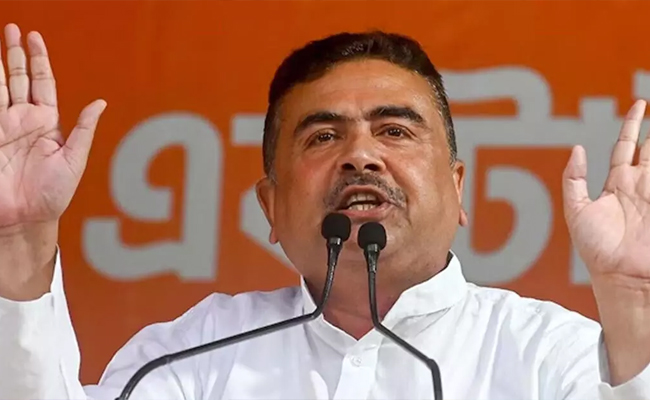
Kolkata (PTI): BJP leader Suvendu Adhikari, who defeated West Bengal Chief Minister Mamata Banerjee in Bhabanipur and secured Nandigram for three times in a row in the recent assembly polls, said on Wednesday that he would vacate one of the two constituencies within 10 days.
Adhikari also asserted that the party's central leadership would decide which constituency he would retain.
"I will vacate one seat within 10 days. The party will decide which one I retain. I will not forget my responsibility towards the people of Bhabanipur and Nandigram," he said.
Adhikari on Monday defeated Banerjee in Bhabanipur by over 15,000 votes, puncturing what was long seen as her safest political refuge and delivering a decisive psychological blow to the TMC, amid a sweeping BJP surge across West Bengal.
Addressing party workers and supporters in Nandigram in Purba Medinipur district, the BJP leader appealed to them not to take out victory processions immediately and instead maintain peace.
"Do not take out victory rallies now. Maintain peace and discipline. Celebrate after May 9, after taking permission," he told party workers.
State BJP president Samik Bhattacharya on Wednesday announced that the oath-taking ceremony of the new government will be held on May 9 at Brigade Parade Ground.
Referring to alleged attacks on BJP workers during the TMC regime, Adhikari said he would not forget the “atrocities" faced by them and assured them of taking appropriate action against perpetrators through legal processes.
"I was part of the 2011 ‘poribartan’ (change), and now I am part of the real change. I offer my gratitude to the people of Nandigram," Adhikari said.
He was referring to the TMC's victory in 2011 when the Mamata Banerjee party dismantled the 34-year Left Front regime in the state.
Adhikari offered prayers at a Hanuman statue in Nandigram and remembered the BJP workers, who had died in political violence.
"We will work in such a way that the BJP government in Bengal stays for 100 years," he said, expressing hope that the BJP’s vote share in the state would rise from the current 46 per cent to 60 per cent in future elections.
The BJP leader also assured residents of Nandigram of improved drinking water supply and better hospital and education infrastructure.